
Should You Deadhead Calla Lilies?
Calla lilies, Zantedeschia spp., are flowering rhizomes suited to year-round cultivation in USDA Hardiness Zones 8 to 11. They prefer full sun to part shade and moist, organically-rich, well-draining soil. In cooler regions, growers cultivate them as annuals and lift them at season’s end to store.
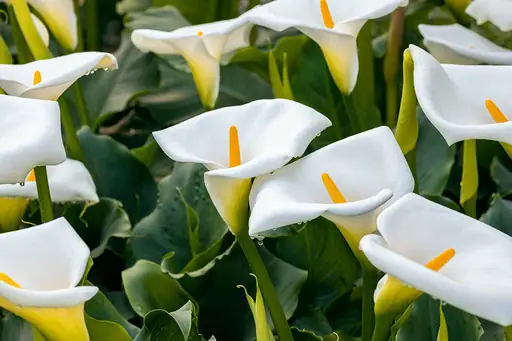
Calla lilies, Zantedeschia spp., are flowering rhizomes suited to year-round cultivation in USDA Hardiness Zones 8 to 11.
They prefer full sun to part shade and moist, organically-rich, well-draining soil.
In cooler regions, growers cultivate them as annuals and lift them at season’s end to store for replanting the following spring.
From evergreen and semi-evergreen arum lilies to deciduous hybrid varieties, the blossoms feature a funnel-shaped, petal-like spathe that swirls around a central spike called a spadix.
Colors vary from pastel apricot and pink to bold yellow, orange, deep burgundy, and black.
Our guide to growing calla lilies has all you need to know to care for plants in your outdoor living space.
This article discusses deadheading and whether or not the practice is beneficial when growing callas.
Here’s what we’ll cover:
What You’ll Learn
The Cycle of Life
Deadheading to Prevent Seed Setting
Cutting Callas
Let’s get started!
The Cycle of Life
The lifecycle of the average perennial flower begins with vegetative growth or leaf production.
Once the leaves mature, the reproductive phase begins with budding, which is soon followed by blooming.
Seed formation completes the succession of events and takes place after the petals fade and wither. When the seeds disperse, they ensure the survival of the species.
What would happen if we prevented seed formation? Would there be additional blooming? Let’s find out!
Deadheading to Prevent Seed Setting
Deadheading is an optional garden practice. It implies the removal of dead flower heads, but this is not quite so in the case of calla lilies.
If we wait for the spathes to dry up and turn brown before we remove them, the seeds will have set, signaling the end of life, and that’s not what we want.
Instead, our goal is to remove entire stems of spent blooms before the spathes lose their color and well before they transition to seed formation.
By cutting at this time, we redirect the plant’s energy from seed setting to reproductive growth and flowering.
Snipping stems as close to their point of origin as possible jumpstarts regrowth because the basal leaf mound is the place from which all stems sprout.
If we don’t deadhead, the spathes turn brown and seed-containing pods form at their base.
As more and more pods form, there are fewer and fewer flowers because the predominant use of energy is seed production and dispersal.
Some flora is self-deadheading, like petunia varieties that shed spent blooms to make way for new ones.
Other plants, for example, spring-blooming tulips and daffodils, don’t respond to deadheading by producing new flowers because they can only bloom once during the growing season.
When plants respond to deadheading by additional flower production, it’s possible to enjoy more blossoms, and, weather permitting, a longer growing season.
Cutting Callas
When deadheading, it’s essential to use sanitary pruners or scissors.
Make sure you cut only the spent bloom stems, and not the neighboring foliage, because even after the flowers finish, the leaves feed the rhizomes to ensure that they will have the energy needed to grow and bloom the following year.
You may wonder, wouldn’t it be better to snip off only the spathes and let the stems continue to feed the rootstock?
The answer is no, and here’s why:
Like many tuberous plants, callas have hollow stems. Leaving them open at the top would render them vulnerable to water penetration with the potential to rot the rhizomes below.
Another reason for pruning entire stems as we do is because they are leafless. Other plants, like coneflowers, have leafy stems. Each leaf is a growing point, so we deadhead coneflowers just above a leaf to jumpstart new growth and reblooming.
To successfully deadhead these plants, carefully snip the stems close to the base down among the leaves because this is the point from which they naturally sprout.
You can read more about deadheading garden flowers in our guide. It’s a great way to encourage many plants to rebloom and keep the landscape looking fresh and tidy.
Copious Quantities of Callas
We set out to determine whether or not to deadhead callas. Here’s what we discussed:
Removing entire spent flower stems redirects energy from seed setting to new bloom formation, enriching and possibly extending the growing season with repeat blooming.
By cutting stems near their point of origin, we minimize exposure to water penetration and jumpstart the regrowth process from this natural growing point. And when we preserve the neighboring foliage, it feeds the rhizomes for next year’s blooms.
Deadheading is an optional garden practice that maximizes reproductive growth for a robust floral display in the early to midsummer garden.
Do you grow callas? Do you deadhead them? Please share your thoughts in the comments section below.
If you found this article helpful and want to learn more about calla lily cultivation, we recommend the following:
- How to Grow Calla Lilies in Containers
- Calla Lily Hardiness: Will Zantedeschia Come Back In Spring?
- 21 of the Best Calla Lilies for Sensational Summer Blooms
- X




질문 및 토론