
When and How to Fertilize Jasmine
Among the most popular types of flowering vine, climbing and shrub jasmine (Jasminum spp.) varieties are highly valued for their delightful, star-shaped flowers, sweetly mesmerizing scent, and attractive foliage. Caring for these plants is generally quite easy, and you can read more about that in.
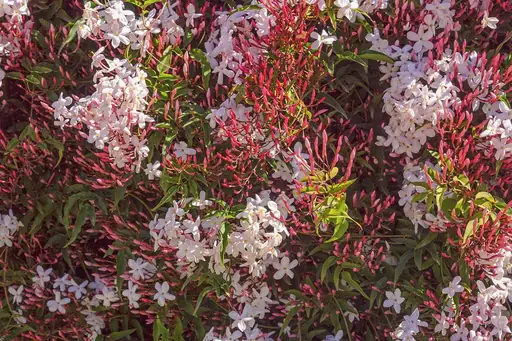
Among the most popular types of flowering vine, climbing and shrub jasmine (Jasminum spp.) varieties are highly valued for their delightful, star-shaped flowers, sweetly mesmerizing scent, and attractive foliage.
Caring for these plants is generally quite easy, and you can read more about that in our guide to growing jasmine.
A regular fertilizing routine with the right nutrients helps the plants to stay strong, healthy, and vibrant with an abundance of perfumed flowers!
Timing your feed applications is important to give them a strong start and to maintain vigor.
And there are a few methods for feeding your jasmine plants, so you can choose the best option for your schedule.
Ready to get down and dirty for spectacular, showy vines? Then let’s dig into how and when to fertilize jasmine plants.
Here’s what’s up ahead:
What You’ll Learn
When to Feed
Start With Compost
Fast Acting or Slow Release?
Container Care
When to Feed
For your jasmine to receive the maximum benefit from the additional nutrients, late winter to early spring is the best time to start providing fertilizer, depending on your region.
Photo by Lorna Kring.Feeding jasmine at this time provides them with the nutrients they need for abundant flowering, foliage development, strong, healthy roots, and resistance to disease and pests.
If you opt to use a slow release fertilizer, a second application is beneficial to promote vigorous growth. This second application is typically applied in early to midsummer, or after flowering.
For liquid or water soluble feeds, monthly applications are needed throughout the growing season, and container-grown jasmine may even require biweekly fertilization.
Use this schedule for all varieties, including winter-blooming types, but wait until the winter flowers have finished before you start to feed the plants.
Once the growing season ends, you can stop fertilizing until the new growth cycle starts again the following spring.
Start With Compost
Jasmine plants that are grown in rich soil with plenty of organic materials rarely need a lot of additional nutrients, but they do benefit from an annual application of compost, well-rotted manure, or worm castings.
Applying a layer of organic mulch in spring feeds the roots slowly, with the nutrients leaching out from the mulch every time it rains or you irrigate, percolating down into the root zone.
Start by scraping away a couple of inches of topsoil then replace it with a two- to three-inch layer of fresh compost.
Compost can be applied as a top dressing or it can be gently worked into the soil with a hand cultivator as a side dressing, taking care not to disturb the roots as you work.
Make sure you apply the compost, manure, or castings evenly over the entire root zone.
Starting out with a feed of organic materials not only provides nutrients for the plant, but it also helps to maintain the soil’s tilth and prevents compaction, so air and water can circulate freely in the root zone.
Fast Acting or Slow Release?
For jasmine plants grown in lean soils or containers, a further application of commercial fertilizer may be required to provide the minerals needed for strong, robust growth.
Either fast acting or slow release fertilizer can be used, depending on your preference.
Fast acting fertilizers are available either as liquid or water-soluble granules, and these products release the nutrients quickly into the soil around the root zone.
For maximum effectiveness, fast acting fertilizers need to be applied monthly while plants are actively growing, starting in early spring and continuing until the end of summer.
Slow release products come in forms such as granules, meal, or pellets and are scratched into the top two inches of the soil surface.
Then, each time the plants are watered or it rains, the pellets or meal gradually dissolves, releasing nutrients slowly into the soil.
Slow release feeds are typically applied once in early spring after new growth emerges, and then again in summer after flowering has finished.
For the most effective dispersion and absorption of nutrients, ensure that the soil in the root zone is moist before applying fertilizer. This is because the roots take up nutrients faster and more efficiently in a moist environment.
Whether you use a fast acting or slow release food, look for an all-purpose or flower-boosting formula that has slightly higher levels of phosphorus than nitrogen.
Phosphorus is used by plants in part for bud set and flower development and is an important element for highly floriferous vines like jasmine.
You can determine the mineral levels by checking the NPK (nitrogen, phosphorus, and potassium) ratio on the product label. The second number in the formula should be higher than the first.
Down to Earth makes an all-purpose granular product with an NPK ratio of 4-6-2 that’s ideal for fertilizing jasmine.
Down to Earth All-Purpose Fertilizer
Bone meal is also high in phosphorus and can be broadcast over the root zone in spring.
But bone meal is not a complete feed and should be used in conjunction with a product that provides other nutrients, including nitrogen and potassium.
For flowering vines like jasmine, I like to use bone meal at planting time but then I switch to a more complete fertilizer for the growing season.
Bone Meal
Container Care
If you’re growing your jasmine in a container, apply a top dressing of compost in spring, as outlined above.
As potted plants have limited access to nutrient sources, I recommend using a fast acting fertilizer to promote healthy growth and blooming.
After applying the compost and once new growth has emerged, use a liquid or water soluble product once a month until the end of the growing season.
If your containers are on the small size – less than 16 inches tall and wide – and your plants are lagging or underperforming, you may need to use a half-strength solution every two weeks instead of once a month.
They’ll respond to the more frequent feeding but take care to dilute the product. Too much fertilizer can create a build up of mineral salts in the soil that can burn the roots.
I recommend this Fish and Seaweed Fertilizer from Neptune’s Harvest.
Neptune’s Harvest Fish and Seaweed
It’s a concentrated liquid with an NPK ratio of 2-3-1 and is available at .
For slower growing indoor container plants, feed monthly while plants are actively growing but don’t feed at all during the winter.
Showy Plants and Abundant Flowers
With the right fertilizing regime, jasmine puts on a showy display with an abundance of fragrant flowers!
Start by feeding in early spring with an application of organic matter, like compost or worm castings.
Then provide supplemental feeding throughout the growing season with fast acting or slow release fertilizers as needed.
And remember that container plants with limited access to nutrients may need feeding as frequently as every two weeks – but at a diluted strength.
By providing your jasmine plants with the nutrients they need as they develop, you’ll enjoy a highly floriferous show for many weeks!
What methods do you use to fertiliz your jasmine vines? Share your tips in the comments section below.
And for more jasmine growing know-how, add these guides to your reading list next:
- Why Is My Jasmine Plant Dropping Leaves?
- 13 Popular Types of Jasmine Vines and Shrubs
- How to Prepare Jasmine Plants for Cold Weather
- Facebook72
- X
질문 및 토론