
How to Grow and Care for Summer Snapdragon Flowers
Angelonia angustifolia Summer snapdragon, Angelonia angustifolia, is a member of the Plantaginaceae family, a very large group that includes plantain, penstemon, and foxglove. It is cultivated as a tender perennial in USDA Hardiness Zones 9 to 11, and as an annual in other zones. Summer.
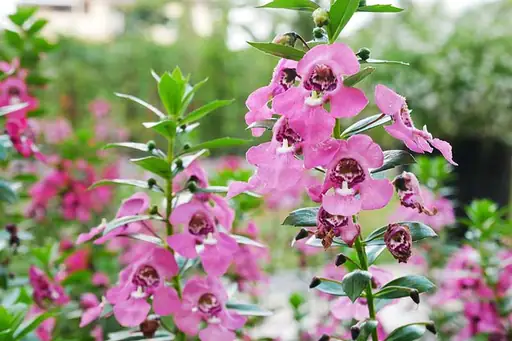
Angelonia angustifolia
Summer snapdragon, Angelonia angustifolia, is a member of the Plantaginaceae family, a very large group that includes plantain, penstemon, and foxglove.
It is cultivated as a tender perennial in USDA Hardiness Zones 9 to 11, and as an annual in other zones.
Summer snapdragon’s name is somewhat misleading. It does resemble the common garden snapdragon, Antirrhinum majus, as well as the wild version, Linaria vulgaris, aka butter and eggs, or toadflax.
However, unlike these childhood favorites of mine, its double lips do not flex open and closed when pinched, like the mouth of a friendly dragon. Instead, they remain fixed, more like the blossom of a penstemon.
In addition, unlike its snapdragon cousins that come from temperate regions of Asia and Europe, A. angustifolia is native to Central and South America, and the West Indies, where it thrives on heat and humidity.
You may also find this species listed under the name narrowleaf angelon, angelonia, or angel flower.
In this article, I’ll discuss how to grow and care for summer snapdragon in your garden.
Here’s what’s in store:
What You’ll Learn
- Cultivation and History
- Propagation
- How to Grow
- Growing Tips
- Maintenance
- Cultivars to Select
- Managing Pests and Disease
- Best Uses
- Quick Reference Growing Guide
Let’s get started!
Cultivation and History
Summer snapdragon has an upright, bushy growth habit. The foliage consists of opposing pairs of narrow leaves. They are dark green and glossy, and emit a pleasant fragrance that resembles that of apples or grapes.
The stems are green and bear spikes of showy blooms that are somewhat smaller than those of the garden snapdragon. New growth is reddish-brown.
Flowers measure up to one inch across and may be bicolor, blue, pink, purple, or white.
Average heights range from about 12 to 18 inches. However, there are taller cultivars that reach 24, or even 36 inches, especially in Florida, where they grow very well. Mature widths are nine to 12 inches.
In addition, there are low-profile “spreading” varieties that range from four to 10 inches tall, and 12 to 20 inches wide.
Blooming is continuous all summer long in locations with full sun and organically-rich, mildly acidic, well-draining soil.
Light shade is tolerated, but too much may result in stretched, leggy stems and few blooms.
Plants exhibit an above average capacity for drought, heat, and humidity, and deer are not attracted to them.
Like so many of today’s garden flora, summer snapdragon probably made its way to US gardens from native tropical habitats via international plant collectors.
It is likely that British botanist George Bentham had a specimen of A. angustifolia in his extensive herbarium, when he donated it to Kew Gardens in 1854.
An ambitious taxonomist, he co-authored three volumes of “Genera Plantarum,” between 1862 and 1883, in which almost 100,000 seed-bearing plants were classified.
Many of the species collected during the 19th Century were crossed with one another and cultivated to develop hybrids suited to commercial propagation for the floral industry, as well as home gardening.
In the case of summer snapdragon, it remained a leggy wildflower propagated by stem cuttings for many years.
In 1998, the cultivated hybrid A. angustifolia ‘Hilo Princess’ was introduced.
Today, in addition to a host of cultivars, we have the Serena and Serenita series that are grown from seed and offer compact size and a varied color palette.
Propagation
You can start plants from seeds, stem cuttings, divisions, or transplants.
From Seed
If you are cultivating these plants as annuals, start seeds indoors up to eight weeks before the last average frost date of spring, to get a head start on the growing season.
Use biodegradable seed starter cells that can be transplanted in their entirety to the garden or container.
Sow several seeds per cell at a depth of 1/8 inch, and cover lightly with potting soil.
The ideal soil temperature for germination is between 70 and 75°F. Some folks like to use a heat mat, but your warm and sunny window may do just as well.
Maintain even moisture during germination, but don’t let the potting medium in the cells become soggy.
When the seedlings have two sets of true leaves, thin them to one per cell.
At this stage, you can fertilize with half-strength liquid fertilizer.
As the seedlings grow, pinch the growing tips back if the stems get too leggy, to promote bushier growth.
After the danger of frost has passed, acclimate the seedlings to the outdoors. This is called “hardening off,” and is accomplished with a few hours outside in a sheltered location for about five to seven days prior to transplanting.
To direct sow seeds in the spring in warm regions, sprinkle a few every nine to 12 inches, or 12 to 20 inches for spreading types, and cover them with 1/8 inch of soil.
Keep them moist, but not soggy, during germination. When the seedlings have two sets of true leaves, thin them to one per nine- to 12-inch interval, and allow the soil to dry out between waterings.
From Stem Cuttings
Once perennials put on new growth in the spring, cut a length of stem about three to four inches long from a non-blooming growing tip.
Snip off all but the top one or two pairs of leaves. Moisten the cut end of the stem and dip it into rooting hormone powder.
Bury the stem in potting medium in a four-inch-tall biodegradable starter pot, or plant it in the garden, at a depth of two inches.
Keep the soil moist, but not soggy. New growth indicates successful rooting which should take two to three weeks.
By Division
Perennial gardeners can divide large clumps in early spring to thin them out and transplant elsewhere.
Please consult our complete guide to dividing perennials for instructions.
From Seedlings/Transplanting
The quickest way to begin is with a nursery seedling.
Simply transplant it upon receipt, maintaining the same depth in the ground or garden container as it was in the nursery pot.
How to Grow
To cultivate summer snapdragon in the garden, choose a location that receives full sun.
The soil should be organically-rich, well-draining, and slightly acidic. The ideal pH is 5.5 to 6.5.
If you don’t know the characteristics of your soil, conduct a soil test through your local agricultural extension.
Work the soil until it’s uniformly crumbly, to a depth of eight to 12 inches. Amend it with compost to boost acidity, drainage, and nutrients.
Allow for nine to 12 inches between upright plants, and 12 to 20 inches between spreading types. Some folks like close spacing, so stems can support one another and require less staking, but be careful not to impede airflow with overcrowding.
Maintain even moisture during establishment, and then wait until the soil is dry before watering again. With regular rain, you may find that you don’t have to water very often.
Apply a well-balanced, all-purpose, slow-release granular fertilizer at planting time for this heavy feeder that blooms continuously.
A. angustifolia grows well in containers. Allow for maximum width, plus an inch to accommodate a watering can spout or hose nozzle.
A depth of 12 to 18 inches should comfortably accommodate the somewhat shallow roots.
Growing Tips
It’s easy to grow summer snapdragon when you remember to:
- Start annuals indoors up to eight weeks before the last frost date.
- Choose a location with full sun.
- Barely cover the seeds at a depth of 1/8 inch.
- Maintain even moisture during germination, but don’t oversaturate.
- Water established plants only when the soil has dried out.
Maintenance
As mentioned, sometimes staking is required for the tall flower stalks.
Choose compact varieties or cut stems back by one-half in early summer for bushier growth and better natural support.
Photo by Dinesh Valke, Wikimedia Commons, via CC BY-SA.One of the advantages of summer snapdragon is that it blooms continuously, and you don’t have to remove spent flower stalks, called deadheading, to achieve this.
For those cultivating A. angustifolia as an annual, you’ll want to pull the stems up by the roots and dispose of them at season’s end to inhibit the wintering over of pests and diseases. Healthy foliage may be added to the compost heap.
And if you are cultivating perennials, in a few years, you may want to divide them, as mentioned earlier.
In addition to fertilizing at planting time, some folks like to apply another dose during the growing season. Be sure to follow your product’s instructions for repeat applications.
Remember that while plants are drought tolerant, they perform best when they are watered soon after the soil dries out.
And finally, keep the garden free of weeds that compete for moisture and attract disease-carrying pests.
Cultivars to Select
There are a number of cultivated series and varieties to choose from. Here are some of our favorites:
Archangel Cherry Red
From the Archangel™ series, ‘Cherry Red’ produces vibrant red flowers on 12- to 14-inch stems.
Archangel™ ‘Cherry Red’
Flowers will vary in color depending on the amount of sun they receive. They will bloom deep red in full sun, with a more muted tone in shadier locations.
You can find sets of four plants available at .
Serena
Serena® is a summer snapdragon series available in a variety of colors, including purple, blue, and white.
Plants reach a mature height of 15 to 18 inches tall and are ideal for providing height to containers and sunny borders.
Waterfall Mix
Waterfall Mix contains a mixture of purple, blue, and white to provide an elegant floral display.
Serenita
A. angustifolia Serenita® series is a compact variety that reaches a low-profile height of just 12 to 14 inches. Available in purple, pink, and white.
Serinita Series Mix
Make room for this petite sweetheart in mixed containers on sunny patios.
Managing Pests and Disease
Successful cultivation starts with quality products bred for optimal disease resistance, a full-sun placement, rich soil that drains well, and water as needed.
Healthy, well-tended plans are much less likely to suffer the ravages of infestation and infection. However, sometimes problems arise.
Pests you may have to contend with include:
- Aphids
- Spider Mites
- Thrips
And diseases common to A. angustifolia are:
- Angelonia Flower Break Virus
- Damping Off
- Downy Mildew
- Gray Mold
- Powdery Mildew
- Root Rot
Angelonia flower break virus is a fatal condition that requires the removal of affected flora. It may come from a nursery where the infection was present.
Damping off is the sudden death of seedlings, and is caused by disease pathogens that thrive in cool, moist locations.
Downy mildew is caused by an oomycete, or water mold, and gray mold, powdery mildew, and root rot are fungal in nature.
The avoidance of oversaturation and overcrowding go a long way toward impeding their development.
Best Uses
Summer snapdragon performs a vital role in garden beds, borders, containers, cottage gardens, and cutting gardens.
Often referred to as a “thriller” in the “thriller-filler-spiller” floral design formula, it makes an exciting focal point that draws the eye up along its flower-laden spikes.
Pair it with companions like coreopsis, liatris, and garden phlox that share the same cultural requirements.
And don’t forget to think of the spreading variety when you’re looking for a flowering ground cover.
Quick Reference Growing Guide
| Plant Type: | Tender flowering perennial | Flower / Foliage Color: | Bicolor, blue, pink, purple, red, white/dark green |
| Native to: | Mexico, South America, West Indies | Tolerance: | Deer, drought, heat, humidity, light shade |
| Hardiness (USDA Zone): | 9-11 | Soil Type: | Organically rich |
| Bloom Time: | Summer to fall | Soil pH: | 5.5-6.5 |
| Exposure: | Full sun | Soil Drainage: | Well-draining |
| Spacing: | 9-12 inches upright types, 12-20 inches spreading types | Attracts: | Bees, butterflies, hummingbirds, and other beneficial pollinators |
| Planting Depth: | 1/8 inch (seeds), depth of root ball (transplants) | Companion Planting: | Coreopsis, liatris, phlox |
| Height: | 12-36 inches upright types, 4-10 inches spreading types | Uses: | Beds, borders, containers, cottage gardens, cutting gardens, ground cover |
| Spread: | 9-12 inches upright types, 12-20 inches spreading types | Family: | Plantaginaceae |
| Water Needs: | Moderate | Genus: | Angelonia |
| Maintenance | Low | Species: | Angustifolia |
| Common Pests: | Aphids spider mites, thrips | Common Diseases: | Angelonia flower break virus, damping off, gray mold, downy mildew, powdery mildew, root rot |
Form and Function
With a good working knowledge of how to grow summer snapdragon, it’s time to add it to your garden planner.
A. angustifolia is a great plant choice because it flourishes in heat and humidity as either an annual or perennial, and its showy stems add height and structure to the landscape, not to mention robust color all season long.
Versatile enough for in-ground or container gardening, not a favorite of deer, and a pollinator magnet, it’s as useful as it is beautiful.
We love to hear from our readers. Do you have experience with this plant? Do you grow it as an annual or perennial? Let us know in the comments section below!
And for more information about growing flowers in your garden, you’ll need these guides next:
- How to Grow Anise Hyssop: A Flowering Perennial Perfect for Borders
- How to Grow Virginia Stock, A Cordial Summer Visitor
- How to Grow and Care for Asters
- Facebook76
- X
질문 및 토론