
Are Leafy Greens with Insect Holes Safe to Eat?
As a gardener, you’re undoubtedly familiar with that perpetual question when you find that something has been nibbling on your greens: Are they safe to eat? In many cases, yes, they are perfectly edible and you need not worry. However, at other times, the answer is absolutely not. In this guide,.
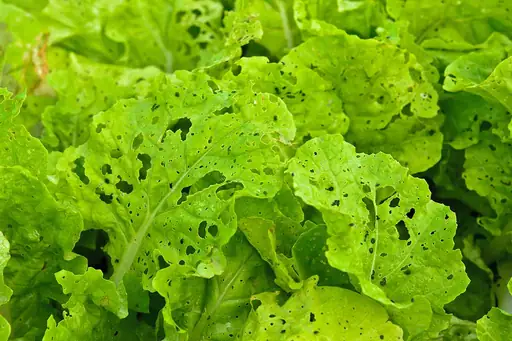
As a gardener, you’re undoubtedly familiar with that perpetual question when you find that something has been nibbling on your greens:
Are they safe to eat?
In many cases, yes, they are perfectly edible and you need not worry. However, at other times, the answer is absolutely not.
In this guide, will walk you through these different scenarios, so you will know whether or not you can eat the damaged greens in your garden.
Here’s what’s ahead:
What You’ll Learn
Are Greens with Holes in Them Safe to Eat?
When to Avoid Greens That Have Holes
Never Eat Raw Slugs or Snails
Treat Your Leafy Greens Carefully
Are Greens with Holes in Them Safe to Eat?
If you pick the leafy vegetables that you so lovingly tended through the season, and you discover that something – or someone – has been enjoying their own feast before you had a chance to harvest your crops, are they safe to consume?
Fortunately, there’s good news!
Greens with holes in them that were created by feeding insects or slugs should be fine to eat, if you cut away the damaged parts.
However, there are times when you do want to avoid produce that has been damaged by the local wildlife. Let’s take a look.
When to Avoid Greens That Have Holes
If you are particularly unlucky, it is possible to become gravely ill from eating damaged greens.
In your vegetable beds, check the ground nearby to look for signs that a mammal may have been nibbling on the leaves.
If you find piles of deer or rabbit poop in the vicinity, do not eat the greens.
These animals can spread dangerous strains of E. coli (the “lab rat” of bacteria and a common ingredient in feces), as well as Salmonella.
While most strains of E. coli are harmless, there are strains that produce a toxin that can prove fatal to susceptible individuals like young children and the elderly.
Deer can be carriers of these strains. The toxin that these bacteria produce can be inactivated by heating food to 158°F, but why take a chance?
I think it’s far better to forego part of your crop than it is to risk your health.
Cat droppings can also pose a health hazard. They can spread the parasite that causes toxoplasmosis.
While toxoplasmosis infections often pass without causing any symptoms, they can cause serious problems for pregnant women and have been found to cause mental illness in some cases.
Some gardeners report using soiled sheep bedding in the garden to keep the cats away, but that will not be practical for many people.
However, the principle should work for other types of animal bedding that contain urine, so if you keep farm animals on your land, you are in luck!
Beyond the realm of mammals, lizards kept as pets commonly spread Salmonella, though it is not clear whether wild lizards are a threat in the veggie patch.
However, according to Anna Rovid Spickler, veterinary specialist from the Center for Food Security and Public Health, “all reptiles can be sources.”
It may be a good idea to err on the side of caution if you find lizards in your garden as well.
Never Eat Raw Slugs or Snails
While escargot is not for everybody, I occasionally enjoy eating large snails cooked in butter and garlic. I feel like I am taking revenge on their brethren, who ravaged my delphiniums…
However, raw snails are another matter.
You may have caught the news story in 2019 about a 19-year-old Australian rugby player who ate a slug on a dare, and ended up paralyzed after coming out of a 420-day coma.
It is rare, but snails and slugs can harbor a nasty disease called rat lungworm that they pick up from rat droppings.
In humans, this parasite often dies out on its own. However, in rare cases, it travels to the brain and causes a form of meningitis. This can result in paralysis, and eventual death.
Rat lungworm is primarily a disease of the tropics, notable in various locations including Hawaii.
The pathogen was a known presence in southern Florida, but researchers were alarmed in 2018 when they discovered how widespread rat lungworm had become in Florida.
And the organism has been found in Louisiana and Texas as well.
Given the ever-warming temperatures that we now experience, experts believe it is just a matter of time before this parasite spreads throughout the continental US.
Because these gastropods like to feed on tender garden greens, be sure to always clean your harvest thoroughly to remove any pests that may still be present before enjoying your salad.
Learn more about dealing with slugs and snails here.
Treat Your Leafy Greens Carefully
If you are pretty sure the holes in your leafy vegetables were caused by insects or slugs, they should be safe to eat, as long as you wash them thoroughly, and remove any damaged portions.
However, if mammals have been through your garden, you should avoid damaged greens.
Check your lettuce, kale, or spinach thoroughly for snails or slugs, especially if you live in the South or in Hawaii.
What has your experience been with bug holes in your Romaine, collards, or kale? Do you play it totally safe when you note signs of damage? Let us know in the comments!
And read on for more information on growing leafy green vegetables in the garden:
- How to Be Successful with Your Lettuce Patch
- Leafy Greens for Salads and Sautees: How to Grow Spinach
- Harvest Hearty Greens from the Garden: How to Grow Kale
- Facebook110
- X850




질문 및 토론