
How to Identify and Treat Pear Scab
Venturia spp. I love the early spring, when the riot of flowers are coloring the landscape and the regular rain makes everything green and lush. Sadly, pear scab, caused by Venturia pirina (syn. V. pyrina) loves the springtime, too. That’s when the fungus starts to spread, and before you know it,.
Venturia spp.
I love the early spring, when the riot of flowers are coloring the landscape and the regular rain makes everything green and lush.
Sadly, pear scab, caused by Venturia pirina (syn. V. pyrina) loves the springtime, too.
That’s when the fungus starts to spread, and before you know it, your pear trees are in trouble.
Scab is a disease that impacts European pears worldwide, and it’s a serious, devastating problem for commercial and home growers alike.
The disease can also infect Asian pears but the causal pathogen, V. nashicola, hasn’t been identified outside of Asia, so growers in Europe or the Americas don’t need to panic about the disease on Asian varieties.
If you notice spots on the undersides of the leaves, or maybe even lesions on the fruit, there’s no time to waste.
We’ll explain everything you need to know about this common disease. Here’s what’s coming up:
What You’ll Learn
What Is Pear Scab?
Symptoms
Biology and Life Cycle
Organic Control Methods
Organic Pesticides
Chemical Control
What Is Pear Scab?
Pear scab is a fungal disease caused by species in the Venturia genus that live and breed exclusively on pears.
European pears become infected by V. pirina and Asian varieties by V. nashicola.
There are multiple races of each species, with varying symptoms, infectiousness, and degree of fungicide resistance.
V. nashicola doesn’t impact European pears, but it does attack all Asian types, including Japanese (P. pyrifolia var. culta) and Chinese (P. bretschneideri and P. ussuriensis) pears.
Currently, it’s only found in Asia, and growers in the Americas and Europe are taking precautions against it spreading to Asian pears growing in those regions.
P. pirina appears in all parts of the globe except Japan and eastern China.
Both are closely related to V. inaequalis, the pathogen that causes apple scab, which produces similar symptoms in apple trees.
Symptoms
Identifying this disease early will make all the difference in how severely it will impact your tree and the amount of damage it will do to the fruit, which is what we all really care about, right?
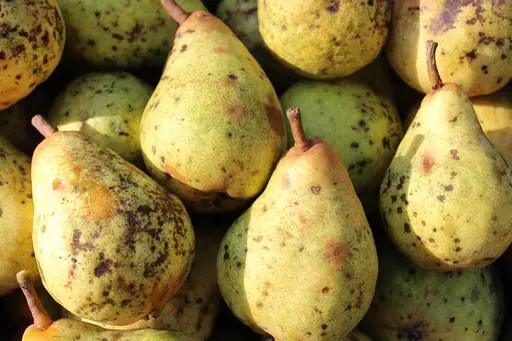
Photo Credit: Bruce Watt, University of Maine, Bugwood.orgA short while after the fungus infects your tree, you’ll start to see small olive or yellow, chlorotic spots on the undersides of the leaves.
Unless you examine your plants closely on a regular basis, it’s likely you’ll miss this initial evidence.
It’s not until patches appear on the upper sides of the leaves and on fruits that we gardeners generally notice the problem. These lesions will be brown or black and soft.
Unlike apple scab which only attacks the leaves and fruit, this disease can also cause lesions on the shoots.
Once the fruits develop, they will have olive-colored circular areas with a velvety texture on the surface of the skin.
These will eventually become dark with a cork-like texture and might crack. The fruits might also be deformed or drop from the tree.
The severity of the symptoms depend entirely on how many fungal spores have infected the plant.
Biology and Life Cycle
Pseudothecia, which are pillow-like structures that protect the fungal spores, overwinter on fallen leaves or fruits. They can also survive on twigs and branches on the trees.
As the weather warms up in spring, spores known as ascospores are released from the pseudothecia and spread via wind and water. These spores are the main method by which the fungus spreads from tree to tree.
The ascospores become active and spread right about the same time that the buds are growing and starting to open on pear trees.
It doesn’t matter if the rain (or irrigation) is happening during the day or night. These spores have adapted so that they can spread any time, unlike many other species of fungi, which can only spread during the day or night.
Once the spores land on a host, they need water for at least nine hours and the temperatures must be between 59 to 77°F for the spores to germinate and infect the plant.
After infection, conidia appear on the branches and leaves of the tree which can also spread via wind and water throughout the rest of the growing season, though these are less infectious than the ascospores produced in spring.
In the fall when the temperatures drop, the fungus breeds on leaf litter, producing the pseudothecia where the spores will remain until the next spring.
Organic Control Methods
Organic control is the best way to deal with pear scab, whether you adhere to organic growing principles or not.
Using several of these techniques will help to control the disease without upsetting the balance of the garden environment with the use of chemicals.
Whether you choose organic or chemical control, it’s absolutely essential that you rotate your fungicides. Scab fungus will develop resistance if you use the same fungicide over and over.
Plant Resistant Varieties
Asian pear varieties are immune to V. pirana, and all European pears are immune to V. nashicola.
While breeders are working hard to create scab-resistant European pear cultivars, there aren’t many available yet. ‘Barnett Perry,’ ‘Batjarka,’ ‘Brandy,’ and ‘Erabasma’ are resistant but a little hard to find.
Some resistant Asian cultivars include ‘Hiangli,’ ‘Kinchaku,’ ‘Nashi,’ and ‘Ya Li.’
Note that resistant doesn’t mean immune. The trees might still display symptoms, but those symptoms tend to be vastly reduced with little damage to fruits.
Physical
Always, always, always clean up any fallen leaves or fruits in the autumn to deny the fungus places to overwinter.
You should also mow the area around the trees to chop up any missed leaf litter.
This alone won’t control the disease, but it will dramatically reduce the amount of inoculum present. Remember, the less inoculum around, the fewer symptoms your tree will experience.
Biological
It’s possible to prevent scab by using the beneficial bacteria, Bacillus subtilis strain QST 713.
This method won’t work if the pathogen is already present, so if you’re already seeing symptoms of scab, use fungicides to eliminate the disease and then use this the following spring to prevent it from returning.
This bacteria works by forming a protective barrier wherever you spray it. It even grows along with the tree, to a certain degree.
Serenade ASO
Apply it carefully following the manufacturer’s directions. It should be applied as a foliar spray in the early spring before buds and shoots start forming or in the fall.
You can also use a product that contains Bacillus amyloliquefaciens strain D747 as a preventative or to suppress the disease. This can be a handy option as you rotate your fungicides.
For example, you could use one fungicide, then turn to B. amyloliquefaciens, and then apply a different fungicide.
Bonide Revitalize
Organic Fungicides
Fungicides work well against pear scab, but you must rotate them, as we mentioned. If you stick to just one product, the fungi will become immune and the fungicide will be ineffective.
When it comes to organic options, copper, Bordeaux, sulfur, mineral oil, neem oil, and lime sulfur are all effective and readily available.
If you choose to use copper or Bordeaux, don’t apply these products after blooming, as it could cause fruit russeting.
Instead, use these starting when green shoots first appear and the buds open. Stop when the blooms fade and fall from the tree. At that point, switch to another product.
I always recommend that gardeners keep copper fungicide in their garden toolkits because it can address so many fungal issues.
Bonide Copper Fungicide
When rotating your product, follow the manufacturer’s directions for timing.
For example, if the manufacturer recommends you apply copper every three weeks and sulfur every four weeks, apply the copper, wait three weeks, then apply the sulfur, wait four weeks, and return to the copper.
Chemical Control
Remember, the fungus will become resistant to whatever fungicide you use if the same product is applied repeatedly.
So it’s crucial to rotate your products. You can even rotate between organic and chemical controls.
Propiconazole is an excellent option if you live in a region with a lot of rainy weather.
Many organic options wash off in the rain, but propiconazole will stick around even after repeated rainfall.
Gunner Propiconazole Fungicide
Amazon carries gallon containers of Gunner 14.3 MEC Propiconazole Fungicide.
You can also use a product that contains myclobutanil or tebuconazole.
Use any of these products on a calm day so the product doesn’t float over unintended plants in the breeze.
Don’t Pick This Scab
No one wants to lose their precious harvest to a nasty pathogen, but as far as plant diseases go, pear scab isn’t the worst, especially if you catch it early.
You can treat it and get going on your pear recipes. Just remember to rotate whichever control method you choose.
Are you dealing with pear scab? What kind of symptoms are you seeing? Let us know what’s going on in the comments section below.
And for more information about growing pears in your garden, have a read of these guides next:
- How to Grow Fruiting Pear Trees
- How to Plant and Grow Asian Pear Trees
- Winter and Summer Pears: What’s the Difference?
- Facebook2
- X




질문 및 토론