
How to Prune Clematis Vines for Copious Flowers
Clematis are beautiful, showy vines with gorgeous flowers, attractive seed heads, and a highly ornate climbing or sprawling habit. They bloom in spring, summer, or fall, depending on their group, and put on a magnificent floral show once established. These fast-growing vines are easy to cultivate.
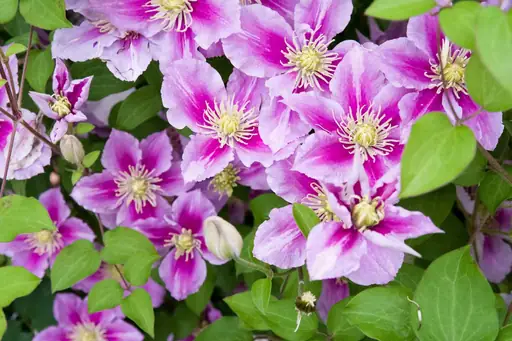
Clematis are beautiful, showy vines with gorgeous flowers, attractive seed heads, and a highly ornate climbing or sprawling habit.
They bloom in spring, summer, or fall, depending on their group, and put on a magnificent floral show once established.
These fast-growing vines are easy to cultivate and care for, but correct pruning is an important step in their annual maintenance.
Not only does it ensure masses of blooms each year, but it’s also needed to establish strong, healthy growth that produces multiple stems loaded with blossoms along their entire length.
So if you’d like to increase your vines’ flower power, let’s cut to the chase!
Here’s how to prune clematis for copious blooms:
What You’ll Learn
First-Year Care
Second-Year Care
Third-Year Care and Beyond: The Three Groups
Early Spring Flowering
Repeat Summer Flowering
Late Summer and Fall Flowering
General Pruning Tips to Promote Flowering
The following steps for first- and second-year care aren’t mandatory – clematis vines love to grow, and they’ll do fine on their own if you want to plant and leave them be to start.
But for strong, multi-stemmed plants with blossoms and leaves from top to bottom, here’s what to do.
First-Year Care
In the first year after planting, all clematis varieties, regardless of the pruning group they belong to, should be cut back hard in late winter to six to 12 inches.
The drawback in doing this is the short-term loss of flowers in their first full growing season – don’t expect any blossoms from Group 1 or Group 2 cultivars, the ones that bloom on old wood.
But the long-term benefits are stronger plants that produce buds low on the stems, not just at the tips, and more blooms overall.
Sacrificing a season’s flowers is emotionally challenging, so hold onto that vision of lush, fanning vines loaded from tip to toe with colorful blooms – this step helps it come true, with a little patience!
The late-blooming Group 3 vines bloom on new wood and these plants always get a hard cut back, so their flowering performance isn’t affected.
Second-Year Care
A repeat of this hard pruning for vines in their second year is often recommended by growers.
Photo by Lorna Kring.But in the second year, cut back only to a height of about three feet – this leaves a section of old wood in place, so you can expect some bud production.
A hard second-year pruning means plants are slower to reach their mature height, but they develop more stems with bushier growth, which naturally results in more flowers.
Third-Year Care and Beyond: The Three Groups
After the first- and/or second-year pruning, follow the guidelines as detailed for each category below in each year to follow.
Early Spring Flowering
Group 1 includes the early varieties that bloom in late winter into early spring, and require no pruning for flower production – only a light cleanup is needed to tidy plants.
These varieties flower on old wood. As a loose rule, if they burst into blossom before June, they’re in Group 1.
Plants in this group can be of two types. Either they don’t die back in winter, and form deciduous, multi-stemmed thickets, like those of ‘Pamela Jackman.’ Or they’re extensive, evergreen climbers that develop thick, woody stems, like ‘Apple Blossom.’
If needed, Group 1 vines can be trimmed sparingly after flowering. At this time, trim stems lightly to tidy plants and remove any dead or damaged wood.
Occasionally, these large, mature vines need to be cut back to renew vigor or for home maintenance, like painting.
For a hard cut back, wait until plants have finished flowering, then cut back to about 12 inches, using a garden saw for thick stems. New shoots will emerge from the crown in summer.
Photo by Lorna Kring.Some popular Group 1 species include Clematis alpina, C. armandii, C. macropetala, C. cirrhosa, and C. montana – which you can read about in our guide to 13 of the best spring-flowering clematis varieties.
Repeat Summer Flowering
Group 2 plants are the showy and large-flowered varieties of summer. Many of these are hybrids.
They develop multi-stemmed thickets that bloom first on old wood in late spring and early summer. Then, after deadheading the spent flowers, plants rebloom on new wood in mid- to late summer.
Pruning these plants is a two-stage process.
The first stage involves a light grooming in late winter to tidy plants and remove dead or damaged stems.
Just as new growth emerges, check each stem, scanning from the top down – you’re looking for the first set of plump leaf buds. Snip lightly a little above the buds to remove just the top growth.
Use a light touch and avoid a hard or heavy shearing – cutting back too much at this time results in flower loss.
Remove any dead stems or spindly, weak growth close to the base.
The second stage involves deadheading spent blooms immediately after flowering. Cut back vines to a set of healthy leaves below spent flowers to encourage new blooms.
Group 2 cultivars include ‘Jackmanii,’ ‘Rouge Cardinal,’ ‘Ville de Lyon,’ and many more that you can read about in our guide to the best summer-flowering varieties of clematis.
Late Summer and Fall Flowering
Vines that flower in late summer and early autumn are the Group 3 types, and these require a hard cut back.
These multi-stemmed bushes go dormant in winter, and produce strong, new shoots from the cut stems each spring. They flower entirely on new growth, which is why they’re the last group to flower.
Pruning these varieties is very straightforward. In late winter, simply cut back all stems to a height of about 12 inches, cutting just above a set of healthy leaf buds.
If you have mature, robust plants with numerous stems, you can stagger where you cut the stems and leave a few longer ones to bloom at varying heights.
And for varieties that self-seed aggressively – like the sweet autumn species, C. paniculata – prune hard to a height of 12 inches immediately after flowering. This removes seed heads and minimizes unwanted self-propagation.
Some popular Group 3 vines include C. tangutica, C. texensis, and C. viticella. ‘Bill MacKenzie,’ ‘Etoile Rose,’ and ‘Alba Luxurians’ are well-known cultivars.
General Pruning Tips to Promote Flowering
For lavish growth with an abundance of flowers, keep the following tips in mind:
- Know which group each vine belongs to and follow the appropriate guidelines. If you’re not sure what you have growing, refer to our guide to the different types of clematis to help ID your plants.
Berger Waved Hedge Shears
The chrome plated blades are nine inches long, and the waved shape prevents branches from slipping.
- For large, woody stems, use a clean, sharp garden saw, such as this one from Garrett Wade.
Folding Pruning Saw
This foldable pruning saw features a 10-inch toothed blade, with a comfortable rubber covered handle. It ships with a leather pouch that can be attached to your belt for easy access.
- Have trellising or other supports in place for new growth to attach to. For trellis ideas, check out this guide on how to train clematis to grow up poles.
- Cut stems in late winter, snipping just above a strong set of leaf buds.
- Promptly deadhead spent flowers on Group 2 vines to encourage reblooming.
- When mature Group 1 or Group 2 vines begin to lag in vitality, producing fewer flowers or blooms that appear only at the stem tips, cut back hard after flowering for renewed floriferous growth.
A Cut Above
Clematis are showy vines that make a gorgeous addition to gardens and yards.
And with just a bit of selective pruning, each year you can enjoy full vines loaded with masses of flowers and lush foliage!
Time your trimming to coincide with the emergence of new growth and always use clean, sharp snips for happy, healthy plants.
How do you folks use these showy vines? Tell us about it in the comments section below.
And for more clematis knowledge, check out these guides next:
- The Complete Clematis Growing Guide
- How to Grow Clematis in Containers
- Guide to Clematis Winter Care: Protect Your Vines from Freezing and Frost
- Facebook66
- X




질문 및 토론