
When and How to Prune a Yucca Plant
Yuccas, Yucca spp., are succulents that grow in full sun and rocky, dry soil in USDA Hardiness Zones ranging from 3 to 11. They have mounds of sharp, sword-shaped foliage, attain heights of two to 30 feet depending upon variety, and produce tall stalks bearing clusters of creamy white to pink.
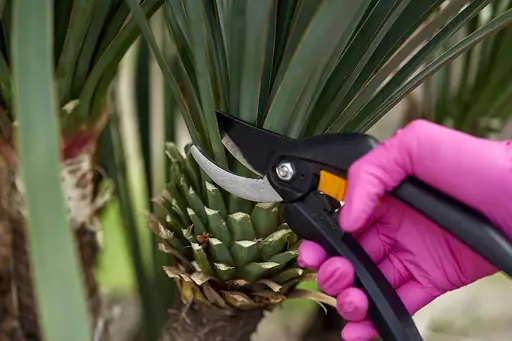
Yuccas, Yucca spp., are succulents that grow in full sun and rocky, dry soil in USDA Hardiness Zones ranging from 3 to 11.
They have mounds of sharp, sword-shaped foliage, attain heights of two to 30 feet depending upon variety, and produce tall stalks bearing clusters of creamy white to pink blossoms.
Our guide to growing yuccas discusses all you need to know to grow your own.
This article zeroes in on how to prune yuccas for health and aesthetics.
Here’s what we’ll cover:
What You’ll Learn
- The Best Time
- The Right Tools
- Deadheading Flowers
- Removing Damaged and Dead Foliage
- Sculpting a Tree from a Bush
- Shortening a Tall Plant
- Taking Cuttings to Propagate
- Thinning Dense Growth
There are many types of yuccas. Yours may be trees, shrubs, or houseplants.
Regardless of their stature and growth habit, periodic pruning is a beneficial part of a standard care regimen.
The Best Time
The best time to prune is when new shoots appear in the spring or early summer. Regrowth occurs rapidly during this time.
The Right Tools
Clean, sharp tools are essential. For smaller varieties, garden scissors may suffice for snipping off unsightly lower leaves.
If you have ground-level mounds, you may find pruners strong enough to cut out clumps of spent bloom stalks and withered foliage. If not, use a pruning saw to sever them from fresh green clumps.
Tree loppers are suitable for reaching overhead to make crisp, clean cuts.
While working, a hat, leather gloves, safety eyewear, and pruning sleeves or a thick shirt offer protection from sharp leaf margins.
With your supplies assembled, let’s discuss different reasons and methods for trimming yuccas.
Deadheading Flowers
Deadheading is the process of removing entire stems of flowers before the color completely fades and they set seed.
Unless you want to collect the seeds for future sowing, cutting off the spent flowers and directing energy back to producing lush greenery is best.
To deadhead, place your pruners around a stalk as low as you can without marring neighboring foliage and snip it off.
Removing Damaged and Dead Foliage
Like a palm tree, the leaves of a yucca turn brown and wither with age. Sometimes they are damaged by pests or pathogens.
Removing damaged and dead material supports a plant’s health and improves its appearance.
Older, desiccated foliage is easier to remove than younger green growth.
A gentle tug is sometimes all that is needed. If it doesn’t come away easily, use pruners to sever it by slicing down through each leaf base with a downward motion.
Sculpting a Tree from a Bush
A stemmed specimen may have leaves all the way up its trunk, like an elongated bush. The lower leaves that point downward are called a “skirt.”
Remove the skirt one leaf at a time to make it more tree-like, cutting each off as close as possible to where it meets the trunk.
Removing lower leaves decreases a plant’s footprint in the landscape, making room for understory flora that thrives in the partial shade it casts.
Shortening a Tall Plant
Sometimes an outdoor or indoor yucca gets so tall it dominates its setting and/or becomes top-heavy. The remedy is to shorten it by up to one-half for more compact growth.
If you are cutting an outdoor tree-like specimen, estimate where the middle is and use a pruning saw to slice straight through the middle of the trunk just above a ridge, as this is a natural growing point. The remaining bare trunk will sprout side growth from its ridges.
If your outdoor tree has a skirt of lower leaves, remove them from the bottom two-thirds of the tree and slice across the middle as described above.
When shortening a houseplant, unpot it and lay it on its side. Estimate where the middle of the stem is and proceed as above, making a straight slice just above a ridge line to jumpstart new side shoots.
Don’t panic at the sight of leafless trunks. They will regrow with vigor.
The upper portions you removed are also useful, so read on!
Taking Cuttings to Propagate
The top you cut off your tall tree or houseplant can regrow.
Bury a third to a half of the bare trunk or stem in a container of potting soil. The pot should be as deep as the buried portion, and the cutting should stand firmly upright.
Another way to make new plants is to dig up the new spring shoots from a ground-level mounding variety, sever the roots to separate them from the main clump, and plant as desired.
Be sure to get roots and shoots and set them at the same depth they were planted to initially.
Taking cuttings is an affordable way to make new plants to keep and share.
Find more tips on propagation here.
Thinning Dense Growth
And finally, whatever the variety, you can thin dense mounds to improve airflow, reduce susceptibility to pests and pathogens, and improve the overall appearance.
Reducing ground-mounding plants and bushy taller specimens creates more opportunities for companion flora in the landscape around and beneath them, respectively.
Well-Dressed Yuccas
While pruning yuccas is unnecessary, it benefits them by stimulating growth, inhibiting pests and pathogens, and showing them to best advantage in the landscape or in the home.
Evaluate your plants each spring and decide if they need sprucing up to look their best for the growing season. Remember to use sanitary pruning equipment and wear a hat, gloves, eyewear, and arm protection to avoid contact with sharp leaf edges.
Now that you know how to deadhead, remove damaged and dead material, sculpt a tree, shorten trunks and stems, take cuttings, and thin dense clumps, you’re ready to showcase your yuccas handsomely.
Which of these tactics have you tried? Have questions we didn’t cover here? Don’t hesitate to drop us a line in the comments below!
If you found this article informative and want to read more about growing yuccas, we recommend the following:
- How to Prevent and Treat Yucca Frost Damage
- Reasons Why Your Yucca Isn’t Blooming
- Are Yucca Plants Edible?
- X




질문 및 토론