
Do Spider Plants Bloom?
We love spider plants (Chlorophytum comosum) for their easy-going nature, beautiful foliage, and fast growth. That and the little babies or pups they produce, which makes them super easy to propagate. You’ve probably got one or two of them in your home, and that’s why you’re here. Maybe you noticed.
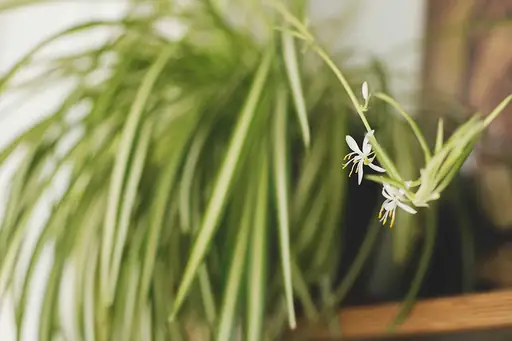
We love spider plants (Chlorophytum comosum) for their easy-going nature, beautiful foliage, and fast growth.
That and the little babies or pups they produce, which makes them super easy to propagate. You’ve probably got one or two of them in your home, and that’s why you’re here.
Maybe you noticed your spider plant is showing off a little with small white blooms dangling from the long stems where the plantlets normally grow, and you’re wondering what is going on.
Or maybe you’re just curious if these are, in fact, flowering plants.
The short answer is yes, spider plants do bloom!
If you have a mature specimen and you’ve never noticed or known that they can produce flowers – until now – that’s possibly because these houseplants are so low maintenance, you’ve missed the short-lived blooms in the past.
Or, the conditions haven’t been quite right to induce your specimen to flower.
If you need a refresher on how to grow and care for spider plants, check out our guide.
Let’s get into all the details of how and why your spider ivy is blooming, or might eventually produce flowers.
What You’ll Learn
- Spider Plant Flowers
- What About the Seeds?
- When Do Spider Plants Flower?
Spider Plant Flowers
To begin, let’s talk about the flowers themselves.
Mature C. comosum plants may produce blooms at the ends of the long wiry stems that the plantlets, also known as pups or spiderettes, grow on. These sprawling stolons can reach up to two feet long.
The blooms are about the size of a dime, and have six smooth, pointed, white to greenish colored petals. Six light yellow pollen-topped stamens burst from the center of each flower.
These blossoms are often described as interesting but insignificant, which is part of the reason why they often go unnoticed. The color and shape of these, especially on white variegated varieties, is easy to miss.
Plus, like I mentioned above, the blooms are short lived, lasting for about a week, and these popular houseplants aren’t needy – so the chances of missing the flowers entirely in between waterings is high.
If you do notice flowers, you may also see little plantlets growing alongside them, or these might appear after they’re done blooming.
Detaching and rooting these spiderettes is the most common way of propagating these popular houseplants.
What About the Seeds?
If you want to try to collect seeds, it’s important to remember that these flowers are pollinated by insects in the wild. You can try placing your C. comosum outdoors when it’s in bloom if the weather is amenable, for pollinators to access.
The resulting seed pods are triangular leathery green capsules that I find quite cute. Once ripe, the pods are held erect. Eventually they dry out and burst open, revealing three to five flat, black seeds.
These seeds may not be viable, and typically seeds collected from hybrids and variegated forms will not grow true to type.
When Do Spider Plants Flower?
In the wild, mature spider plants flower during the warm summer months.
The constant relative warmth of the indoors means blooming is possible year-round in your house.
A study on the effects of photoperiod and light quality published in the Journal of the American Society for Horticultural Science in 1978 shows long days and warm temperatures can lead to more flowers and faster production of blooms.
More than 12 hours of light (at least 1,500 foot candles) per day will result in the highest number of stolons, and thus potential blooms.
However, exposing the spider plant to short days of eight hours of daylight for at least three weeks will also encourage it to produce more stolons, which may produce both flowers and offsets.
An article published in the International Society for Horticultural Science Journal, Acta Horticulturae, concluded that daylength does affect the time taken to flower, and that days of 12 or more hours of sunshine can reduce the amount of time from stolon production to bloom from 24 weeks to 17 weeks.
What you can take from all that is, regardless, a mature houseplant may flower eventually if conditions are right.
Provided it’s receiving enough light and warm temperatures, keep an eye on it and you may just see some of those little blooms appearing on the arching stolons!
An Understated Bloom
They might not be elaborate, showy flowers, but spider plant blooms are still a cute surprise when you notice them hanging out on the specimen you typically enjoy for its beautiful foliage.
Since C. comosum can bloom year-round indoors in the right conditions, you can expect to see blooms on your houseplant eventually as long as you’re keeping an eye out for them.
Have you ever been surprised to see flowers on your C. comosum? Tell us about it in the comments section below.
Next up, for more information about growing and caring for spider plants check out these guides:
- Troubleshooting Yellow Leaves on Spider Plants
- Why Do Spider Plants Fade or Lose Their Variegation?
- How to Revive a Wilting Spider Plant
- X




질문 및 토론