
How to Control White Leaf Spots on Cruciferous Vegetables
Cercospora / Pseudocercosporella While the fungi Cercospora or Pseudocercosporella that cause white spot can severely affect turnip, rutabaga, canola, mustard, radish, horseradish, and hybrids of turnips and mustard, they are much less likely to affect kale, collards, broccoli, or cauliflower. This.
Cercospora / Pseudocercosporella
While the fungi Cercospora or Pseudocercosporella that cause white spot can severely affect turnip, rutabaga, canola, mustard, radish, horseradish, and hybrids of turnips and mustard, they are much less likely to affect kale, collards, broccoli, or cauliflower.
This is a cool weather disease and is most likely to strike at 55 to 65 F.
The disease has been a particular problem on canola plants in Europe with pod losses of up to 15%.
Photo via Alamy.Cultural treatments are the best way to control this disease, and the discussion below will walk you through the symptoms, life cycle, and control measures of white spot disease on crucifers.
What You’ll Learn
- Symptoms
- Cool Moist Conditions Favor Disease Development
- Cultural Controls
- Liquid Copper Treatment
- Fungicide Treatment
- White Spot Fungi Infects Some Crucifers and Not Others
Symptoms
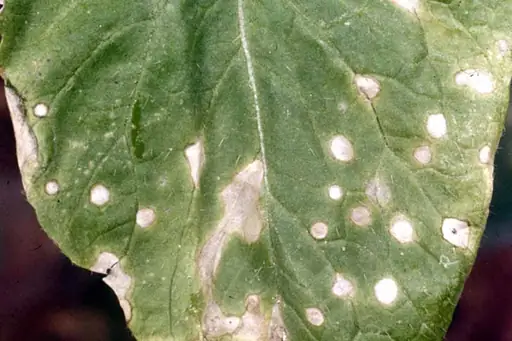
White spot disease gets its name from the circular white spots that are scattered over the leaves, stems, or pods of infected plants. Older spots may develop dark borders, and the centers may fall out. Such lesions look like shot holes.
White spot (Pseudocercosporella capsellae) infecting a turnip leaf. Cropped. Photo courtesy of Gerald Holmes, California Polytechnic State University at San Luis Obispo, Bugwood.org via CC 3.0.In addition to turning yellow, leaves that are severely affected dry out and wither, although they remain attached to the plants.
Lesions on the stems are superficial with a distinct boundary between tissue that is diseased or healthy. The lesions start out brown and then turn ash-gray to white. Large numbers of tiny dark specks form in the lesions, which are known as gray stem.
Infected seed pods start out with small brown spots. They then expand and become grayish-white with dark spots inside.
Cool Moist Conditions Favor Disease Development
The remains of infected plants are a significant source of spores to spread the disease. The wind can spread the sexual spores long distances in the fall if the weather is moist following rain or dew and the temperatures are 55 to 65 F.
Rain or splashing water spread asexual spores in the late fall that can cause disease the following spring.
The fungus can overwinter in volunteer crop plants or in susceptible weeds like wild mustard, wild radish, and shepherd’s purse.
Cultural Controls
Prevention is the best bet to control white spot of crucifers. Purge susceptible weeds and any volunteer crucifers that are growing near your crop.
At the end of the season, remove the plant debris or plow it deeply into the soil.
Rotate your crops and avoid growing any brassicas in the immediatel area for three years.
Don’t plant cole crops in or near an area that was infected during the previous season.
Promoting good soil drainage will also help to protect against this infection.
Liquid Copper Treatment
You can apply liquid copper (a solution certfified organic) to your cole crops to control white spot fungus.
Spray all the plant as soon as you see the disease. Be sure and spray the tops and bottoms of the leaves, and spray again every 7-10 days.
Fungicide Treatment
As soon as you see the white spot symptoms, you can apply the fungicide Benlate to the plants. This fungicide is a 50% solution of the compound benomyl. Benlate can be toxic to some crucifers, especially cabbage.
White Spot Fungi Infects Some Crucifers and Not Others
While these fungi do not typically infect kale, collards, cauliflower or broccoli, they do affect a range of cruciferous vegetables. They have been severe pathogens of canola in Europe.
White spot fungi prefer cool temperatures and frequently overwinter on volunteer crucifers, susceptible weeds, or in plant tissue.
White leaf spot (Cercospora brassicicola) on turnip leaf. Photo courtsy of Clemson University – USDA Cooperative Extension Slide Series, Bugwood.orgWhile liquid copper is an option, prevention is usually the best way to control this disease.
Have you done battle with white spot fungus on your crucifer plants? If so, let us know your plants fared in the comments.
If you are still trying to identify a particular disease on your cole crops, you might try one of our other guides such as:
- How to Identify and Treat Diseases of Turnips and Rutabagas
- Facebook32
- X




질문 및 토론