

이 페이지는 원문으로 표시됩니다. 번역본은 아직 제공되지 않았습니다.
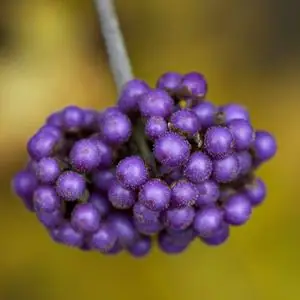
시드선 셀렉션
Callicarpa bodinieri var. giraldii 'Profusion'
SKU: CALL-BODI-GIRA-PROF-01G
'Profusion' is the beautyberry that finally made the genus behave. A Dutch selection out of Callicarpa bodinieri var. giraldii, a deciduous shrub from west and central China, this clone was chosen for one quality above all: fruit, in quantity, on a young plant, without needing a second shrub nearby.
맞춤 견적을 요청하세요
가격, 포장 크기 및 재고 여부는 개별 견적서에서 확인하실 수 있습니다. 문의를 보내는 것만으로는 유료 주문이 접수되지 않습니다.
재배 적합성, 파종 및 재배 요건에 대해 문의하십시오.
견적서에서 배송 옵션과 필요 서류를 확인하세요.
이 품종에 대하여
'Profusion' is the beautyberry that finally made the genus behave. A Dutch selection out of Callicarpa bodinieri var. giraldii, a deciduous shrub from west and central China, this clone was chosen for one quality above all: fruit, in quantity, on a young plant, without needing a second shrub nearby to make it happen. Upright arching canes reach eight to ten feet, carrying bronze-purple new growth that shifts to pinkish purple in autumn. Small lilac-pink flowers open at the end of summer, unremarkable and much loved by bees. Then in October the point of the whole thing arrives: tight clusters of berries in a violet so saturated and so metallic that first-time visitors routinely assume the shrub has been sprayed. The berries hold on long after the leaves have gone, which is exactly when a garden needs them.
The names are a small roll call of nineteenth-century plant hunting. Callicarpa is Greek, kallos and karpos, beautiful fruit, and no genus has ever been more literally named. The species honors Émile-Marie Bodinier, a French missionary who botanized across China until his death in 1901 and sent home a great many things nobody in Europe had seen. The varietal epithet honors Giuseppe Giraldi, an Italian missionary collecting in Shaanxi in the same era. Modern floras increasingly fold var. giraldii back into the species, but the trade has kept the longer name on this cultivar for decades, and the Royal Horticultural Society still lists 'Profusion' under it, complete with an Award of Garden Merit.
In China the genus is zi zhu, purple pearl, and the leaves have a long place in the traditional pharmacopoeia as a hemostatic, used to stop bleeding both internal and external. Callicarpa bodinieri itself is among the species drawn on. Phytochemical surveys of the genus have turned up well over two hundred compounds, diterpenes and triterpenoids and flavonoids chief among them, and laboratory work has reported anti-inflammatory and analgesic activity alongside the traditional hemostatic use. customers may know the American cousin, Callicarpa americana, which carries a parallel tradition among Indigenous peoples of the Southeast, where crushed leaves were worked into a mosquito repellent.
Plant in full sun. Shade costs you fruit, and fruit is the entire proposition. Beautyberries flower and fruit on new wood, so cut the whole shrub back hard in late winter, to a foot or two from the ground if you like; the response is vigorous and the berry display improves for it. Ordinary soil suits, moisture is welcome, and nothing much bothers the plants. Site where the October color will be seen from a window or a path, ideally against something dark or evergreen, since violet berries disappear entirely against a background of brown twigs. Good partners are Ilex verticillata for the red-against-violet argument, ornamental grasses for the movement, and any evergreen backdrop that will hold the color still.
더 많은 것을 발견해 보세요



질문 및 토론