

이 페이지는 원문으로 표시됩니다. 번역본은 아직 제공되지 않았습니다.
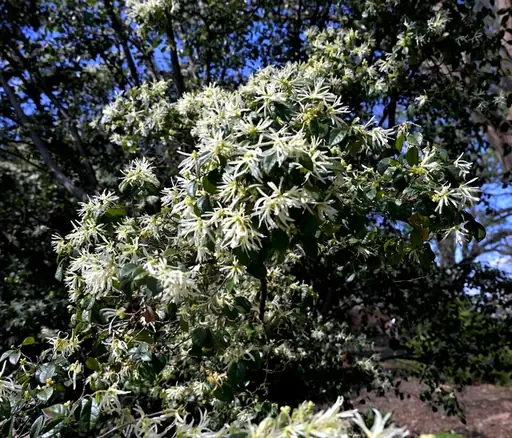
시드선 셀렉션
Loropetalum chinense
SKU: LORO-CHIN-01G
This Chinese evergreen shrub in the witch hazel family can become almost tree-like with age, reaching fifteen to twenty feet on a layered, wide-spreading frame. The leaves are small, dark green, and slightly rough, held densely enough to read as a solid mass from a distance. In early spring the.
맞춤 견적을 요청하세요
가격, 포장 크기 및 재고 여부는 개별 견적서에서 확인하실 수 있습니다. 문의를 보내는 것만으로는 유료 주문이 접수되지 않습니다.
재배 적합성, 파종 및 재배 요건에 대해 문의하십시오.
견적서에서 배송 옵션과 필요 서류를 확인하세요.
이 품종에 대하여
This Chinese evergreen shrub in the witch hazel family can become almost tree-like with age, reaching fifteen to twenty feet on a layered, wide-spreading frame. The leaves are small, dark green, and slightly rough, held densely enough to read as a solid mass from a distance. In early spring the whole shrub covers itself in white flowers built from narrow filamentous petals, four to a flower, giving the fringed effect that runs through the whole witch hazel family and a light sweet fragrance to go with it. That fringe is where the common name Chinese fringe flower comes from, though the name Chinese fringetree is more properly applied to another plant entirely, Chionanthus retusus.
The genus name is a small piece of precision: Loropetalum from the Greek loron, a strap or thong, and petalon, petal, describing exactly what you see. Hamamelidaceae puts this shrub in company with the witch hazels, Fothergilla, Corylopsis, and sweetgum, and the family resemblance is obvious once the flowers open. The wild range runs across southern China, Japan, and northeastern India.
Many purple-leaf and pink-flowered forms of this species have become very popular in recent years, to the point where most gardeners under a certain age have never seen anything else. This is the standard white-flowered form, occasionally seen in southern gardens where it has been grown for many years, and it is a quieter and in our view better plant: the white against dark green is cleaner than the pink against burgundy, the fragrance is stronger, and the mature layered habit is something the compact colored selections never achieve. Our propagation stock was taken from George's yard, off a plant of exactly that old southern kind. In China the species is ji mu, and leaves, flowers, and roots all enter traditional practice, chiefly as a hemostatic. Chewed leaves were a field remedy for staunching a small wound, and the plant carried uses for burns, dysentery, and diarrhea as well. The chemistry behind that is a heavy load of gallic acid tannins and flavonoids.
Plant in sun or semi-shade in soil that is well-drained but not droughty. Acid soil suits best, as it does most of the family. Growth is fast when young, so decide early what you want: left alone the shrub builds into a broad layered small tree worth standing under, and pruned it holds as a dense screen or a large informal hedge. Prune right after flowering, since buds form on growth made later in the season. Good with camellias, Osmanthus fragrans, Illicium, and hellebores beneath, and worth siting where the early bloom can be seen from a window, because it arrives before most of the garden has decided to wake up.
더 많은 것을 발견해 보세요



질문 및 토론