

이 페이지는 원문으로 표시됩니다. 번역본은 아직 제공되지 않았습니다.
시드선 셀렉션
Patrinia villosa
SKU: PATR-VILL-01G
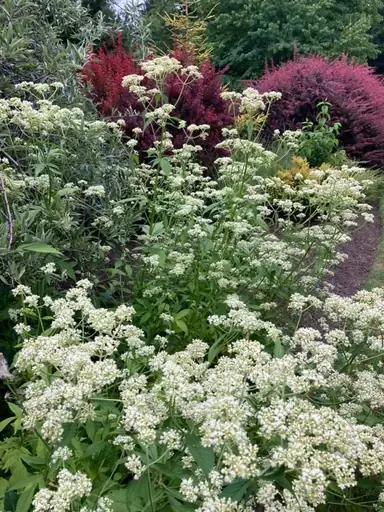
Patrinia villosa is a good perennial for warm climates, introduced to American gardens by Heronswood Nursery, and the appeal is easy to miss in a catalog photograph and obvious in a border. Broad flat clusters of small white flowers are held well clear of the foliage on wiry stems through summer,.
맞춤 견적을 요청하세요
가격, 포장 크기 및 재고 여부는 개별 견적서에서 확인하실 수 있습니다. 문의를 보내는 것만으로는 유료 주문이 접수되지 않습니다.
재배 적합성, 파종 및 재배 요건에 대해 문의하십시오.
견적서에서 배송 옵션과 필요 서류를 확인하세요.
이 품종에 대하여
Patrinia villosa is a good perennial for warm climates, introduced to American gardens by Heronswood Nursery, and the appeal is easy to miss in a catalog photograph and obvious in a border. Broad flat clusters of small white flowers are held well clear of the foliage on wiry stems through summer, giving the effect of a white lace-cap floating above the planting rather than sitting in it. The basal leaves are coarsely toothed, ovate to rhomboid, and covered in the short white hairs that give the species its epithet. Plants run gently at the root, so a single crown widens into a colony over a few seasons without ever becoming a nuisance.
Patrinia honors Eugène Louis Melchior Patrin, a French naturalist who spent years travelling and collecting in Siberia in the late eighteenth century, and villosa simply means hairy, for those softly furred stems and leaves. The genus has moved house botanically: the old family Valerianaceae has been folded into Caprifoliaceae, so this plant is now formally a relative of honeysuckle and valerian alike. The wild range covers China, Japan, Korea, and Taiwan, on grassy slopes, forest margins, and thickets from four hundred to fifteen hundred meters.
In China the plant is bai jiang cao, and the name is a piece of blunt honesty: bai jiang means something close to spoiled fermented sauce, for the distinctly sour smell of the dried root. Patrinia villosa is one of two species accepted in the Chinese Pharmacopoeia under that name, the other being Patrinia scabiosifolia, and the herb goes back to the Shen Nong Ben Cao Jing, the foundational Chinese materia medica, where it is listed among the middle-grade medicines. Traditional use centers on clearing heat and resolving toxicity, and above all on internal abscesses, particularly of the intestines. Modern laboratory work has looked at anti-inflammatory and hepatoprotective activity in the extracts.
Grow in full sun to light shade in ordinary garden soil with reasonable moisture; nothing here is fussy. The airy flower heads are made for weaving through a sunny border, softening stiffer neighbors and reading as a haze rather than a block of color, which is exactly the job that Ammi and Selinum do in cooler gardens and that neither will do reliably in the Southeast. Good with Rudbeckia, Echinacea, Amsonia, ornamental grasses, and late asters. Deer generally leave the plants alone. Cut the whole clump to the ground in late winter and expect fresh growth well before spring is finished. One practical note: the flowering stems last well when cut, though the faint sour scent that gave the plant its Chinese name is more noticeable indoors than out.
더 많은 것을 발견해 보세요



질문 및 토론