

이 페이지는 원문으로 표시됩니다. 번역본은 아직 제공되지 않았습니다.
시드선 셀렉션
Rhododendron periclymenoides 'Purple'
SKU: RHOD-PERI-PURP-01G
Among the most beloved of the eastern wild azaleas, Rhododendron periclymenoides drifts through the open woods and swamp margins of the eastern United States from New Hampshire and Massachusetts south to South Carolina, Tennessee, and Alabama, opening clouds of pink bloom just as the woodland wakes.
맞춤 견적을 요청하세요
가격, 포장 크기 및 재고 여부는 개별 견적서에서 확인하실 수 있습니다. 문의를 보내는 것만으로는 유료 주문이 접수되지 않습니다.
재배 적합성, 파종 및 재배 요건에 대해 문의하십시오.
견적서에서 배송 옵션과 필요 서류를 확인하세요.
이 품종에 대하여
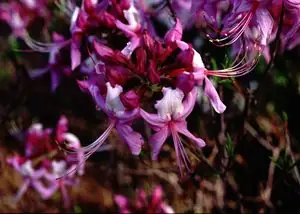
Among the most beloved of the eastern wild azaleas, Rhododendron periclymenoides drifts through the open woods and swamp margins of the eastern United States from New Hampshire and Massachusetts south to South Carolina, Tennessee, and Alabama, opening clouds of pink bloom just as the woodland wakes in spring. This selection breaks from the ordinary pink of the species: a soft lavender-purple color form discovered in Lancaster County, South Carolina, and introduced by , uncommon in the wild and rarer still in cultivation. Botanists once filed the species under the name Rhododendron nudiflorum, and the plant still answers to that older label in many an old garden book.
The names carry their own small history. The species epithet periclymenoides means resembling Periclymenum, the European honeysuckle, a nod to the slender, long-tubed flowers and their sweet, petunia-like scent, and the old common names wild honeysuckle and purple honeysuckle follow the same thought. Pinxterbloom, the name most often heard, comes from the Dutch Pinksteren, or Pentecost, the late-spring feast that arrives just as the flowers do; Dutch settlers of the Hudson Valley named the shrub for the season that announced them. The flowers open before or with the unfurling leaves, each blossom trailing stamens nearly twice the length of the corolla, so a shrub in full bloom reads as a haze of pale lavender rather than a mass of solid color.
For all the delicacy, pinxterbloom azalea does hard ecological work. The early nectar feeds returning hummingbirds and the first swallowtails, and the foliage is a documented larval host for dozens of butterflies and moths, so a single shrub anchors a great deal of spring life. Gardeners should know the plant is much loved by deer as well, and browsing pressure can run heavy where herds are large. As with all azaleas, every part carries grayanotoxins and is poisonous if eaten, so the shrub is one to enjoy for scent and color rather than for any use in the kitchen.
Site this azalea where the fragrance can be met in passing, at a woodland edge, along a shaded path, or in a naturalistic native border, and give the cool, moist, acidic, humus-rich soil that dogwoods, mountain laurel, and blueberries share. The stoloniferous roots knit slowly into a loose, well-mannered colony over the years, lovely drifted among ferns, native phlox, and other spring , or set against darker evergreens that throw the lavender bloom forward. Morning sun with afternoon shade suits the plant best in the South, and a pine-straw mulch keeps the shallow roots cool. For the collector of native azaleas, the unusual color and the provenance make this a quietly special thing to grow.
더 많은 것을 발견해 보세요



질문 및 토론