
21 of the Best Red Succulent Plants
Are you looking for a selection of succulents with a crimson glow? No matter if you want a houseplant for a windowsill or a drought-tolerant landscaping plant for the yard – there is a wonderfully diverse selection of red succulent plants to choose from! In this article you’ll discover 21 of the.
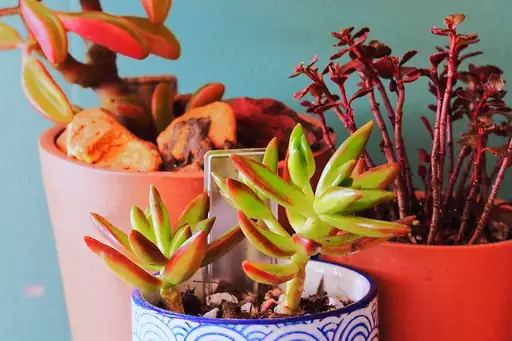
Are you looking for a selection of succulents with a crimson glow?
No matter if you want a houseplant for a windowsill or a drought-tolerant landscaping plant for the yard – there is a wonderfully diverse selection of red succulent plants to choose from!
In this article you’ll discover 21 of the best red succulent options – different types of plants featuring a spectrum of fiery shades, from bright vermillion to deep, dark burgundy.
Photo by Kristina Hicks-Hamblin.So that you can be sure you’re choosing a plant that will work for your conditions, for each of these options I’ll mention the USDA Hardiness Zone, water and sunlight needs, mature size, and details about what the plant looks like.
And to help you out when you identify exactly the plant you’re looking for, I’ll also provide tips for where to buy some of these selections.
Ready to learn more about 21 of the best red succulents for your home or garden?
Here’s a peek at our list:
21 Types of Red Succulents
- Calico Hearts
- Campfire
- Christmas Carol
- Cyclops
- Firestorm
- Fred’s Redhead
- Jelly Bean Plant
- Job’s Beard
- Lipstick
- Medusa
- Melaco
- Mission to Mars
- Nodulosa
- Red Carpet
- Red Lion
- Red Pagoda
- Royal Red
- Ruby Glow
- Ruby Necklace
- Ruby Slippers
- Tiger Kalanchoe
Before we start digging into the scarlet, carmine, maroon, and burgundy colorations of these red succulents, there’s something you should know about ruddy hues in succulent foliage.
To varying degrees, the succulents in this list produce more red pigments when they are exposed to stressful conditions such as intense light, cold, or drought.
Warm-toned pigments help protect the plants from those stressors.
Gee, you might be thinking, all I have to do is plop my succulent in the sun and never give it any water, and it will be beautiful!
Not exactly.
Depriving succulents of water as the sole method of encouraging colorful pigmentation is likely to backfire, producing sad looking specimens. Instead, follow the watering directions included in this article for each particular plant.
And regarding sun exposure, keep in mind that these plants must be acclimated to more intense light conditions gradually to avoid scalding.
As for cold stress – while cool temperatures can certainly bring out ruby tones in fleshy leaves, not all succulents have the same cold hardiness, so only expose your selection to cool temperatures within its tolerance.
Now that you know why red succulents display those warm red colors – and how to carefully encourage ruddy foliage coloration – let’s start looking at our options!
1. Calico Hearts
Do you wear your heart on your sleeve?
With our first selection, you can also wear it on your succulent shelf.
Calico hearts (Adromischus maculatus) is a small succulent with plump greenish-gray, heart- to paddle-shaped leaves that have burgundy spots and leaf margins.
Also known as mottled pig’s ears or chocolate drop, this red succulent has a mat-forming growth habit, reaching three to six inches tall with a 14-inch spread.
Calico hearts (A. maculatus).When they bloom, these succulents bear small, white, tube-shaped flowers.
Calico hearts needs at least four hours of direct sun per day, preferably during the morning or late afternoon. Protect it from direct sun during the hottest part of the day.
If you don’t have a location with enough direct sunlight to grow this – or the other plants in this list – as a houseplant, consider supplementing with a grow light.
Read our article to learn more about using and choosing grow lights.
As for water, allow the growing medium to dry out entirely between waterings, and water less frequently in cooler conditions to avoid rotting.
Bottom watering is a great method to use with succulents, including calico hearts.
Calico hearts can be grown outdoors year-round if you live in USDA Hardiness Zones 9b to 11b – otherwise, be sure to bring it inside before the weather cools down in fall.
Calico Hearts
Do you feel the beat of these calico hearts?
2. Campfire
There’s nothing as mesmerizing as staring into the flames of a campfire – unless it’s gazing at the flame-like foliage of this red succulent!
‘Campfire’ is a cultivated variety of Crassula capitella and the foliage takes on a vermillion, carmine, or burgundy tint when exposed to bright sunlight. In dimmer lighting conditions, expect foliage to remain apple green.
The pointed leaves of this red succulent are narrow and propeller-like, growing in stacked, opposite pairs, creating pyramid-like shapes.
C. capitella ‘Campfire.’‘Campfire’ has a spreading, mat forming growth habit with stems growing upright or horizontally. It reaches six inches tall and up to three feet wide when allowed to spread.
This succulent bears small, star-shaped flowers that are white with a blush of pink.
‘Campfire’ prefers bright light, with at least six hours of direct sunlight per day. When growing it outdoors in Zones 9 to 10, you might situate the plant in filtered sun, offering some shade during the heat of the day.
Allow the growing medium to dry thoroughly between waterings.
Crassula ‘Campfire’
Ready to keep your own ‘Campfire’ going all year long in your home or yard?
Read our guide to growing crassulas to learn more about caring for these succulents.
3. Christmas Carol
For those who wish Christmas could last all year long, here’s a red succulent that will serve as a constant reminder of that end of year celebration.
‘Christmas Carol’ is a type of hybrid aloe with uncertain parentage, named for its green and ruby-colored foliage.
Aloe ‘Christmas Carol.’With lance shaped leaves that have ruddy spikes along the margins and in the center, ‘Christmas Carol’ is composed of open, spiky rosettes. These plants reach up to twelve inches tall and wide.
When in bloom, ‘Christmas Carol’ bears tubular, pink to scarlet flowers.
This red succulent can grow in full sun to light shade – provide at least six hours of direct sunlight and offer some shade during the hottest part of the day in the summer.
Allow the soil to dry thoroughly between waterings, and err on the side of underwatering rather than overwatering.
Are you hoping to let your ‘Christmas Carol’ sing in the great outdoors year round? Don’t think about it unless you live in USDA Hardiness Zones 9b to 11b.
‘Christmas Carol’ Aloe
Want to keep a Christmassy reminder by your side all year long?
Learn more about growing ‘Christmas Carol’ aloe in our guide.
4. Cyclops
Unlike the one-eyed monster from Greek mythology, this ‘Cyclops’ won’t make you run for your life. On the contrary, you will likely find yourself drawing nearer to gaze at its beautiful “eye.”
‘Cyclops’ is a type of Aeonium that has maroon leaves – except in the center of the plant, where the foliage is lime green.
This is a hybrid cross between A. undulatum and A. arboreum ‘Zwartkop.’
Aeonium ‘Cyclops.’Mature ‘Cyclops’ plants can reach three to four feet tall with a three-foot spread, bearing rosettes at the ends of long, branching stems.
The yellow flowers are borne on a pyramid shaped inflorescence.
Provide at least six hours of direct sun for this aeonium and let the growing medium dry completely between waterings.
And be prepared to bring your own personal ‘Cyclops’ indoors for the winter unless you live in USDA Hardiness Zones 9 to 11.
‘Cyclops’ Cuttings
Fancy a tame ‘Cyclops’ to call your own?
No need to travel far to find one!
5. Firestorm
Are you looking for a red succulent with bright scarlet coloration?
Firestorm™ is a selection of golden sedum (Sedum adolphii), also classified botanically as Sedum nussbaumerianum, that has foliage with intensely colored, bright red margins.
With increased light exposure, the entire leaves can flush with a ruby hue. These red succulents reach eight inches tall and have a spread of up to two feet.
S. adolphii Firestorm. Photo by Kristina Hicks-Hamblin.Firestorm™ sedum produces showy umbels of star shaped white flowers.
Provide six to eight hours of direct sunlight and allow the soil to dry two to three inches down before watering.
If you have plans to include Firestorm™ in your xeriscape, check your USDA Hardiness Zone first – this sedum is hardy in Zones 10 to 11.
Sedum Firestorm
Ready to bring on the Firestorm?
6. Fred’s Redhead
Our next selection, ‘Fred’s Redhead’ is a type of lithops, or living stone, known for its cherry coloration.
Lithops are diminutive mimicry plants with fascinating markings that blend in with the stones on the ground in their native ranges.
‘Fred’s Redhead,’ a cultivar of Lithops lesliei, has a cerise colored body and is relatively large for a lithops, reaching between one and one and a quarter inches wide and tall.
L. lesliei ‘Fred’s Redhead.’‘Fred’s Redhead’ produces relatively large, yellow, daisy-like flowers when it blooms.
This lithops needs bright light, and should be provided with six to eight hours of direct sunlight per day, but during summer, offer it some shade from midday heat.
Watering lithops isn’t as straightforward as with the other red succulents in this article, and requires a great deal of restraint.
If you situate your lithops outdoors for the warm months, be sure to protect it from rain, and bring it back indoors in the autumn unless you live in Zones 9 to 11.
Lithops ‘Fred’s Redhead’
Want to grow your own cherry-hued living stone from seed?
Read our guide to growing and caring for lithops to learn more.
7. Jelly Bean Plant
Would you prefer to get your sweet fix visually from your houseplants instead of from candy?
Sedum x rubrotinctum, more commonly known as jelly bean plant, is an interspecies cross between S. pachyphyllum and S. stahlii.
Also known as pork and beans, jelly bean plant has thick, rounded, bean-shaped leaves that have a high gloss, contributing to their jelly bean-like appearance.
Jelly bean plant (S. × rubrotinctum).In low light the foliage is green, but as sunlight increases, the plump leaves take on a beautiful carmine color.
Jelly bean plant usually reaches about four inches tall and eight inches wide, and has a low-growing, spreading growth habit.
The flowers of this hybrid appear in clusters and are bright yellow.
Provide jelly bean plants with at least six to eight hours of direct sunlight for best color and compact growth, and allow the soil to dry thoroughly between waterings.
Does your area experience mild winters? You can grow jelly bean plant outdoors year-round if you live in USDA Hardiness Zones 9a to 11a.
Jelly Bean Plant
Skip the candy but go straight for the jelly beans!
8. Job’s Beard
If bringing up Greek mythology earlier in the article got your attention, here’s another mythological reference that might be of interest.
This selection is named for Jupiter, the Roman god of the sky and thunder.
Known as either Job’s beard or Jove’s beard, this red succulent is now classified botanically as Sempervivum heuffelii, but used to be considered a species of Jovibarba, now considered by experts to be a subgenus of Sempervivum.
Job’s beard (S. heuffelii).A type of hens and chicks, Job’s beard grows lovely rosettes consisting of elongated, spade-shaped burgundy leaves, on plants that reach four to six inches wide and tall.
This succulent only produces flowers once, right before dying, but leaves behind offsets which go on growing after the parent plant is gone. Flowers are whitish-yellow and are borne on the end of the rosette.
Give Job’s beard four to eight hours of direct sun and allow the top one to two inches of the growing medium to dry between waterings.
Job’s beard provides options for landscaping use to a wider range of gardeners than the other selections we’ve considered so far. This red succulent is hardy in Zones 4 to 9.
Learn more about growing hens and chicks in our guide.
9. Lipstick
Red is a color sometimes associated with drama, and with its high contrast, this selection signals visual excitement more than any of the other options in this list.
Echeveria agavoides ‘Lipstick’ is a type of echeveria that has triangle-shaped, neon green leaves with wine-colored margins and leaf tips.
The tips of the leaves are pointed, and look as though they have been dipped in paint or makeup. I find the effect more reminiscent of nail paint than lip coating, but ‘Nail Polish’ doesn’t really have the same ring to it, does it?
E. agavoides ‘Lipstick.’‘Lipstick’ usually grows as a solitary rosette without producing offsets, and those lone rosettes reach six inches tall and eight inches wide at maturity.
The flowers of this cultivar are pink to red with dark yellow tips.
‘Lipstick’ echeverias need at least six to eight hours of direct sun to maintain their beautiful coloration and compact shape. Allow the growing medium to dry thoroughly between waterings.
This selection would be beautiful in a rock garden, but if you plan to grow it outdoors year-round, make sure you live in Zones 10 to 11.
‘Lipstick’ Echeveria
Call it what you want, but I think ‘Lipstick’ is prettier than any makeup.
Want more tips on caring for these plants? Be sure to read our guide to growing echeverias.
10. Medusa
So that ‘Cyclops’ and Job’s beard don’t get lonely, we have one more reference from the mythology of classical antiquity.
‘Medusa,’ in this case, is not a snake-haired woman but a type of Aeonium known for its brightly colored, variegated rosettes.
With parentage from Aeonium canariense and A. arboreum ‘Zwartkop,’ the spoon-shaped leaves of ‘Medusa’ each have a central band that’s darker than the rest of the leaf.
Aeonium ‘Medusa.’Depending on light exposure, foliage may be red with burgundy to black central bands, pink with red bands, or in lower light, cream colored with green bands.
These red succulents are branching, and reach 12 inches tall and 24 inches wide.
‘Medusa’ produces cone-shaped inflorescences covered with yellow blooms.
Grow this cultivar in a spot with at least four hours of direct sun, and water as soon as the soil has dried out completely.
If you situate ‘Medusa’ outdoors during summer, be sure to return her indoors before the weather cools in fall – unless you are in Zones 10 to 11.
‘Medusa’ Aeonium
Is this mythic red succulent snaking its way into your heart?
11. Melaco
If you’re looking for a succulent in muted shades of red, consider ‘Melaco.’
A hybrid Echeveria cultivar with unknown parentage, ‘Melaco’ has chocolatey-red rosettes and the red tones become more pronounced with increased sun exposure.
Rosettes are three to four inches wide on plants that grow to six to eight inches tall.
Echeveria ‘Melaco.’With a cultivar name that means “molasses” in Portuguese, E. ‘Melaco’ produces orange flowers when in bloom.
This echeveria cross needs at least four hours of direct sunlight each day, and should be watered only when the growing medium is thoroughly dry.
‘Melaco’ makes a gorgeous choice for a rock garden – but only if you live in USDA Hardiness Zones 9b to 11b, otherwise keep it inside for the cooler months.
Echeveria ‘Melaco’
Ready to indulge in this chocolatey red succulent?
Head to Amazon for ‘Melaco’ echeveria plants in two-inch pots from the Next Gardener.
12. Mission to Mars
If you love agaves as landscaping plants but wish they came in rich, red colors instead of cool blue tones, this next one is for you!
‘Mission to Mars’ is a type of red-leaved Mangave, an intergeneric cross between an agave and a manfreda.
‘Mission to Mars’ mangave.The long, pointed leaves of ‘Mission to Mars’ are spined, arranged in a rosette, and burgundy colored, mottled with green.
A cross between Agave shawii and x Mangave ‘PDN#9,’ ‘Mission to Mars’ plants grow up to two feet tall and three to four feet wide at maturity.
These xerophytic plants produce huge spikes of yellow blooms, and unlike agaves, mangaves don’t die after flowering.
Grow ‘Mission to Mars’ in six to eight hours of direct sun, and wait until the soil is dry before watering.
You can grow ‘Mission to Mars’ outdoors year round in Zones 9 to 10.
13. Nodulosa
If you appreciate succulent rosettes but have been hoping for something really different, get ready for this next option.
Echeveria nodulosa looks like a botanical creation that came out of a lab, but in this case, it was nature’s lab – this is a species plant, not a hybrid!
The foliage is grayish-green with dark red markings on the centers of leaves as well as on the margins. These markings look as though they’ve been applied with a painterly stroke.
E. nodulosa. Photo by Stickpen, Wikimedia Commons, Public Domain.These red succulents may be upright or sprawling and have branching stems, reaching up to two feet tall and wide, with open, five-inch rosettes.
Sometimes called painted echeveria, the flowers of these fantastical looking succulents are yellow, pink, and white. These plants are also sometimes referred to as painted lady echeverias, though that common name is usually reserved for E. derenbergii.
E. nodulosa requires at least four hours of direct sun per day, but be sure to provide light shade during the hottest part of the day. Allow the growing medium to dry fully before watering.
Be sure to keep your painted echeveria as a houseplant and bring it in during cooler weather unless you live in Zones 9b to 11b.
Echeveria Nodulosa
Want to add the artistic leaves of this echeveria to your collection?
14. Red Carpet
Looking for a succulent ground cover that will look and behave perfectly in a rock garden?
‘Red Carpet’ is a creeping, mat-forming succulent that takes on a burgundy hue in cooler weather.
A cultivated variety of Phedimus spurius (formerly known as Sedum spurium), ‘Red Carpet’ is a type of stonecrop that is semi-evergreen and reaches two to six inches tall with a 12-inch spread.
P. spurius ‘Red Carpet.’ Photo by Kristina Hicks-Hamblin.This burgundy-colored succulent bears clusters of star-shaped flowers in shades of pink to red.
‘Red Carpet’ needs at least six hours of direct sunlight, and the soil can be allowed to dry out between waterings.
Are you envisioning this carpet as a ground cover? ‘Red Carpet’ can be grown outdoors year-round in Zones 4 to 9.
‘Red Carpet’
Learn more about how to grow stonecrop in our guide.
15. Red Lion
Though smallish, this next red succulent roars with its rich coloration!
‘Red Lion’ is a type of sempervivum (also known as houseleeks or hens and chicks), that has a beautiful bright red hue on compact rosettes.
The rosettes are composed of spade-shaped leaves and the plant can reach five to six inches tall and wide.
‘Red Lion’ sempervivum.This sempervivum produces showy pink flowers only when dying, but parent plants leave offsets to take their place.
‘Red Lion’ needs at least four hours of direct sun each day and should be watered when the growing medium is partly to fully dry.
Want to grow this sempervivum outdoors year round? Go for it if you live in 4 to 10.
‘Red Lion’ Sempervivum
Care to add this petite beast to your succulent menagerie?
16. Red Pagoda
One of the fascinating things about succulents is the huge array of intriguing shapes that have evolved among these species – and red pagoda is a case in point!
Also known as shark’s tooth, the leaves of red pagoda (Crassula capitella subs. thyrsiflora) are arranged stacked in four ranks, like a four-pointed star, or in a spiral.
This type of crassula has bright green foliage that turns red in cold weather or bright sun, often appearing as a psychedelic looking mix of green and red.
Red pagoda (C. capitella subs. thyrsiflora).With a branching, mat-forming growth habit, red pagoda plants reach seven inches tall and have an 18-inch spread.
Want to encourage it to drape down? Add red pagoda to your list of options for trailing cacti and succulents for hanging baskets!
Also known as pagoda village, the flowers are tiny, and white or white with a pink blush, appearing at the ends of stems.
Offer red pagoda crassula at least six hours a day of direct sunlight to bring out the plant’s warm tones and to encourage compact growth, but provide a little shade during the hottest part of the day. Allow the growing medium to dry thoroughly between waterings.
If you want to grow this red succulent outdoors year-round, make sure you live in Zones 9 to 11.
Red Pagoda Crassula
Love the repeating patterns of this red succulent?
17. Royal Red
If you’re looking for a larger, more upright red succulent, something with some majesty, you’ll want to consider ‘Royal Red.’
‘Royal Red’ is a cultivated variety of African milk tree (Euphorbia trigona) that has branching, columnar, three- or four-angled stems that bear both sharp thorns and small, teardrop-shaped leaves.
Both the stems and leaves have a red to burgundy flush.
African milk tree ‘Royal Red,’ also known as red African milk tree and E. trigona var. rubra.This red succulent grows into a large shrub or small tree with stems taking on a candelabra-like growth pattern and the main stem turning into a woody trunk as the plant matures.
Outdoors, African milk trees can reach 12 to 15 feet tall and four to six feet wide, while indoors they typically grow to about six and a half feet tall and two feet wide.
This plant isn’t known to produce flowers, which makes some botanists think the species is actually a hybrid.
Grow ‘Royal Red’ in a spot with four to eight hours of direct sunlight, and allow the soil to dry completely between waterings.
If choosing this option as a houseplant, don’t forget it has the potential to reach over six feet tall, so make sure you have room!
Gardeners in Zones 10 to 11 can grow ‘Royal Red’ outdoors year-round with protection from frequent rainfall.
However, be forewarned that this plant contains toxic sap – hence the name milk tree – so be sure to wear gloves when handling it and keep it away from pets and small children.
Red African Milk Tree
Do you have the perfect spot for this majestic euphorbia?
Want to learn more about growing euphorbias? Read our guide.
18. Ruby Glow
If you enjoy growing succulents and haven’t yet ventured into peperomia territory, ruby glow is an excellent choice to start with.
Ruby glow (Peperomia graveolens) has thick, chunky leaves that are glossy and shaped like tacos, with burgundy stems and leaf bottoms, and green leaf tops.
This type of peperomia has a mounding growth habit, reaches 10 inches tall and has a 12- to 18-inch spread.
Ruby glow (P. graveolens). Photo by Kristina Hicks-Hamblin.The extremely tiny flowers are yellowish-white and grow on slim spikes.
This red succulent will be happy with indirect bright light, but can handle some direct sun early in the morning.
Let the soil dry to an inch or two deep between waterings, but avoid letting the growing medium dry out entirely.
If you live in Zones 10 to 11, you have the option of growing ruby glow outdoors year-round, while other gardeners can enjoy this peperomia as a houseplant.
Peperomia Ruby Glow
Thinking of adding ruby glow to your collection?
Need more growing tips? We have a complete guide to growing ruby glow peperomias.
19. Ruby Necklace
Perhaps in reading this article, you’re hoping to find the perfect red succulent for a hanging basket.
Ruby necklace (Crassothonna capensis) takes first place on our list for its ability to fill and hang beautifully over the sides of a hanging planter.
The leaves are cylindrical, resembling the small French pickles known as cornichons, and are bluish-green in color unless stressed, when they take on a burgundy hue.
Ruby necklace (C. capensis).Formerly classified as Othonna capensis and sometimes called by the common name “little pickles,” this redsucculent has a trailing growth habit and reaches four inches tall and 12 inches wide.
When in bloom, it bears bright yellow, daisy-like flowers.
Ruby necklace requires at least four hours of direct sunlight, but will be happy with more sun if acclimated gradually. Water when the growing medium is dry or nearly dry, and take special care not to let it become oversaturated in winter.
Gardeners who would like to add this selection to their xeric landscaping can grow ruby necklace outdoors year round in USDA Hardiness Zones 5 to 10.
Ruby Necklace
Is your favorite hanging planter anxiously awaiting its ruby necklace?
20. Ruby Slippers
If you’re familiar only with the types of echeverias with waxy looking leaves arranged in lotus-blossom shaped rosettes, you’ll be surprised to learn that this next selection is a member of the same genus.
Ruby slippers is a common name for Echeveria harmsii, a plant that is covered with silvery hairs, giving it a velvety appearance.
Ruby slippers (E. harmsii). Photo by KM, Wikimedia Commons, via CC BY-SA.Also known as plush plant, this echeveria has green foliage that develops ruby-colored margins and leaf tips in bright sunlight.
Branching plants produce three- to four-inch, open rosettes on stems that can reach nine to 12 inches tall. Mature plants can spread up to 15 inches wide, and sports orange, urn-shaped flowers.
Grow ruby slippers in at least six hours of direct sunlight to bring out its ruddy margins, but provide light shade during the hottest part of the day. Allow the top two inches of the growing medium to dry between waterings.
If you’re thinking of growing this echeveria outdoors year-round, make sure you live in USDA Hardiness Zones 10 to 11.
Ruby Slippers
Ready to see if this slipper is the perfect fit?
21. Tiger Kalanchoe
Our final selection has a similar appearance to the first option in this list, but can potentially reach a much larger size.
Tiger kalanchoe (Kalanchoe humilis), closely related to mother of millions, has beautiful foliage that is grayish-green to yellowish-green with burgundy stripes.
Tiger kalanchoe (K. humilis).Also known as spotted kalanchoe, this red succulent sports open rosettes of spoon-shaped leaves and reaches six to 36 inches tall and wide.
The flowers are small, and green to purple in color.
Tiger kalanchoe needs at least four hours of direct sun per day, but provide shade during the hottest parts of the day, and allow the growing medium to dry thoroughly between waterings.
Want to consider growing tiger kalanchoe outdoors all year? Make sure you live in USDA Hardiness Zones 9 to 11.
Tiger Kalanchoe
Love the tiger stripes on this succulent?
Learn more about caring for kalanchoes in our guide.
A Flush of Fiery Fleshy Plants
As I’m sure you’ve noticed perusing this list of succulents, ruddy foliage certainly stands out and catches the eye.
Did any of these red succulents particularly catch your eye? Did you find one to add to your windowsill or grow in your yard? I’d love to know, so drop me a note in the comments section below!
And if I left out any of your favorites, feel free to share them with our other readers in the comments section too.
Would you like to keep expanding your knowledge of cacti and succulents? We have more reading for you right here:
- How to Grow and Care for Succulents
- How to Grow Succulents Outdoors in the Garden
- 29 of the Best Blue Succulent Plants
- Facebook34
- X




Vragen en discussie