
Should You Let Coleus Flower? Best Practices for Vibrant Foliage
Coleus is an easy-to-grow herbaceous perennial prized for its vibrant, variegated leaves that feature almost every color except true blue. A perennial in Zones 10 to 11, gardeners cultivate it as an annual or houseplant in cooler regions. Our guide to growing coleus has all you need to know to grow.
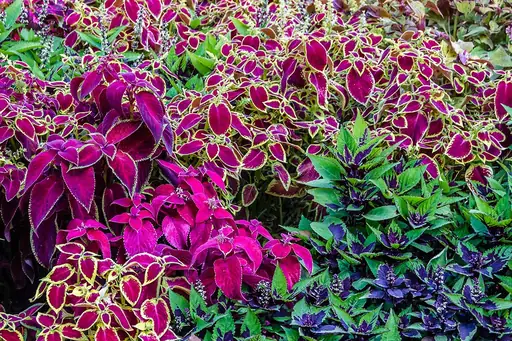
Coleus is an easy-to-grow herbaceous perennial prized for its vibrant, variegated leaves that feature almost every color except true blue.
A perennial in Zones 10 to 11, gardeners cultivate it as an annual or houseplant in cooler regions.
Our guide to growing coleus has all you need to know to grow plants in your landscape.
This brief article discusses whether or not you should let your plants bloom.
Here’s what we’ll cover:
What You’ll Learn
Coleus Characteristics
Cultural Requirements
Life Cycle
Managing the Blooms
Coleus Characteristics
This species is native to tropical Africa, Asia, and Australia.
The colors of the leaves are often so remarkable that you have to touch the foliage to make sure it’s real!
Imagine electric lime, hot pink, copper, chartreuse, and burgundy, so rich you would swear it was velvet.
Multicolor combinations and contrasting veining and margins make each variety more exciting than the next.
The leaves have soft hairs, prominent veining, and bold features – like scalloped, ruffled, pointed, or serrated margins.
They are arranged in opposite pairs along the square stems typical of members of the mint family.
Plants have a bushy, mounding growth habit, and under ideal conditions, mature dimensions are three feet tall and wide.
Cultural Requirements
Outdoors, these plants generally prefers a part- to full-shade location, but there are some cultivars that tolerate full sun conditions.
I have had great success growing coleus in east-facing window boxes that are exposed to morning sun and afternoon shade.
The soil should be moist, organically rich, and well-draining with a slightly acidic to neutral pH of 6.0 to 7.0.
Applications of balanced fertilizer, such as 10-10-10 (NPK) is beneficial at planting time and two or three times during the growing season to keep plants vigorous and colorful.
Indoors, coleus does best in bright, indirect sunlight in a well-draining container and organically-rich potting soil.
Potted specimens appreciate applications of liquid fertilizer formulated for tropical foliage plants diluted to half strength at planting time and in spring.
Water when the top inch of soil is dry, and ensure that water is applied to the surface of the soil instead of over the leaves to reduce the risk of fungal disease.
Life Cycle
Flowering plants go through five stages of their life cycle: germination, vegetative and reproductive growth, flowering, seed setting, and seed dispersal.
In the spring, coleus plants grow new leaves. By late summer, green-budded racemes, or spikes, become visible.
They rise above the mounds of foliage, and the buds open to reveal bluish-lavender, two-lipped blossoms.
As fall approaches, the flowers fade, seeds form, and they disperse. Then the plants die.
Annuals have one life cycle. Perennials can have multiple cycles.
Managing the Blooms
Each time you see the green tip of a raceme poking up from the leaves, you can pinch or snip it off as close to the point of origin as possible.
Removing the flower buds directs energy back to leaf production, the vegetative stage, and away from bloom production, the reproductive stage.
Preventing the plant from blooming stimulates lush, compact, leafy growth.
Alternatively, you can allow the flowers to bloom.
Before they fade and drop, deadhead entire racemes at their point of origin to prevent seed setting, disrupting the reproductive stage, and redirecting energy to the foliage.
I used both methods with my window box specimens. They remained vigorous, I enjoyed some blossoms, and my display lasted from spring until the first frost.
Youth Restored
In a nutshell, when the leaves are stunning and the flowers are not, growers often manipulate a plant’s life cycle by inhibiting blooming to promote vigorous leafy growth.
By pinching off green, budding racemes or deadheading post-bloom before the flowers fade and seeds form, we help the plant redirect energy back into foliage production.
Do you grow coleus? Do you allow the plants to bloom? Let us know in the comments section below!
If you found this guide informative and want to read more about coleus, we recommend the following:
- 21 of the Best Coleus Varieties
- How to Grow Coleus as a Houseplant
- How to Grow Coleus in Containers
- X

Vragen en discussie