
19 of the Best Reblooming Flowers for Months of Color
But these days, I don’t have to. There are so many newly-bred plants out there that can rebloom for a second round of flowers, and some that will even rebloom three or more times. I still feel sad when the flowers fade, but now I can enjoy the abundance for months longer. Do you feel the same way?.
But these days, I don’t have to.
There are so many newly-bred plants out there that can rebloom for a second round of flowers, and some that will even rebloom three or more times.
I still feel sad when the flowers fade, but now I can enjoy the abundance for months longer.
Do you feel the same way? Wishing you could enjoy your blooming plants longer?
The 19 plants in this guide come back at least once during the growing season so you can continue to enjoy them. Here are the varieties we’re about to discuss:
19 Favorite Reblooming Flowers
1. Azalea
2. Black-Eyed Susan
3. Bougainvillea
4. Butterfly Bush
5. Clematis
6. Daylily
7. Echinacea
8. Honeysuckle
9. Hydrangea
10. Ice Plant
11. Iris
12. Lilac
13. Lily
14. Magnolia
15. Phlox
16. Poppy
17. Rose
18. Weigela
19. Wisteria
Keep in mind that for some plants, only certain species, cultivars, or hybrids will rebloom.
Not all roses, for instance, send out a second flush of flowers. Some need deadheading to make them return for an encore. We’ll call these out.
Plants that produce more than one round of flowers and seeds (or crops) are known as remontant.
This remontancy can happen either because it’s bred into the plant or because a stressor followed by a cool period tricks the plant into thinking it was winter and it sets another round of buds.
We can also trick plants by removing the seeds before they mature. The plant decides it’s not done with its job and it sends out more blossoms (and so, more seeds).
Plants that rebloom unexpectedly usually won’t set a bud in that same location next year, so this can impact the next year’s show.
But deadheading, or plants that are bred to rebloom, can do so without impacting the following year’s bud set.
So, with that mini botany lesson out of the way, let’s take a look at some of the great remontant flowering plants out there:
1. Azalea
Associated with temperance, azaleas are finicky and floriferous. Not all azaleas (Rhododendron spp.) rebloom. You have to seek them out.
The Encore series of azaleas is dedicated to producing plants that rebloom.
Any of these can be relied on to send out flowers a second time during the year, usually in the fall, but some even bloom a second time in summer and a third in fall.
Autumn Embers
Bloom-A-Thon by Proven Winners also features repeat-blooming azaleas to look out for.
And Perfecto Mundo is another series of rebloomers from Proven Winners. They boast being particularly disease-resistant with a dense growth habit.
Perfecto Mundo White
Learn more about growing azaleas here.
2. Black-Eyed Susan
Black-eyed Susans (Rudbeckia hirta) are popular across the US, and you can find them growing practically everywhere.
They aren’t traditional rebloomers in the sense that they’ll return after the first flush of blossoms.
But if you deadhead them after they bloom, you can usually entice them into tossing out a second batch.
These plants don’t necessarily need to be deadheaded, and it won’t guarantee a return of flowers. But it’s worth a try, right?
‘Goldsturm’ Black-Eyed Susans
Grab some gloriously golden ‘Goldsturm’ plants at in packs of three, six, or nine roots.
Our guide to growing black-eyed Susans has cultivation tips.
3. Bougainvillea
Bougainvillea (Bougainvillea spp.) reliably rebloom in the fall in temperate zones if you prune them back well after the blossoms fade in the summer.
Bougainvillea blooms when the days are short in the spring and will bloom again when the days are short in the fall, so don’t feel bad if there’s nothing happening during the dog days of summer.
‘Alexandra’ Bougainvillea
The majestic purple of ‘Alexandra’ is pretty hard to beat.
Check out our guide to learn more about growing bougainvillea.
4. Butterfly Bush
(Buddleja spp.) won’t naturally rebloom, but if you prune them back after the flowers fade, they usually send out a second round of flowers right away.
These plants form buds on new wood, so if you encourage them to send out new growth early enough in the year, you’ll likely get more and more blossoms.
If you end up trimming them later in the growing season, they probably won’t bloom again.
Blueberry Pie
Blueberry Pie sports gorgeous purple and blue flowers on shrubs that grow two to three feet tall and wide.
You can learn more about growing butterfly bush here.
5. Clematis
Clever clematis (Clematis spp.) can cunningly climb up even the flimsiest of supports, and that’s part of why we love her.
These vining plants are sorted into three groups, and Group 2 (or B) is the one packed with plants that put on a floral show in spring and another in summer.
Herbaceous clematis will return for a second round of flowers if you prune back the plant after the initial flush has faded.
‘Belle of Woking,’ ‘Edith,’ ‘Jackmanii Alba,’ ‘Marie Boisselot,’ ‘Nelly Moser,’ ‘Snow Queen,’ and ‘The President’ are cultivars that all reliably rebloom with the right kind of pruning.
Check out our clematis pruning guide for tips.
Then there are those that are basically pruning-optional. These are categorized as group B1.
‘Piilu,’ for instance, reblooms in the fall with smaller, semi-double blossoms practically without any effort on your part.
‘Piilu’ Clematis
The massive, double flowers in hues of red, purple, and light pink. It’s a pretty eye-catching show, and you get to enjoy an encore performance!
Ready to pick up your tickets for the show? Head to for ‘Piilu’ plants.
Learn more about growing clematis here.
6. Daylily
Daylilies (Hemerocallis spp.) are awesome for so many reasons, and just one of these is their ability to rebloom over and over.
Some bloom early in the year and then rebloom again later in the growing season. Others bloom again and again with one flush after another, from spring until fall.
‘Stella d’Oro’
Golden yellow ‘Stella d’Oro’ is the most famous, but you can find lots of other great options.
Yellow ‘Going Bananas,’ orange ‘Earlybird Oriole,’ peach and purple ‘Stephanie Returns,’ and cultivars from the Summer Solstice series all rebloom reliably.
If you want to try the classic, has packs of three bare root ‘Stella d’Oro’ plants available.
Learn more about daylilies and how to grow them here.
7. Echinacea
No pruning, no deadheading, no fussing necessary. Purple coneflower (Echinacea spp.) reliably reblooms over and over throughout the growing season.
Often, the subsequent blossoms will be a bit smaller than the initial ones, but that doesn’t make them any less lovely.
Deadheading will only make the return more likely.
One of the prettiest options I’ve seen if you want to step away from the typical purple is ‘Playful Meadow Mama.’
‘Playful Meadow Mama’
The petals are raspberry and mango, tipped in white. You can find plants available from .
Want to learn more about growing Echinacea? Check out our guide here.
8. Honeysuckle
Victiorians believed you’d dream about your one true love if you put a sprig of honeysuckle under your pillow.
All I know for sure is that if I slept with honeysuckle under my pillow, I’d wake up even more in love with these fragrant marvels.
Here’s the thing about honeysuckle (Diervilla and Lonicera spp.). Depending on the type, it blooms on old or new growth.
Many bloom on the previous season’s growth, so if you prune these back, they won’t bloom a second time. But those that bloom on new growth can be encouraged to return with some pruning.
After the spring blossoms start to die off, give the plant a general haircut. As new growth emerges, so will new blossoms.
‘Peaches and Cream’ Honeysuckle
‘Peaches and Cream’ stands out among a group of stunning plants, with its purple, red, pink, cream, and yellow blossoms.
Learn more about honeysuckle here.
9. Hydrangea
Hydrangeas have such abundant, showy blossoms that they’re associated with boastfulness. Not a bad way to earn your reputation.
Most hydrangeas (Hydrangea spp.) bloom once and are done for the year, but there are many newer reblooming cultivars.
If one is a rebloomer, this information will be on the tag, so just watch for that if you want a hydrangea that puts on multiple performances each year.
There’s no pruning required, because these types bloom on old wood first and then again on new wood later in the season.
Endless Summer® ‘Bloomstruck,’ cultivars from the Everlasting Revolution series, ‘Forever and Ever,’ ‘Penny Mae,’ ‘Tuff Stuff,’ and cultivars from the Let’s Dance® series are all ones to watch for.
Endless Summer® Hydrangea
Really, any with a version of the words “endless,” “everlasting,” or “forever” in the name are probably the ones you’re looking for.
Check out our guide to growing hydrangeas to learn more.
10. Ice Plant
Ice plants (Aizoaceae spp., Lampranthus spp, and Delosperma spp.) are one of those types that just need a good deadheading to rebloom.
If you keep up on that common garden chore, you’ll be rewarded month after month with one flush of flowers after another.
These succulent plants have vibrant blossoms that reliably return year after year, covering the ground with bright starbursts of color, so long as you give them full sun.
You don’t need to do anything special. Not all species make a second showing, but many will, and they’ll do it without any input from you.
‘Hot Pink Wonder’ Ice Plant
Delosperma ‘Hot Pink Wonder’ is extremely elegant, forming a carpet of fuchsia, red, orange, and yellow blossoms.
I can’t imagine why you wouldn’t want to have this beauty in your garden, and if you agree, you can find a live plant at .
Learn more about growing Delosperma ice plants here.
11. Iris
Ever since ancient Egyptians placed irises on the brow of the Sphinx to represent the god Horus, irises (Iris spp.) have been associated with victory and power.
They triumph at conquering our hearts in the garden. So much so that we can’t get enough after just one round of flowers.
Not all irises come back for a second round of blossoms, but some will. They’re usually advertised as reblooming, so they aren’t hard to find if you’re shopping around.
Also look for the term “remontant.” There’s an entire society dedicated to reblooming irises, so this isn’t some sort of obscure type.
The plants typically send out flowers in summer and again in fall in most climates. In warmer climates, you might even see a third flush.
There are constantly new varieties coming out on the market, so keep an eye out. Your local nursery likely has some lovely options that are ideal for your climate.
I totally realize that taste is subjective, but I think ‘Concertina’ is extremely beautiful.
‘Concertina’ Bearded Iris
At first glance, it almost appears white. But on closer examination, the blossoms have dark purple, rose pink, and yellow undertones. The color looks like the iridescent hues of dragonfly wings.
Bring the color to your garden by heading to to pick up packs of one, three, or five bulbs.
Have a read of our guide to learn more about growing irises.
12. Lilac
Lilacs (Syringa spp.) don’t typically rebloom, but breeders have managed to create a few that do.
‘Josee’ and cultivars from the Bloomerang® series all give you a second round of those fragrant flowers in the fall.
Just imagine it. The joy at the sight and scent of the spring lilac, but in the fall. It seems too good to be true.
To be completely honest, it kind of is too good to be true for people in hot locations.
Lilacs thrive best in cool weather and those that rebloom will only do it well in places with cooler summer and fall weather like Canada, New England and the Pacific Northwest.
In those areas, you might see up to four flushes of fragrant blossoms. In hotter regions, the second showing will be less impressive, if it turns up at all.
Bloomerang® Lilac
You can learn more about growing lilacs in our guide.
13. Lily
True liles (Lilium spp.), not to be confused with daylilies, shouldn’t be counted on to perform all summer long.
But if you have a long enough growing season and you remove any spent flowers, you can usually see a second flush.
Now, I admit that I’m a bit biased. I’m a rose lover, so when I spotted Roselilies, I was sold.
Cultivars in this series have a ton more petals than your usual lily flower, which is enough to make me happy. But they don’t produce any pollen either.
Roselily Pink and White Mix
If you’ve ever stained your tablecloth or nearby furniture, you know what challenging stuff pollen can be.
Anyway, if you want to try a mix of white and pink Roselilies, visit for three, six, or nine bulbs.
Mixed Perennial Lilies
If you’d rather go the more traditional route, has a mix of yellow, pink, orange, and red lilies available.
Learn more about how to grow lilies here.
14. Magnolia
Magnolias (Magnolia spp.) may be thought of as a harbinger of spring in most regions, but some of them rebloom again in the summer or fall.
Any of the Little Girl® series, which includes ‘Ann’ ‘Betty’ ‘Jane,’ ‘Judy,’ ‘Pinkie,’ ‘Randy,’ ‘Ricki’ and ‘Susan,’ rebloom sporadically in the late summer or early fall.
‘Genie’ and ‘Yellow Bird’ will do the same.
‘Ann’ is one of the most popular options from the Little Girl series thanks to its tolerance for a wide range of climates, petite size, and massive, tulip-like flowers.
‘Ann’ Magnolia
Enjoy the encore that can be every bit as beautiful as the original show.
Read our guide to learn how to grow and care for magnolias.
15. Phlox
With phlox (Phlox spp.), you can leave the flowers to fade and go to seed, sending up new plants the following year.
Or, you can deadhead them and encourage a second flush of blossoms. Then, you can allow the second batch of flowers to fade and go to seed, if you’d like.
The second method takes a little more work, but isn’t it worth it to be able to soak up the color for several extra weeks each year?
Obviously, a garden full of a single color of phlox makes a big statement, but picture a spot packed with muted pink and cream blossoms.
Phlox Pastel Mix
It would be more subtle but far more elegant. For five or 10 roots, visit for their pastel mix.
Learn about growing phlox here.
16. Poppy
Poppies come in two types: annuals and short-lived perennials.
The Iceland poppy (Papaver nudaucaule), oriental poppy (P. orientale), and alpine poppy (P. alpinum) are all perennials.
When these are done showing off their characteristic papery petals, deadhead them. If you do, you can expect to see more color in a few weeks.
‘Patty’s Plum’ Poppy
It’s nearly impossible for me to narrow down to just one or two of my favorite poppies. There are just so many incredible options! But I will say that ‘Patty’s Plum’ is a standout.
The rich purple, burgundy, and fuchsia hues on big, ruffled petals are luscious, and you can buy two, four, or 10 roots at .
Check out our guide to growing poppies here.
17. Rose
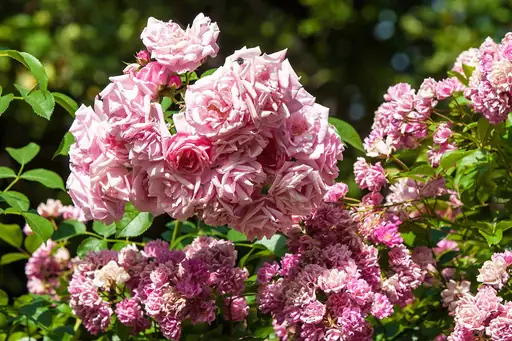
Some roses (Rosa spp.) rebloom, and some don’t. Some never stop sending out blossoms from spring until fall.
You can make generalizations about a rose’s behavior based on what type it is, and find more information on rose types here.
Floribundas, for instance, tend to continually bloom all season long. But some take a break between flushes.
China roses, hybrid musks, many climbers, minifloras, and most modern shrubs rebloom or bloom continuously.
Hybrid teas send out blossoms, fade for six or seven weeks, and then bloom again.
Sweet Drift
Sweet Drift® is a compact variety that produces tons of pink blooms from spring to frost.
Check out our guide to growing roses for more.
18. Weigela
Weigela (Weigela spp.) don’t normally rebloom, but breeders have managed to create a few that will put on a second performance.
The Sonic Bloom series is perhaps the best known.
Proven Winners has also bred their own “Wine” line of W. florida cultivars under the names Wine & Roses (‘Alexandra’), Fine Wine (‘Bramwell’), Spilled Wine (‘Bokraspiwi’), Midnight Wine (‘Elvera’) and Wine & Spirits (‘SMNWFGC’).
Sonic Bloom Red Weigela
Learn more about growing weigela shrubs here.
19. Wisteria
While most wisteria (Wisteria spp.) bloom once in the year and are done until next spring, some rebloom a second time in the summer.
The second flush may be a bit smaller, but it’s always impressive.
I always feel so lucky to be able to enjoy the weeping racemes, but being able to revel in them twice a year is downright awesome.
‘Amethyst Falls’ Wisteria
‘Amethyst Falls’ and ‘Blue Moon,’ for example, will return two or three times each season without any help on your part.
Learn how to grow and care for wisteria here.
Choose Flowers that Return for an Encore Performance
See? There’s no reason to mourn the end of your favorite flowers early in the season.
There are so many cultivars and hybrids in addition to some marvelous natural rebloomers, that we can keep enjoying when other gardeners are kissing their petals goodbye.
Which of the options on this list are calling your name? Do you have a favorite rebloomer that we missed? Share with us in the comments.
If you’re looking for some species of flowers that will bloom continuously all season, we have a few other guides that might be of interest:
- Grow Sweet Alyssum for a Long Season of Fragrant Blooms
- How to Grow Fabulous Fuchsia Flowers
- How to Grow and Care for Marigold Flowers
- Facebook54
- X




Vragen en discussie