

Deze pagina wordt in de oorspronkelijke taal weergegeven. Een vertaling is nog niet beschikbaar.
De Seedsun-selectie
Camellia sinensis
SKU: CAME-SINE-01G
This is the tea plant. Not a tea plant but the tea plant. Every cup of green tea, black tea, white tea, oolong, and pu-erh on Earth comes from a single species, Camellia sinensis. The differences in flavor and color come from the timing of the harvest and the way the leaves are handled afterward:.
Vraag een offerte op maat aan.
Prijzen, verpakkingsgroottes en beschikbaarheid worden bevestigd in uw persoonlijke offerte. Het versturen van een aanvraag is geen betaalde bestelling.
Informeer naar de geschiktheid, zaai- en kweekvereisten.
Bevestig de leveringsopties en benodigde documenten in uw offerte.
Over deze variëteit
This is the tea plant. Not a tea plant but the tea plant. Every cup of green tea, black tea, white tea, oolong, and pu-erh on Earth comes from a single species, Camellia sinensis. The differences in flavor and color come from the timing of the harvest and the way the leaves are handled afterward: green tea from the youngest leaves, briefly steamed; white tea from the unopened buds; black tea from fully oxidized older leaves; oolong from partial oxidation. One plant, many fates.
People have cultivated the species in China for at least three thousand years. The native range is debated, somewhere in the borderlands where southwestern China meets Myanmar, northeast India, and the eastern Himalayas, but humans have moved the plant for so long that a clean point of origin is essentially impossible to recover. Tea began as Buddhist monastic practice, became court refinement, and is now the most-consumed beverage in the world after water. Camellia honors Georg Joseph Kamel, a seventeenth-century Moravian Jesuit who worked as a pharmacist and naturalist in the Philippines and wrote widely about Asian plants, though he never actually saw a tea plant; Linnaeus named the genus for him anyway.
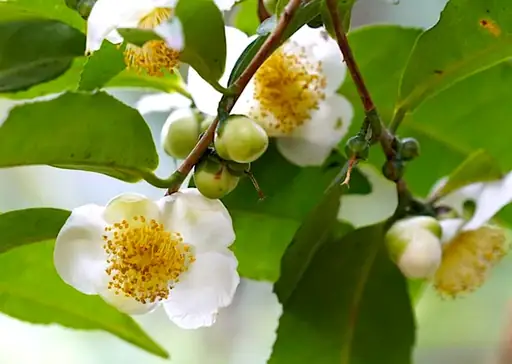
What admirers of the showy japonica and sasanqua camellias do not always realize is that Camellia sinensis is a fine ornamental in its own right. The leaves are smaller, narrower, and more refined than the glossy paddles of the ornamental species, fine-toothed, deep green, with a willow-like texture. Small fragrant white flowers, each with a generous boss of yellow stamens, open from late fall into early winter, often half-tucked under the foliage like a quiet detail. The plant takes well to hedging, shaping, foundation use, container growing, or simply being left alone to round out at four to eight feet. Hardier than the ornamental camellias, the small-leaved Camellia sinensis var. sinensis that grows is reliably hardy through zone 7 and has been pushed into zone 6b with shelter.
For Southerners the plant carries an unexpected regional weight: South Carolina is home to the only commercial tea plantation in the continental United States, the Charleston Tea Garden on Wadmalaw Island, less than two hours from Aiken, growing Camellia sinensis for tea since the 1960s. Plant a few in the garden and you join a small, very Lowcountry tradition. A mature, well-kept plant will produce tea for a hundred years.
For the gardener who wants an ornamental that also does something useful, the collector ready to add the species that started it all, or anyone who has ever wanted to step out the back door, snip a handful of new leaves, and brew a pot.
Er valt nog veel meer te ontdekken



Vragen en discussie