

Deze pagina wordt in de oorspronkelijke taal weergegeven. Een vertaling is nog niet beschikbaar.
De Seedsun-selectie
Cephalanthus occidentalis
SKU: CEPH-OCCI-01G
Buttonbush is the shrub that fishermen know and gardeners forget. Along every slow river and pond margin from Nova Scotia to Florida and west into Texas, Cephalanthus occidentalis stands with roots in the water and flowers in the sun, and from June into August those flowers are unlike anything else.
Vraag een offerte op maat aan.
Prijzen, verpakkingsgroottes en beschikbaarheid worden bevestigd in uw persoonlijke offerte. Het versturen van een aanvraag is geen betaalde bestelling.
Informeer naar de geschiktheid, zaai- en kweekvereisten.
Bevestig de leveringsopties en benodigde documenten in uw offerte.
Over deze variëteit
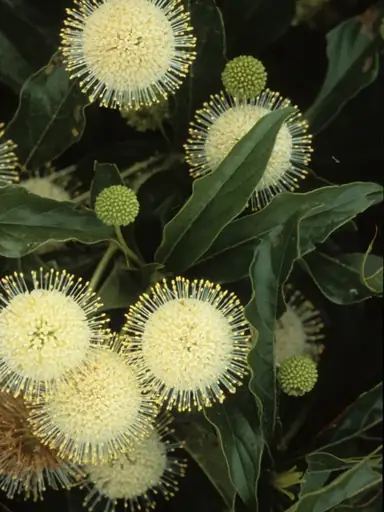
Buttonbush is the shrub that fishermen know and gardeners forget. Along every slow river and pond margin from Nova Scotia to Florida and west into Texas, Cephalanthus occidentalis stands with roots in the water and flowers in the sun, and from June into August those flowers are unlike anything else in the native flora: perfect creamy-white spheres about an inch across, each one a pincushion of tiny tubular blooms with the styles sticking out like pins, honey-sweet and so thick with bees, swallowtails, and skippers that the whole shrub seems to hum. The name is older than the science. Colonial Americans saw the globes and called the plant buttonbush, or honey-balls, or in the Carolina lowcountry, globe-flower; Linnaeus took the Greek for head (kephale) and flower (anthos) and made the name official in 1753.
Buttonbush had a working life long before any garden. The Choctaw, Seminole, and Meskwaki all used the bitter bark in decoctions, and nineteenth-century physicians sold the bark as a quinine substitute during the malaria years in the river valleys, with the caution that the leaves carry glycosides and are not for eating. Beekeepers have always counted buttonbush among the great summer honey plants, and waterfowl hunters know the dense thickets as the place wood ducks nest and mallards feed on the round, nutlet-studded seedheads that ripen reddish-brown and hang on through winter.
In the garden the plant is a broad, rounded deciduous shrub of six to twelve feet, open and a little rangy if left alone, easily limbed up into a small multi-stemmed tree with handsome fissured bark. Buttonbush will stand in a foot of water through the growing season and survive weeks of flooding, which makes this the shrub for the one spot nothing else tolerates: the rain garden overflow, the pond edge, the ditch line, the low corner where the downspouts meet. Given ordinary moist garden soil and sun, the shrub behaves perfectly well in a border too. Cut hard in late winter if a tighter shape is wanted; flowers come on new wood, so nothing is lost.
Plant buttonbush where a July afternoon can be spent watching. Pair with Hibiscus coccineus, Itea virginica, and Lobelia cardinalis for a wet-foot border that runs from June to frost, or set a single plant at the water's edge and let the reflection double the globes. Few natives give this much to this many, and almost none do so in standing water.
Er valt nog veel meer te ontdekken



Vragen en discussie