

Ta strona jest wyświetlana w oryginalnym języku. Tłumaczenie nie jest jeszcze dostępne.
Selekcja Seedsun
Gordonia lasianthus
SKU: GORD-LASI-01G
Read the full plant profile, with design and field notes, on our blog.There are trees that feel as though they were written into the land's original scripture, and Gordonia lasianthus, the loblolly bay, is one of them: a native evergreen of the Southern coastal plain whose white flowers gleam like.
Poproś o indywidualną wycenę
Ceny, rozmiary opakowań i dostępność zostaną potwierdzone w Państwa indywidualnej wycenie. Wysłanie zapytania nie oznacza złożenia opłaconego zamówienia.
Zapytaj o przydatność, wymagania dotyczące siewu i uprawy.
Potwierdź opcje dostawy i wymagane dokumenty w swojej ofercie.
O tej odmianie
Read the full plant profile, with design and field notes, on our blog.
There are trees that feel as though they were written into the land's original scripture, and Gordonia lasianthus, the loblolly bay, is one of them: a native evergreen of the Southern coastal plain whose white flowers gleam like prayers unfolding in the heat of high summer.
This noble member of the tea family, Theaceae, shares kinship with the celebrated camellias and with Franklinia alatamaha, that long-lost ghost tree of Georgia's riverbanks. But unlike the mythic cousin, the loblolly bay has remained a quiet and constant presence, thriving in the moist, acidic soils of pinewoods, boggy hollows, and sandy seepage slopes from Virginia to eastern Texas.
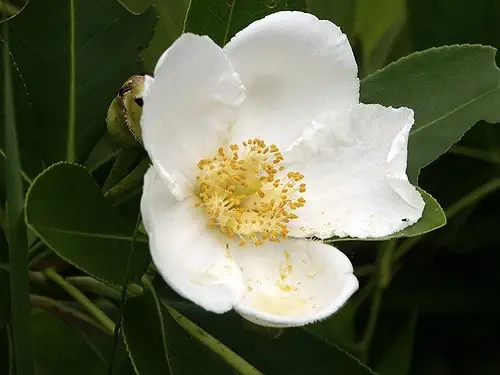
Reaching a stately height in the wild, often thirty to sixty feet, the tree grows straight and tall with smooth gray bark and a narrow crown. The evergreen leaves are glossy and lance-shaped, catching light like bayonets, while the flowers, large, pure white, and golden-throated, open in succession from early summer into August. Each bloom lasts but a day, yet the steady procession brings a quiet brilliance to the woodland edge when most other native trees have long finished flowering. Early American botanists exploring the southeastern wilderness admired the tree, and William Bartram praised the grace of the loblolly bay in the wet pine savannas of Florida.
Gordonia can be particular in cultivation, but rewards the careful gardener. The tree prefers moist yet well-drained sandy soils, especially along seeps and natural woodland slopes, and will not abide standing water or heavy, compacted ground, where the plant languishes or perishes. Given the right site, though, the loblolly bay grows straight and tall, flowers faithfully, and offers a taste of the native grandeur of the Southern wilderness.
Photos courtesy of Will Cook and Scott Zona.
Więcej do odkrycia



Pytania i dyskusja