

Ta strona jest wyświetlana w oryginalnym języku. Tłumaczenie nie jest jeszcze dostępne.
Selekcja Seedsun
Helleborus argutifolius
SKU: HELL-CORS-01G
Among hellebores the Corsican is the architect. Stout pale green stems rise two to three feet and arch outward, clothed the whole length in leathery trifoliate leaves, each leaflet edged with hard spines that give the plant a distinctly holly-like bite. From midwinter into spring those stems finish.
Poproś o indywidualną wycenę
Ceny, rozmiary opakowań i dostępność zostaną potwierdzone w Państwa indywidualnej wycenie. Wysłanie zapytania nie oznacza złożenia opłaconego zamówienia.
Zapytaj o przydatność, wymagania dotyczące siewu i uprawy.
Potwierdź opcje dostawy i wymagane dokumenty w swojej ofercie.
O tej odmianie
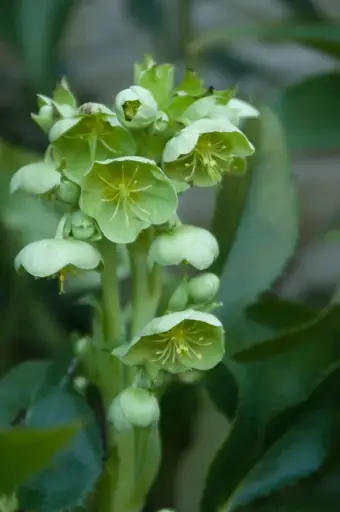
Among hellebores the Corsican is the architect. Stout pale green stems rise two to three feet and arch outward, clothed the whole length in leathery trifoliate leaves, each leaflet edged with hard spines that give the plant a distinctly holly-like bite. From midwinter into spring those stems finish in wide open clusters of nodding bowls, apple green to chartreuse, an inch and a half across, holding on the plant for weeks and often months and aging slowly to a soft parchment green rather than dropping.
The accepted name is now Helleborus argutifolius, from the Latin argutus, sharply toothed, though gardeners have used H. corsicus so long that both names still travel together, and older references file the plant as H. lividus subsp. corsicus. The wild range is small and specific: Corsica and Sardinia, on rocky maquis slopes and open woodland edges. Botanically this species belongs to the caulescent hellebores, the small group that carries leaves and flowers on one stem rather than sending each up separately from the crown. Every stem lives two years, growing through the first and flowering in the second before giving way to a replacement already waiting at the base.
The genus name is a warning label. Helleborus comes from the Greek helein, to injure or destroy, and bora, food. Classical medicine read the warning as an invitation. Pliny and Dioscorides both describe hellebore preparations, and the myth of Melampus curing the maddened daughters of Proetus with hellebore gave the ancient world a byword for treating insanity; the town of Anticyra, where the plant grew abundantly, traded on that reputation for centuries. The species involved were chiefly the black hellebore, H. niger, and relatives rather than the Corsican, and the treatments were violently purgative and occasionally fatal. Every part of every hellebore carries irritant and cardiotoxic compounds. Wear gloves when cutting, keep the sap off skin, and grow this one strictly as an ornamental.
Design work is where the Corsican earns a place the flowers alone would not justify. The evergreen structure is the point: a coarse, spiny, glaucous mound that holds shape through every month and reads beautifully against fine texture, against ferns, epimedium, hakone grass, and the smooth leaves of hosta and the stemless hellebores. Part shade suits best in the South and more sun the further north you garden. Drainage must be sharp, since this is a Mediterranean hillside plant that resents wet feet far more than cold. Cut each flowered stem to the ground once the bloom finally goes over in late spring and the waiting shoots take over immediately. Seedlings turn up nearby and are worth keeping.
Więcej do odkrycia



Pytania i dyskusja