

Ta strona jest wyświetlana w oryginalnym języku. Tłumaczenie nie jest jeszcze dostępne.
Selekcja Seedsun
Ilex glabra f. leucocarpa
SKU: ILEX-GLAB-LEUC-01G
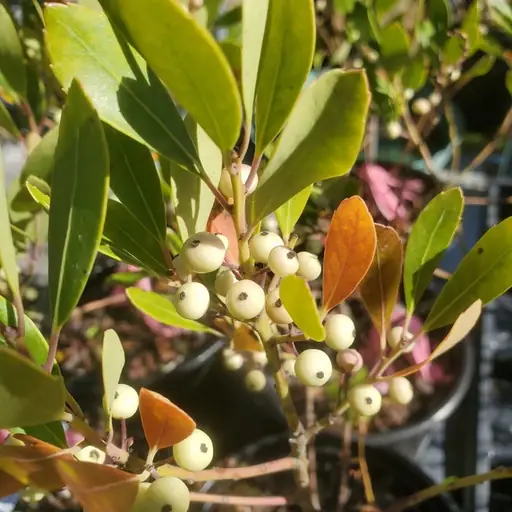
Ilex glabra f. leucocarpa is the white-berried surprise among the inkberries, a native evergreen holly that trades the usual near-black fruit for berries of clean ivory white. On the ordinary inkberry the dark berries all but vanish against the deep green leaves, but here the pale fruit stands out.
Poproś o indywidualną wycenę
Ceny, rozmiary opakowań i dostępność zostaną potwierdzone w Państwa indywidualnej wycenie. Wysłanie zapytania nie oznacza złożenia opłaconego zamówienia.
Zapytaj o przydatność, wymagania dotyczące siewu i uprawy.
Potwierdź opcje dostawy i wymagane dokumenty w swojej ofercie.
O tej odmianie
Ilex glabra f. leucocarpa is the white-berried surprise among the inkberries, a native evergreen holly that trades the usual near-black fruit for berries of clean ivory white. On the ordinary inkberry the dark berries all but vanish against the deep green leaves, but here the pale fruit stands out cleanly and holds on the branches from fall right through to spring, a quiet, unexpected show in the winter garden.
The name is worth getting right, because the trade almost never does. This is a botanical form, published by F. W. Woods in Rhodora in 1956, not a cultivar, so the correct styling is f. leucocarpa in lower-case italics rather than a name in single quotes. Kew now treats the form as a synonym of the species outright, on the reasonable ground that a white-fruited plant is still an inkberry. We keep the name because the fruit color is the entire reason anyone seeks the plant out. Glabra means smooth, for the neat, spineless, glossy leaves that set inkberry apart from the prickly hollies, and leucocarpa means white-fruited.
Behind the novelty stands one of the finest native broadleaf evergreens of eastern North America, ranging along the coastal plain from Nova Scotia to Florida and west to the Gulf, growing in sandy, acid, often boggy ground. The small greenish-white flowers open in May and June and matter most to the bees: inkberry nectar yields the celebrated gallberry honey, a mild, light honey long tied to the pinewoods and bogs of the South. As with any holly, the white berries appear only on pollinated female plants, so a male inkberry set nearby is needed to insure the crop.
Neat, rounded, and evergreen, inkberry works as a low informal hedge, a foundation planting, a massing in a rain garden, or a companion to azaleas, camellias, and other acid-loving plants. Give the roots moist, acidic soil in sun to part shade and keep the ground from drying out. Two honest cautions come with the species. Inkberry suckers steadily from the roots and will drift into a colony, which is a virtue in a mass planting and a nuisance beside a path. And every inkberry goes bare-legged with age, dropping the lower leaves and losing the billowy look of a young plant; the answer is selective renewal pruning in early spring, cutting old stems to the base, rather than shearing the outside and hoping.
Więcej do odkrycia



Pytania i dyskusja