

Ta strona jest wyświetlana w oryginalnym języku. Tłumaczenie nie jest jeszcze dostępne.
Selekcja Seedsun
Sarcandra glabra
SKU: SARC-GLAB-01G
This plant is a botanical time machine. Sarcandra glabra belongs to the Chloranthaceae, a flowering-plant family with only four surviving genera worldwide and a fossil record reaching back into the Early Cretaceous, more than a hundred million years ago. Pollen and floral fossils of the.
Poproś o indywidualną wycenę
Ceny, rozmiary opakowań i dostępność zostaną potwierdzone w Państwa indywidualnej wycenie. Wysłanie zapytania nie oznacza złożenia opłaconego zamówienia.
Zapytaj o przydatność, wymagania dotyczące siewu i uprawy.
Potwierdź opcje dostawy i wymagane dokumenty w swojej ofercie.
O tej odmianie
This plant is a botanical time machine. Sarcandra glabra belongs to the Chloranthaceae, a flowering-plant family with only four surviving genera worldwide and a fossil record reaching back into the Early Cretaceous, more than a hundred million years ago. Pollen and floral fossils of the Chloranthaceae are among the earliest evidence of flowering plants anywhere on Earth, and the family was already abundant when the dinosaurs were only in their middle age. Today Sarcandra is one of just four genera left from a lineage that once spread across what is now Portugal, Spain, and eastern North America, and most of that Cretaceous diversity is gone. The little plant in the garden is a quiet survivor of a family that mostly did not make it.
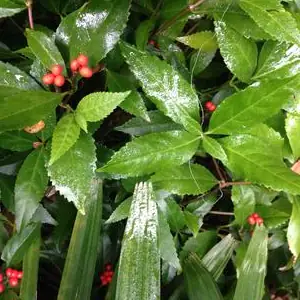
The plant is genuinely beautiful, too. Sarcandra forms a slow-spreading mound one to two feet tall, with elliptical, leathery, deeply serrated evergreen leaves that carry a hint of nandina without the legginess. The Chinese name Cao Shan Hu, grass coral, catches the point exactly: the small, bright orange-red drupes that ripen in autumn and hold through winter into spring, glossy and tightly clustered like miniature branches of coral against the leaves. Small yellowish flowers come in late spring, but the fruit is the show. Another Chinese name, Zhong Jie Feng, and the old Western name nine-knotted flower both come from the segmented, jointed stems.
The native range runs across the eastern half of Asia, from China, Japan, Korea, and Taiwan through Vietnam, Cambodia, and Malaysia to Sri Lanka, India, and the Philippines, wherever there are wet, shaded slopes and humid valley floors. In China the plant has served in traditional medicine for a thousand years, above all for bruises, bone fractures, arthritis, and injury, a tradition set out in the fields below. In Japan the branches are one of the plants used for chabana, the spare flower arrangement of the tea ceremony, especially at New Year, paired with winter jasmine.
In a Southeastern garden Sarcandra glabra makes a refined evergreen groundcover for moist, deeply shaded ground, lovely with hellebores, hostas, hakone grass, ferns, wild ginger, and the smaller woodland camellias. Reliably hardy through zone 8, the plant pushes into zone 7 with shelter, though hard freezes can cut it to the ground, from which it usually returns in spring. Give the rich, moist, organic floor of a woodland understory, keep it out of drying full sun, and the plant rewards the effort with year-round structure and a coral-bright fruit display that runs for months.
For the gardener building a serious shade garden, the collector with a taste for evolutionary depth, or anyone who would like to grow something whose lineage has, in one form or another, come through every mass extinction since flowering plants began.
Więcej do odkrycia



Pytania i dyskusja