

Esta página é exibida em seu idioma original. A tradução ainda não está disponível.
A seleção Seedsun
Juglans nigra
SKU: JUGL-NIGR-01G
Juglans nigra, the eastern black walnut, is one of the great trees of eastern North America, a towering, long-lived hardwood native from the Appalachians and Midwest to the Mississippi Valley, most at home in deep, rich, moist but well-drained soils along river bottoms and fertile uplands. Large.
Solicite um orçamento personalizado.
Os preços, tamanhos das embalagens e disponibilidade serão confirmados em seu orçamento personalizado. O envio de uma consulta não implica na efetivação de um pedido pago.
Informe-se sobre a adequação, o período de semeadura e os requisitos de cultivo.
Confirme as opções de entrega e os documentos necessários em seu orçamento.
Sobre esta variedade
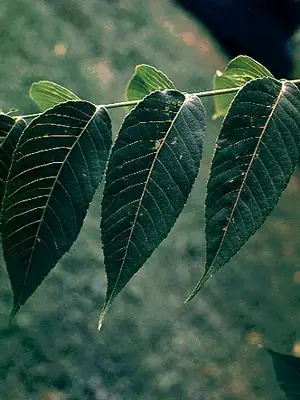
Juglans nigra, the eastern black walnut, is one of the great trees of eastern North America, a towering, long-lived hardwood native from the Appalachians and Midwest to the Mississippi Valley, most at home in deep, rich, moist but well-drained soils along river bottoms and fertile uplands. Large pinnate leaves cast a broad, airy shade in summer, leaf out late in spring, and drop early in fall to a soft gold, making way for the tree's most famous gift, the crop of hard-shelled nuts.
Those nuts, held in thick green husks, carry rich, oily kernels with a deep, distinctive flavor, a staple of traditional Southern and Appalachian baking and the essential note behind black walnut cake and brownies. The crop feeds wildlife as much as people: squirrels, turkeys, and other woodland creatures depend on the mast. The husks and bark also gave the eastern tribes and later settlers a lasting brown and black dye, and an ink that stains anything it touches.
Black walnut holds a long place in traditional medicine, spanning Native American and European folk practice. The Cherokee chewed the bark for toothache and brewed it as a mild laxative tea, and the green hulls, rich in juglone and tannins, were used as an astringent wash and a folk antifungal and antiparasitic, a use that continues in herbal traditions today. Modern study confirms that juglone has antimicrobial activity, though rigorous clinical evidence is limited. This is traditional-use and early-research information, shared for interest only, and not medical advice.
The dark, fine-grained heartwood is among the most valuable of all American hardwoods, long prized for furniture, cabinetry, gunstocks, and veneer, so that to plant a black walnut is to grow a living heirloom for generations to come. In the landscape the tree is best on large properties, reaching fifty to eighty feet and sometimes more, a majestic shade tree and orchard specimen. Site with care: the roots, leaves, and hulls release juglone, a natural compound that inhibits many plants within the root zone, so keep sensitive species such as tomatoes, azaleas, and rhododendrons well clear.
Há muito mais para descobrir.



Perguntas e discussão