

Esta página é exibida em seu idioma original. A tradução ainda não está disponível.
A seleção Seedsun
Pseudolarix kaempferi (amabilis)
SKU: PSEU-KAEM-AMAB-01G
Pseudolarix kaempferi, better known by the synonym Pseudolarix amabilis and the common name golden larch, is a rare, slow-growing deciduous conifer native to eastern China. Despite the name, the golden larch is not a true larch but the sole member of its own genus, Pseudolarix, prized for a.
Solicite um orçamento personalizado.
Os preços, tamanhos das embalagens e disponibilidade serão confirmados em seu orçamento personalizado. O envio de uma consulta não implica na efetivação de um pedido pago.
Informe-se sobre a adequação, o período de semeadura e os requisitos de cultivo.
Confirme as opções de entrega e os documentos necessários em seu orçamento.
Sobre esta variedade
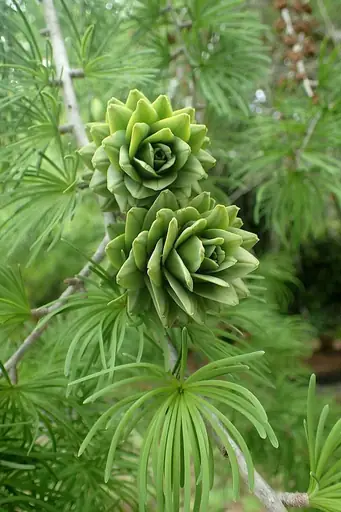
Pseudolarix kaempferi, better known by the synonym Pseudolarix amabilis and the common name golden larch, is a rare, slow-growing deciduous conifer native to eastern China. Despite the name, the golden larch is not a true larch but the sole member of its own genus, Pseudolarix, prized for a graceful broad-pyramidal form, soft texture, and a brilliant golden fall color that rivals any maple or ginkgo.
Through the growing season the tree is clothed in soft, spiraled tufts of bright green needles arranged in rosettes along the branches. In autumn the needles turn a rich, buttery yellow before dropping, leaving a stately, sculptural silhouette, and the bark exfoliates subtly with age to add winter texture.
In China the bark of the golden larch, known as tu jin pi, has a long place in traditional medicine as an antifungal wash for ringworm, athlete's foot, and other damp skin conditions, and modern study has taken an interest in the antifungal compounds behind that tradition.
Grow the golden larch as a specimen in well-drained, evenly moist soil and full sun, with shelter from drying winds in hotter climates. Slow and long-lived, the tree suits a large garden, an arboretum, or a naturalistic planting as a botanical showpiece, and rewards patience with one of the finest gold-conifer displays of the fall.
Photos courtesy of Suzanne Cadwell and Jim Robbins.
Há muito mais para descobrir.



Perguntas e discussão