
9 of the Most Beautiful Spiderworts to Grow as Houseplants
Spiderworts are very low maintenance houseplants that are ideal for beginning gardeners. They are also available in a dazzling array of unique cultivars. While in some regions, members of the Tradescantia genus can be invasive, the colors and easy-care nature make them ideal for displaying indoors.
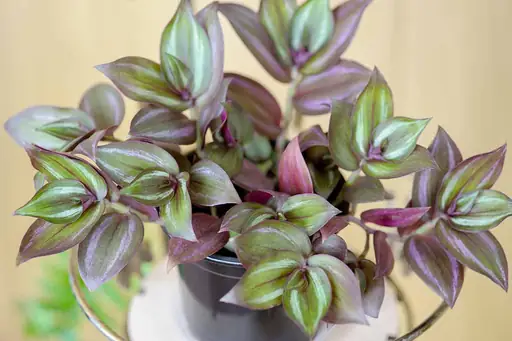
Spiderworts are very low maintenance houseplants that are ideal for beginning gardeners.
They are also available in a dazzling array of unique cultivars.
While in some regions, members of the Tradescantia genus can be invasive, the colors and easy-care nature make them ideal for displaying indoors or in pots on the patio.
There are around 85 species in the genus, though only about five or six are commonly grown as houseplants.
In our guide to growing spiderwort, we cover how to cultivate this tropical plant indoors.
In this article, we look at the diverse varieties that come in both solid and variegated foliage, and some truly lovely color combinations.
Here’s the lineup:
9 of the Most Beautiful Types of Spiderwort
1. Baby Bunny Bellies
2. Burgundy
3. Lilac
4. Moses in the Cradle
5. Nanouk
6. Purple Heart
7. Red Gem
8. Tricolor
9. White Velvet
1. Baby Bunny Bellies
‘Baby Bunny Bellies’ is a cultivated variety of T. chrysophylla, a species native to south and southeastern Brazil.
‘Baby Bunny Bellies’If you enjoy plants with soft textures like lamb’s ear (Stachys byzantine), I bet you’ll be delighted by the velvety leaves of ‘Baby Bunny Bellies.’
Also known as “speedy Jenny,” ‘Baby Bunny Bellies’ has oval-shaped green leaves with purple-pink undersides – and is covered with tiny hairs, which give this cultivar its soft texture.
2. Burgundy
‘Burgundy’ is a cultivated variety of T. zebrina, whose species name means “striped like a zebra.”
The species is also sometimes referred to by the alternate scientific names T. pendula, Zebrina pendula, or Cyanotis zebrina. In its native range, it thrives from Mexico to Colombia.
‘Burgundy’The ‘Burgundy’ cultivar of T. zebrina has leaves that are a deep burgundy hue with silvery green outlines on the top sides, and purple-colored undersides.
If you’re considering this for an addition to your cottage garden, it will grow outdoors as a perennial in Zones 8a to 12a.
3. Lilac
‘Lilac’ is a cultivar of the species T. fluminensis, also sometimes called T. albiflora.
The species, native to Brazil and Argentina, is also known as “striped inch plant.”
‘Lilac’ has creamy leaves striped with delicate touches of green and shows a delicate lilac colored blush.
‘Lilac’When ‘Lilac’ is in flower, its tiny blooms are just as advertised, with a soft pinkish purple hue.
This species is hardy as a perennial in Zones 9b to 12a, but take care before planting this one outdoors.
It is considered an invasive species in Australia, New Zealand, South Africa, and the southeastern United States.
That doesn’t mean you can’t enjoy it indoors though, no matter where you live.
4. Moses in the Cradle
While its foliage is already fairly interesting with its combination of green top sides and purple undersides, the truly fascinating part of T. spathacea is its flowers.
This plant’s flowers are enclosed in bracts, giving rise to its many common names – “Moses in a basket,” “boatlily,” and “oyster plant” – in addition to “Moses in the cradle.”
T. spathacea, also known as Moses in the cradle.This species was formerly classified taxonomically as Rhoeo spathacea.
While Moses in the cradle does not have a trailing growth habit like the other selections presented here, it looks beautiful as a houseplant and can still spill nicely over the edges of a hanging basket.
Although it’s hardy in Zones 9b through 11a, keep it indoors in Zones 9 and up, as it has invasive tendencies.
And if you have pets or small kids at home, make sure to treat this one with a bit of caution – it is described as moderately toxic by the experts at the NC State Extension.
5. Nanouk
Another variety of T. fluminensis, ‘Nanouk’ looks much like ‘Lilac’ with its thin green stripes and creamy white background, but has brighter pink accents than ‘Lilac.’
‘Nanouk’‘Nanouk’ has foliage with bright pink undersides, and its flowers are white with a pink blush at the tips of the petals.
It’s hardy (but, again, potentially invasive) when grown as a perennial in Zones 9b and 12a.
6. Purple Heart
Purple Heart is the common name of T. pallida ‘Purpurea,’ one of the most popular spiderworts.
Purple HeartThe lance-shaped leaves are a deep violet-purple, held on sprawling purple stems, and small pink three-petaled flowers appear at the stem tips during summer.
In low light the purple fades toward a muddy green and the stems stretch and flop so give it bright light. This one is hardy in Zones 7 to 11.
7. Red Gem
‘Red Gem’ is a cultivated variety of T. zebrina. The leaves are a rich burgundy purple, crossed by shimmering silver bands, with ruby red highlights that come out strongest in part sun.
‘Red Gem’The undersides are purple. In bright light the foliage flushes a deep purplish red.
Keep it somewhere sunny or you’ll lose the color entirely. In a dim corner the ruby tones fade and the leaves turn a duller purple.
Like the rest of the zebrina cultivars, it’s fast-growing and very forgiving, and it looks best trailing from a hanging basket.
It’s hardy outdoors in Zones 8a to 12a.
8. Tricolor
‘Tricolor’ is a cultivated variety of T. fluminensis, the species used to create both cultivars ‘Lilac’ and ‘Nanouk.’
‘Tricolor’ has foliage that is an attractive mix of green, cream, and pinkish purple.
‘Tricolor’Each leaf seems to have a different pattern and color combination – some leaves are nearly solid green, some mostly cream, and others have different degrees of striping and pink tints.
Variegation will be the best on this colorful plant when it’s exposed to bright, indirect light.
9. White Velvet
A cultivated variety of T. sillamontana, ‘White Velvet’ is an even fuzzier spiderwort than ‘Baby Bunny Bellies.’
‘White Velvet’Also known as “white gossamer plant” and “cobweb spiderwort,” ‘White Velvet’ is covered with silvery white hairs that give the leaves a fuzzy feel and appearance.
Previously classified as T. pexata, the species is native to northeastern Mexico.
A Fiesta of Foliage
From the soft leaves of ‘Baby Bunny Bellies’ and ‘White Velvet’ to the cradled flowers of Moses in a basket, the Tradescantia genus certainly gives us an intriguing selection of houseplants to choose from.
Which variety is your favorite? Although the species T. zebrina has a permanent place on my list of top houseplants, it’s going to have to make some room for the fascinating foliage of ‘Tricolor.’
Let me know yours in the comment selection below!
And if you’re looking for more houseplant inspiration, check out these articles next:
- Propagating Tradescantia: How to Root Spiderwort Cuttings
- 23 Colorful Houseplants to Warm Up Your Home This Winter
- 21 of the Most Stunning Species of Prayer Plants to Grow at Home
- Facebook20
- X




คำถามและการอภิปราย