
การคัดเลือกโดย Seedsun
Baptisia 'Grape Taffy' (FALSE INDIGO)
ขอใบเสนอราคาที่ปรับแต่งให้เหมาะสมกับความต้องการของคุณ

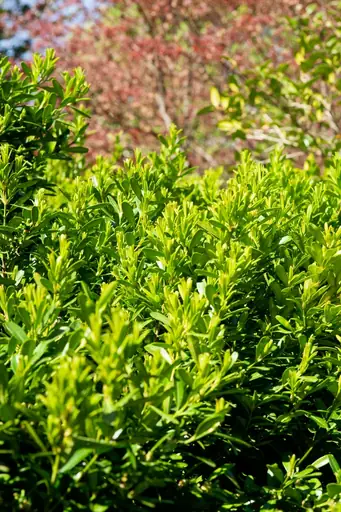
รหัสสินค้า: BUXU-HARL-01G
A small boxwood with narrow, bright green leaves and an unusually showy spring bloom, this is apparently the true Buxus harlandii. The boxwoods commonly sold in the South as B. harlandii, including the variety 'Richard', are, according to Dr. Todd Lasseigne, another Asian species, Buxus bodinieri;.
ราคา ขนาดบรรจุภัณฑ์ และความพร้อมจำหน่ายจะได้รับการยืนยันในใบเสนอราคาส่วนบุคคลของคุณ การส่งคำสอบถามไม่ได้หมายถึงการสั่งซื้อและชำระเงินเรียบร้อยแล้ว
A small boxwood with narrow, bright green leaves and an unusually showy spring bloom, this is apparently the true Buxus harlandii. The boxwoods commonly sold in the South as B. harlandii, including the variety 'Richard', are, according to Dr. Todd Lasseigne, another Asian species, Buxus bodinieri; the real harlandii is much less often seen.
The confusion is old and well documented. Henry Fletcher Hance described the species from Chinese material in the early 1870s, and on the herbarium sheet that anchors the name two different plants were mounted side by side, one the true harlandii and one a form of Buxus microphylla var. sinica. Generations of nurseries went on propagating the wrong half of the sheet. The name honors William Aurelius Harland, colonial surgeon at the Victoria Seamen's Hospital in Hong Kong and an early student of the local flora, who botanized around the harbor between hospital rounds and corresponded with Hance until his death in the late 1850s. In the wild the plant grows from Hong Kong and the Guangdong islands south to Hainan and into Vietnam, rooted among rocks and river cobble at low elevation, which explains both the appetite for sharp drainage and the dislike of hard winters.
acquired this plant from a small nursery in north Florida. The true Harland boxwood is best known to bonsai growers, who prize the fine bright foliage, the dense twiggy frame, and the handsome corky bark that ages faster than most box. Where common boxwood reads as a green mass, harlandii reads as a set of small deliberate lines, which is exactly what earns the plant a pot and a bench.
In the ground, use Harland boxwood as a low evergreen edger, a small specimen, or a container plant, where the compact two to three foot frame and bright narrow leaves can be appreciated up close. Well-drained soil in sun or semi-shade suits the shrub, good air movement discourages boxwood blight, and the deer leave the foliage alone. As with all box, the leaves are toxic if eaten, so site accordingly. An uncommon, choice boxwood for the warm-climate garden.
ขอใบเสนอราคาที่ปรับแต่งให้เหมาะสมกับความต้องการของคุณ

ขอใบเสนอราคาที่ปรับแต่งให้เหมาะสมกับความต้องการของคุณ

ขอใบเสนอราคาที่ปรับแต่งให้เหมาะสมกับความต้องการของคุณ

ขอใบเสนอราคาที่ปรับแต่งให้เหมาะสมกับความต้องการของคุณ
คำถามและการอภิปราย