
การคัดเลือกโดย Seedsun
Baptisia 'Grape Taffy' (FALSE INDIGO)
ขอใบเสนอราคาที่ปรับแต่งให้เหมาะสมกับความต้องการของคุณ

รหัสสินค้า: VACC-SEMP-01G
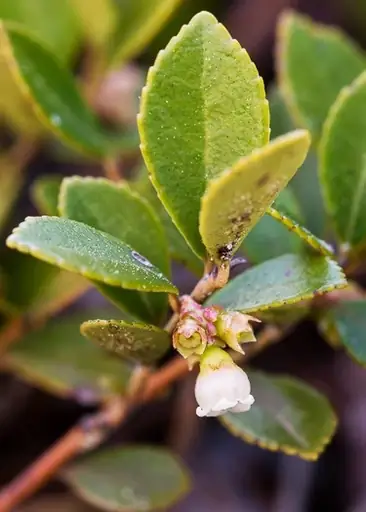
Vaccinium sempervirens is one of the rarest plants in this catalog, an evergreen blueberry known in the wild from a single sandy corner of Lexington County, in the Sandhills of South Carolina. A true local endemic, the plant grows along Atlantic white cedar bogs and seepage slopes where the water.
ราคา ขนาดบรรจุภัณฑ์ และความพร้อมจำหน่ายจะได้รับการยืนยันในใบเสนอราคาส่วนบุคคลของคุณ การส่งคำสอบถามไม่ได้หมายถึงการสั่งซื้อและชำระเงินเรียบร้อยแล้ว
Vaccinium sempervirens is one of the rarest plants in this catalog, an evergreen blueberry known in the wild from a single sandy corner of Lexington County, in the Sandhills of South Carolina. A true local endemic, the plant grows along Atlantic white cedar bogs and seepage slopes where the water table sits high and the sand stays acid, and to grow one is to hold a small piece of a landscape almost nobody has seen.
The plant came to botanical attention in 1980, when the botanists D. A. Rayner and J. Henderson described it as a distinct species and gave it the name that honors the first of them, Rayner's blueberry. Later taxonomists, W. B. Kirkman and J. Ballington among them, judged the plant a close cousin of the creeping blueberry rather than a species apart, and reduced it to Vaccinium crassifolium subspecies sempervirens, a reflection of both the kinship and the geographic isolation that set the plant on its own path.
Where the creeping blueberry runs flat along the ground, Rayner's blueberry stands more erect and arching, and carries noticeably larger, glossier, evergreen leaves. In the garden the plant takes the form of a graceful low shrub, trailing or upright to about two feet, hung in spring with the small white bells of the blueberries and, later, with small dark fruit. The evergreen foliage holds year-round interest that few native blueberries can match.
Give Rayner's blueberry the moist, acid, sandy, well-drained ground of the wild home, where water moves through but never stands, in full sun to part shade. Use the plant in a native or Piedmont-restoration planting, a collector's bed of southeastern rarities, or a naturalistic border where a storied evergreen groundcover is wanted. For the gardener drawn to the poetry of place, few plants carry so much history in so quiet a form, and every plant grown helps hold a vanishing South Carolina endemic in cultivation. Photos courtesy of Keith Bradley and Michael Kunz.
ขอใบเสนอราคาที่ปรับแต่งให้เหมาะสมกับความต้องการของคุณ

ขอใบเสนอราคาที่ปรับแต่งให้เหมาะสมกับความต้องการของคุณ

ขอใบเสนอราคาที่ปรับแต่งให้เหมาะสมกับความต้องการของคุณ

ขอใบเสนอราคาที่ปรับแต่งให้เหมาะสมกับความต้องการของคุณ
คำถามและการอภิปราย