
How to Grow and Care for Showy Garden Croton
Codiaeum variegatum Tropical garden croton, Codiaeum variegatum, makes a spectacular houseplant. A member of the Euphorbiaceae, or spurge, family, it’s not to be confused with the “true croton” species of the genus Croton, which belongs to the same family but looks completely different. If you’ve.
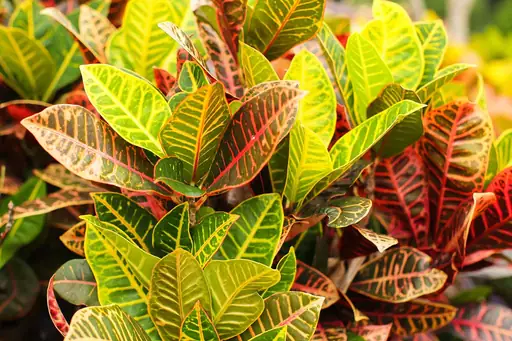
Codiaeum variegatum
Tropical garden croton, Codiaeum variegatum, makes a spectacular houseplant.
A member of the Euphorbiaceae, or spurge, family, it’s not to be confused with the “true croton” species of the genus Croton, which belongs to the same family but looks completely different.
If you’ve ever vacationed somewhere hot and humid, chances are you’ve spotted this plant lighting up the landscape.
Crotons are hard to miss, with their vivid foliage splashed in fiery shades that can rival a sunset.
Ready to grow your own? We’ll teach you how! Here’s what’s ahead in this article:
What You’ll Learn
Quick Look
How to Grow
Cultivars to Select
Maintenance
Propagation
Pests and Disease
Garden crotons are all about the leaves. Depending on the cultivar, they can be long and narrow, broad and oval, or twisted and curly.
Photo by Nan Schiller.Glossy and leathery, the foliage is painted in everything from bright yellow and lime green to deep burgundy, crimson, orange, and nearly black.
Some are speckled, others veined, and still others streaked with contrasting colors that look almost hand-drawn.
Quick Look
Common name(s): Croton, Joseph’s coat, tropical garden croton, rushfoil, variegated laurel
Plant type: Evergreen perennial shrub
Hardiness (USDA Zone): 10-12 (outdoors, elsewhere as houseplant)
Native to: Australia, Indonesia, Southeast Asia
Bloom time / season: Rare indoors, summer to fall outdoors
Exposure: Bright, indirect light
Soil type: Loose, organically-rich, well-draining
Soil pH: 6.0-7.0, slightly acidic to neutral
Time to maturity: 2-3 years
Mature size: 2-3 feet tall and wide indoors, up to 10 feet tall outdoors
Best uses: Houseplant, specimen plant, colorful accent in tropical gardens, patio container
Taxonomy
Order: Malpighiales
Family: Euphorbiaceae
Genus: Codiaeum
Species: Variegatum
They can produce flowers, but don’t expect much of a show. The blooms are tiny yellow clusters that dangle like little charms but next to the bold foliage, they’re easy to overlook.
Also known as rushfoil, Joseph’s coat, and variegated laurel, this slow-growing evergreen perennial is native to Australia and Southeast Asia.
Croton flowers are tiny, blooming down the length of a long stalk. Photo by Nan Schiller.In the wild, it can reach impressive sizes, but indoors it generally tops out at about three feet tall, making it a manageable yet eye-catching houseplant.
Crotons are true showstoppers, with their wild splash of color making them just as valuable indoors as they are in tropical landscapes.
Grown inside, they’re often used as bold statement plants, adding a pop of living color to corners, entryways, or sunny window spots.
Outdoors in USDA Hardiness Zones 10 to 12, crotons are equally dazzling as border shrubs or container features on patios and porches.
How to Grow
Choose a sunny placement with a south, west, or southwest exposure that is draft-free, and maintains a temperature above 60°F.
Photo by Nan Schiller.If your home lacks adequate daylight, you can try using a grow light. Garden crotons that don’t receive enough sunlight are likely to be less colorful.
Your new croton is likely to come in a grower’s pot. If you want to upgrade to a sturdier, more decorative container, choose one with one or more drainage holes and a drip tray.
Place a layer of pea gravel in the bottom of the pot, and fill with a good quality potting soil.
Miracle-Gro Indoor Plant Food
When the surface of the soil becomes dry to the touch, it’s time to water at soil level and mist the leaves.
You can leave a little water in the drip tray to add to the humidity in the environment.
Please note that garden croton is toxic if ingested, and its sap may cause skin irritation.
Cultivars to Select
There are so many different cultivars to choose from, it’s going to be tough to pick just one!
Here are a few of my favorites:
Banana
‘Banana’ sports elongated, twisting leaves are speckled and veined with yellow.
Dreadlocks
‘Dreadlocks’ has multi-colored, twisting, elongated leaves are accented with red and yellow.
Petra
This is the most common croton cultivar that you will find in many nurseries and garden centers. Elliptical green leaves are lavishly veined in yellow and red.
‘Petra’
Grower’s Choice
If you can’t pick just one, maybe try a Grower’s Choice assortment instead!
Costa Farms Croton Grower’s Choice Assortment, 4-Pack
Maintenance
Crotons grow slowly. Over time, you may notice that you need to water more frequently or that your croton isn’t as perky as it used to be. If so, may be time to repot.
To be certain, examine the drainage holes. If you see roots poking through, it’s time. Spring is the best time for repotting, as your plant is feeling especially vigorous.
Photo by Nan Schiller.This is where some folks err on the side of generosity, myself included.
When you repot a houseplant, choose the next size up, or in other words, a pot that is only an inch or two wider in diameter than the current container.
A pot that is too deep will encourage excessive root growth, rather than lush foliage.
To repot, first take note of how deep your plant sits in its old pot. You’ll want to replicate this depth in the new one.
Gently ease your plant out of its old pot, dirt and all. Remove most of the old potting mix and tease the roots apart.
A small croton in failing health after repotting. Photo by Allison Sidhu.Your new pot should be clean and have a drainage hole. Cover the bottom with pea gravel and pour in new potting medium to a depth of about one-third the total depth of the pot.
Center your plant in the new pot, at the same depth it was in the old pot. Holding the plant with one hand, use your other to fill in around it with potting medium.
Don’t fill to the top, but rather, leave a little space to prevent watering spillover.
Tamp down gently, water, and tamp again. Your freshly repotted plant may droop or drop leaves until it regains its composure.
Give it time to acclimate, and resist the urge to fertilize for at least a few weeks.
To prevent transplant shock, you can also water with tepid rather than cool or cold water.
Propagation
Friends are sure to admire your new favorite houseplant, so why not try your hand at propagation so you can give them one of their very own?
Photo by Nan Schiller.It’s easy! Here’s what you need to do:
- Wear gloves to prevent contact with stem sap, and select a branch with new growth.
- Use shears, like our favorite Felco F-2 pruners, to make a clean cut cross the branch about six inches below the tip.
- Remove the lowest leaves, if necessary, to reveal at least an inch of stem.
- Place your cutting in water or rooting medium until roots form. This may take several weeks.
When roots have developed, pot as described above, and your new plant (or plants) will be ready to go!
Pests and Disease
A healthy croton is not prone to disease or insects. However, a plant weakened by too much or too little water, or one that is shocked by a change in environment, may be vulnerable to aphids, mealybugs, scale, or spider mites.
Periodically wipe your plant’s leaves down with a soft, damp cloth. You’ll not only keep them glossy, but if there’s trouble brewing, you’ll see it right away.
And if you do notice pests, try spraying them away with neem oil.
In oversaturated conditions, these plants my succumb to root rot, which may be abiotic or caused by pathogens.
Learn more about how to deal with root rot here.
A Croton to Love
I know you’re going to love having a garden croton in the house. Let me tell you about the one that lives at ours.
Photo by Nan Schiller.When my daughter arrived at college, the freshmen were given a tiny plant for their dorm room windowsills.
She received a C. variegatum ‘Petra.’ Most of the students’ plants didn’t live to see Christmas, but my daughter’s not only survived, it thrived, and she named it “Jules.”
Jules came home in May and went back to school in August for four years, and never dropped her leaves. This girl was a champ!
All was well until the day I went in and found her down to one leaf. Did I forget to water, or was she unhappy with her new surroundings?
Either way, I am happy to report that crotons are quite resilient, and with a little TLC from my dad’s very green thumb, Jules made a full recovery.
If you’ve never grown a big houseplant, now’s the time to make room for garden croton. It’s sure to become part of the family!
Feel free to share your comments, questions, and advice in the comments section below.
And for more houseplant care tips, be sure to check out these guides next:
- Houseplant Propagation for Beginners
- 21 of the Best Houseplants for Bright Light
- Houseplant Primer: A Guide to Basic Care and Durable Plants
- Facebook112
- X




Sorular ve tartışma