
5 Spider Plant Diseases and Disorders and How to Solve Them
When I say that spider plants (Chlorophytum comosum) are relatively disease-free, I’m not kidding. There are very few diseases that will ever bother them. You’re far more likely to encounter spider mites or some other pest than to ever see a disease affecting your spider plant. You might run across.
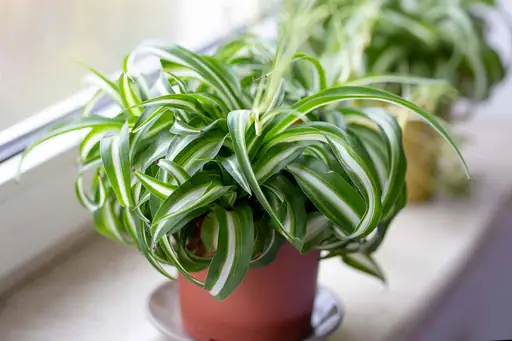
When I say that spider plants (Chlorophytum comosum) are relatively disease-free, I’m not kidding.
There are very few diseases that will ever bother them. You’re far more likely to encounter spider mites or some other pest than to ever see a disease affecting your spider plant.
You might run across a few physiological issues, though. Overwatering is particularly dangerous, and is the most common cause of problems in these houseplants.
Our guide to growing spider plants covers everything you need to know about care and cultivation.
In this guide, we’ll talk about the diseases and disorders that can trouble spider plants. Here’s the lineup:
Common Spider Plant Disorders
1. Leaf Spot
2. Root Rot
3. Tip Burn
4. Wilting
5. Yellow, Pale, or Solid Leaves
This list is short, but we’re going to cover a lot of important info, so let’s jump right in.
1. Leaf Spot
In theory, spider plants can suffer infections from pathogens such as Alternaria, Cercospora, Fusarium, and Phyllosticta spp., which cause leaf spots. But there have only been a few cases documented.
That doesn’t mean that it can’t happen, since researchers aren’t usually concerned with documenting the experience of home growers, but if it does happen, you have used up all your bad luck for the year, and you should buy yourself a lottery ticket.
If the leaves have brown, black, or yellow spots, not speckles, which could be the feces of a visiting pest, it’s possible the specimen is suffering from leaf spot disease.
To deal with it, grab yourself a good, broad-spectrum fungicide.
Copper fungicide is always a safe option, and so is Mycostop, which harnesses the bacterium Streptomyces strain K61, a beneficial pathogen present in sphagnum peat moss.
Mycostop Biofungicide
Be sure to follow the manufacturers direction for application.
2. Root Rot
If you’re going to be unlucky enough to run into a disease with your spider plant, root rot is the most common.
It’s caused primarily by overwatering, which deprives the roots of oxygen and essentially drowns them.
Or, it can be caused by the oomycete Pythium splendens, or the fungi Rhizoctonia solani or Sclerotium rolfsii, all of which thrive in wet, soggy environments.
The specific cause isn’t important, so don’t worry about trying to figure out which is the source of your woes. The important thing is to act quickly to resolve the situation.
Take your spider plant out of its pot and remove all the soil from around the roots. Trim away any dead or mushy roots.
Then wipe the container clean, and sterilize it with a mixture of one part bleach to nine parts water.
Repot the specimen with fresh, clean potting soil, and keep your watering habits in check going forwards!
Learn more about root rot prevention and treatment.
3. Tip Burn
If just the very tips of the leaves are brown and dry rather than the whole leaf, it’s most often a problem caused by either extremely low humidity or too much sun.
This species prefers bright, indirect light and humidity between 50 and 65 percent.
However, if the tips are brown and the browning continues to expand up the length of the leaf, that is more likely to be a result of too little light or overwatering.
Photo by Kristine Lofgren.I have a spider plant in a wide, shallow pot, and it’s a challenge not to overwater any specimen in a pot like that. There’s nowhere for the excess water to escape, so there is little room to make mistakes.
I tell you this as an illustration that overwatering isn’t just caused by watering too often or too much all at once, necessarily.
The type of container, time of year, light exposure, and relative humidity can impact how often a houseplant needs watering and how much water it requires.
You should always check the soil before adding moisture, especially if you are growing in a small or shallow pot.
4. Wilting
Wilting can be a sign of root rot, so check out that section above if the leaves are looking floppy and sad.
But root rot isn’t the only cause of drooping foliage. Both over- and underwatering, as well as too much sun exposure, can result in wilting.
Photo by Kristine Lofgren.We often assume that if a specimen is wilting, it needs more water. I know I’ve been guilty of making that assumption. But if you touch the soil and it feels moist, it’s more likely that it has been overwatered.
If that’s the case, you might be able to get away with withholding water for a while, but if it doesn’t start to perk up after a day or two, it’s time to act.
If the soil is wet, unpot the C. comosum and inspect the roots as discussed above.
Wilting can also indicate a pest problem like fungus gnats or spider mites, though with the latter you’ll usually see webbing or the physical presence of pests if that’s the case.
If the soil feels dry, the solution is easy. Just add water! We have a guide that discusses how to revive a wilting spider plant if you’d like to learn more.
5. Yellowing, Pale, or Solid Leaves
Sometimes, a specimen will start to look just a little bit sickly without any specific symptoms.
Maybe the leaves will turn yellow, or instead of vibrant green they’ll become pale. Other times, the leaves become solid green even though they’re supposed to be variegated.
Photo by Kristine Lofgren.If the leaves turn pale or lose variegation, it could be issues with sun exposure or the amount of water you’re giving, or your C. comosum could be underfed, and adding a dose of fertilizer may be all that’s needed.
Learn more about fading or loss of variegation.
Yellow leaves can indicate too much sun or overfertilization, a pest problem, overwatering, iron deficiency, or if the leaves are primarily toward the outside of the specimen, could just be older leaves that are getting ready to shed.
Learn more about troubleshooting yellow foliage.
No One Wants a Sickly Spider
Some people will say that such-and-such species is unkillable, and it feels awful when yours starts suffering.
I’ve been guilty of telling people that myself. But just because spider plants are known for being tough-as-nails, don’t feel bad if yours isn’t thriving.
It truly happens to all of us. I almost killed a spider plant because I was keeping it in an area that was way too dark, and I watered it too often. Now, hopefully, you feel like you have the skills to make yours happy again.
What issue are you facing? Do you still have any questions about how to fix the problem? Let us know in the comments section below
And if you want to expand your knowledge about spider plants, read these guides next:
- Are Spider Plants Toxic to Cats?
- Propagating Spider Plant Babies: 3 Methods to Root Spiderettes
- Do Spider Plants Bloom?
- Facebook16
- X
Sorular ve tartışma