

Bu sayfa orijinal dilinde gösterilmektedir. Çevirisi henüz mevcut değil.
Seedsun seçimi
Rhododendron colemanii
Ürün Kodu: RHOD-COLE-01G
Rhododendron colemanii, the Red Hills azalea, is one of the most recently recognized of all the native deciduous azaleas, first described as a distinct species only in 2008. For years the plant was folded in with the Alabama azalea, Rhododendron alabamense, which blooms earlier and holds.
Size özel fiyat teklifi isteyin.
Fiyatlandırma, paket boyutları ve stok durumu kişisel teklifinizde teyit edilecektir. Sorgulama göndermek ücretli sipariş anlamına gelmez.
Uygunluk, ekim ve yetiştirme gereksinimleri hakkında bilgi alın.
Teklifinizde teslimat seçeneklerini ve gerekli belgeleri teyit edin.
Bu çeşit hakkında
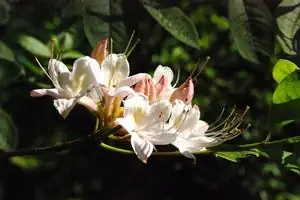
Rhododendron colemanii, the Red Hills azalea, is one of the most recently recognized of all the native deciduous azaleas, first described as a distinct species only in 2008. For years the plant was folded in with the Alabama azalea, Rhododendron alabamense, which blooms earlier and holds consistently white, yellow-blotched flowers; the Red Hills azalea, by contrast, flowers later and in a wider range of color. The species takes its home ground from the Red Hills country of the inner coastal plain, a narrow range across southwest Georgia and southern Alabama.
Blooming in mid to late May, well after most native azaleas have finished, the Red Hills azalea opens fragrant, tubular flowers that may echo the white-and-yellow of the Alabama azalea or run to white, pink, or soft yellow, with or without a blotch, so that no two plants are quite alike. The long-stamened blooms carry the sweet honeysuckle scent for which the wild azaleas are loved, and the late timing extends the native-azalea season into early summer. Green summer leaves close the year in yellow and bronze.
Restricted in the wild and still little known in cultivation, the Red Hills azalea is a genuine rarity, a plant that only recently stepped out of the shadow of a better-known cousin. Like all the Southern wild azaleas, the shrub is grown for fragrance and flower rather than the table: every Rhododendron carries grayanotoxins in leaf and nectar and should not be eaten by people or pets. The late, nectar-rich flowers feed bees and butterflies at a season when little else in the shade garden is in bloom.
A tall, multi-stemmed shrub reaching ten to twelve feet in time, the Red Hills azalea belongs at the woodland edge, along a shaded creek, or in a naturalistic native planting that mirrors the wild home on slopes and stream banks. Give sandy, acidic, well-drained soil, filtered light or morning sun with afternoon shade, and steady moisture without soggy ground. Set the shrub where the late fragrance can be caught, and pair with ferns, native phlox, and earlier-blooming azaleas so the season runs from first warmth into summer. Additional photos courtesy of Ron Miller.
Keşfedilecek daha çok şey var.



Sorular ve tartışma