

Bu sayfa orijinal dilinde gösterilmektedir. Çevirisi henüz mevcut değil.
Seedsun seçimi
Salvia koyamae
Ürün Kodu: SALV-KOYA-01G
Here is a salvia that wants what salvias are not supposed to want. Most of the genus comes from sunbaked Mediterranean hillsides, dry Mexican mountains, and dusty California chaparral, so that the very word Salvia is shorthand for full sun, gravelly soil, and a watering regime closer to neglect.
Size özel fiyat teklifi isteyin.
Fiyatlandırma, paket boyutları ve stok durumu kişisel teklifinizde teyit edilecektir. Sorgulama göndermek ücretli sipariş anlamına gelmez.
Uygunluk, ekim ve yetiştirme gereksinimleri hakkında bilgi alın.
Teklifinizde teslimat seçeneklerini ve gerekli belgeleri teyit edin.
Bu çeşit hakkında
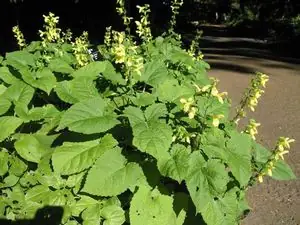
Here is a salvia that wants what salvias are not supposed to want. Most of the genus comes from sunbaked Mediterranean hillsides, dry Mexican mountains, and dusty California chaparral, so that the very word Salvia is shorthand for full sun, gravelly soil, and a watering regime closer to neglect than care. Salvia koyamae, endemic to the cool wooded slopes of Honshu in Japan, breaks every rule, asking instead for shade, moist humus-rich woodland duff, and the cool morning light that filters through a deciduous canopy. This is, in short, the salvia to grow where hostas would otherwise go.
The Japanese name, Shinano-akigiri, names both the plant's home and season: Shinano is the old name for the mountainous Nagano region where the species was first collected, and akigiri reads loosely as autumn paulownia, aki for autumn and kiri for the way the broad, arrow-shaped leaves echo the foliage of the paulownia tree. The species was formally described by Tomitaro Makino, the self-taught botanist often called the father of Japanese plant science, and named in honor of his colleague Mitsuo Koyama, the same man remembered in Picea koyamae, a small overlapping circle of late-Meiji Japanese botany.
The leaves are the first thing to catch the eye. Large for a salvia, six inches long and nearly as wide, softly hairy, arrow-to-heart-shaped, fresh green and lightly fragrant when bruised, they build a loose, low, almost groundcover-like clump that fills space generously through the season. From August into October slender spikes lift just above the foliage carrying the second surprise, pale butter-yellow tubular flowers, two-lipped and translucent, in a color almost no other salvia produces. Yellow is rare in the genus at all, and a yellow shade salvia is a small horticultural unicorn.
Pair the plant with hostas, hellebores, hakone grass, tiarella, heuchera, Iris cristata, the smaller ferns, and the spring ephemerals such as trillium, mertensia, and bloodroot that go dormant just as Salvia koyamae hits full stride. Genuinely rare even in the wild of its native Honshu, and uncommon enough in the Western trade to feel like a real find in a catalog, this is the salvia for the gardener whose sunny sage patch is full and whose shade beds want something no one else is growing.
Keşfedilecek daha çok şey var.



Sorular ve tartışma