

此页面以其原始语言显示,暂无翻译版本。
Seedsun 精选
Stewartia monadelpha
SKU: STEW-MONO-01G
Tall stewartia is an upright deciduous tree of medium size, and for most of the year the reason to grow one is the trunk. The bark sheds in thin flakes to leave a smooth surface of cinnamon and orange-brown, warm enough to pull the eye across a winter garden from some distance, and the effect only.
索取定制报价
价格、包装规格和供货情况将在您的专属报价单中确认。发送询价并不代表您已下单付款。
询问其适宜性、播种和生长要求。
请在报价单中确认送货方式和所需文件。
品种介绍
Tall stewartia is an upright deciduous tree of medium size, and for most of the year the reason to grow one is the trunk. The bark sheds in thin flakes to leave a smooth surface of cinnamon and orange-brown, warm enough to pull the eye across a winter garden from some distance, and the effect only improves as the tree ages. Abundant small white flowers follow in summer and the leaves turn red and purple in fall, but the bark is the long argument. Reckon on twenty to twenty-five feet in a garden, though in the forests of Japan the species has been recorded at eighty.
Two name stories meet in this tree. The genus honors John Stuart, third Earl of Bute, an eighteenth-century patron of botany whose name Linnaeus wrote down as Stewart, an error the rules of nomenclature have since made permanent. The epithet monadelpha means one brotherhood, and describes the stamens, which are fused at the base into a single tube rather than standing free. In Japan, where the tree is native to Honshu, Shikoku and Kyushu, the name is himeshara, princess shara, a diminutive of the shara given to the larger-leaved Stewartia pseudocamellia. That shara comes in turn from the sal tree of Buddhist tradition, under which the Buddha is said to have died; Japanese gardeners long ago transferred the association to a hardy local stand-in, and the stewartias have carried the borrowed name ever since.
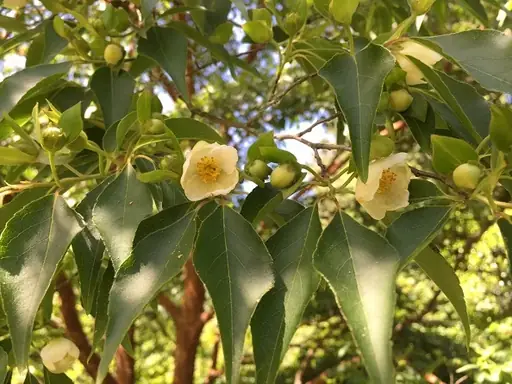
The flowers open through early and midsummer, white, cupped and camellia-like, an inch or so across with a boss of orange anthers at the center, and they are borne in real quantity rather than as an occasional event. Stewartia belongs to Theaceae, the tea family, alongside Camellia and the vanished Franklinia alatamaha, and the flower is where that kinship is most obvious. Among gardeners this species has a reputation as the most forgiving stewartia, more tolerant of ordinary garden conditions than a genus famous for sulking usually manages, which makes tall stewartia the sensible place to start for anyone who has killed one before.
Site the tree where the winter trunk will be lit and looked at, near a path, a drive, or a window, in moist, acid, well-drained soil with plenty of leaf mold, in morning sun with afternoon shade in the South. Stewartias resent root disturbance, so plant once and mulch well rather than shifting the tree around later. Underplant with ferns, epimedium and spring ephemerals that will not fight at the root, and leave the lower limbs high enough that the bark stays visible. Hardy through USDA zones 6 to 8. There is no ethnobotanical tradition here beyond the borrowed Buddhist name and a little use of the timber in Japan, which is fair enough for a tree grown honestly for beauty.
您可能也感兴趣



问题与讨论