

此頁面以其原始語言顯示,暫無翻譯版本。
Seedsun 精選
Spiraea virginiana
SKU: SPIR-VIRG-01G
Important: This plant is sold within South Carolina only.In the high-gradient streams of the southern Appalachians, the Gauley, the Bluestone, the Greenbrier, scattered tributaries of the New River, and a handful of similar second- and third-order rivers, grows a shrub that holds on to rocky bars.
索取客製報價
價格、包裝規格和供貨情況將在您的專屬報價單中確認。發送詢價並不代表您已下單付款。
詢問其適宜性、播種和生長要求。
請在報價單中確認送貨方式和所需文件。
品種介紹
Important: This plant is sold within South Carolina only.
In the high-gradient streams of the southern Appalachians, the Gauley, the Bluestone, the Greenbrier, scattered tributaries of the New River, and a handful of similar second- and third-order rivers, grows a shrub that holds on to rocky bars and scoured banks where almost nothing else can. This is Spiraea virginiana, the Appalachian spiraea, a plant that evolved alongside the violent flood regime of these mountain rivers and depends on that disturbance. The floods scour competing vegetation off the banks, expose mineral soil for germination, and break off rhizome fragments that float downstream to colonize new sites. Where the rivers were dammed, the floods stopped, and the spiraea began to disappear.
Spiraea virginiana has been federally listed as Threatened under the U.S. Endangered Species Act since 1990. Fewer than thirty genetically distinct individuals are known across the entire range, from Georgia and the Carolinas north through Tennessee, Virginia, West Virginia, Kentucky, and Ohio, though each of those individuals spreads into clonal colonies of dozens or hundreds of stems. The species was extirpated from Pennsylvania and Alabama, and persists in West Virginia in roughly 1,000 to 4,000 stems, mostly in the Gauley River Gorge below Summersville Dam, thought to be the largest surviving population in the world. Many populations have not set viable seed in living memory, because the plant is self-incompatible, requires cross-pollination from a genetically different individual to set seed, and most surviving stands are reduced to a single clone reproducing only by rhizome.
There is a bitter irony in the decline. One of the principal threats to Spiraea virginiana in the wild is Spiraea japonica, the Japanese spiraea, an introduced ornamental that has escaped cultivation and now displaces the native along Appalachian streams. The very plant most American gardeners picture at the word spiraea is helping push the native one toward extinction.
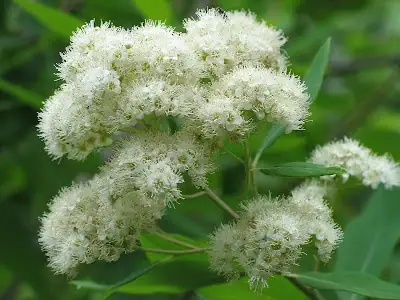
The shrub earns a place on looks alone: a three- to eight-foot deciduous plant with arching, slightly weeping stems, alternate lance-shaped leaves deep green above and distinctively powdery-white beneath, one of the diagnostic field characters, and broad, flat-topped clusters of tiny creamy-white flowers two to eight inches across, blooming from late May through July. Each small five-petaled, rose-family flower carries a soft greenish-yellow stamen disk that lends the clusters their warmth. In cultivation, Spiraea virginiana has proven forgiving and adaptable, far more tolerant of ordinary garden conditions than the wild habitat would suggest, with strong multi-year performance reported from the Georgia Perimeter College Native Plant Garden and from trials in Aiken.
This is one of those plants where the act of growing carries real weight. Cultivated stock from multiple genetic provenances is one of the few ways sexual reproduction can be restored to Spiraea virginiana in any meaningful sense. Wild populations have grown so reduced and so isolated that the species has effectively lost the ability to make seed in the wild; garden specimens sourced from genetically distinct populations, planted in proximity, can produce viable seed for the first time in decades. A conservation-minded gardener growing this shrub is not merely supporting a native species but maintaining a genetic reservoir that the wild populations can no longer maintain themselves. The plant suits the serious native-plant collector, the conservation gardener with a tie to the southern Appalachians, and the institutional buyer building a collection of southeastern endemics worth preserving.
Important: This plant is sold within South Carolina only.
您可能也感興趣



問題與討論