
Update Your Landscape: Get Creative with Garden Paths and Walkways
Gardeners have many reasons for building paths in their landscapes. Some are looking to provide more convenient passageway from Point A to Point B. Others may want easier access to plantings. Some gardeners may be looking for interesting and attractive ways to delineate different parts of their.
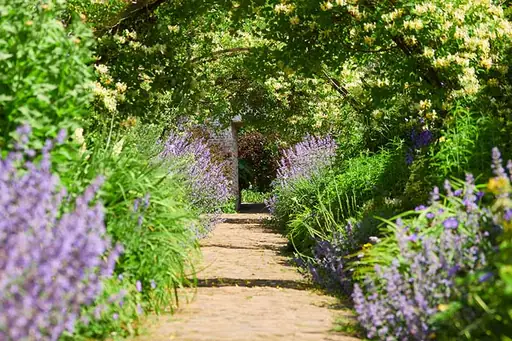
Gardeners have many reasons for building paths in their landscapes.
Some are looking to provide more convenient passageway from Point A to Point B. Others may want easier access to plantings. Some gardeners may be looking for interesting and attractive ways to delineate different parts of their gardens.
We started out with a basic suburban lot adorned with rectangles of homeowners-association-mandated sod, a small garden bed, and a few trees (we got extra trees because we’re on a corner lot – woohoo!).
Such a mundane gardenscape was nothing we’d ever be satisfied with, in the long term. But we’re not the types to sit down and design a landscape.
Nor did we want to have to submit plans and pay the $75 fee to the HOA for a “palette change.”
We embedded stepping stones in this crushed granite path, and used a bit of metal edging along the concrete path to try to contain the granite. As you can see, it’s not working very well. And the oaks are dropping their acorns like crazy! Photo by Gretchen Heber.So, our system of walkways just evolved over the years, largely due to these factors:
- Our 60+-pound dogs – being the intelligent beasts they are and wanting to get from A to B efficiently – wore their own paths through the grass, down to the dirt.
- Watering vast expanses of St. Augustine in Austin in summer is likely to result in bankruptcy.
- As our gorgeous Monterrey oaks matured, the grass underneath them got little sun and struggled to survive.
- We removed the railing from our house-wide front porch and wanted to create egress and ingress from the porch out into the yard and vice versa.
- The less lawn to mow, the better, right? Have you ever mowed grass in 100°F weather?
Additionally, we didn’t have the resources to build a whole system of paths in a single shot, so we just did one or so per season over several years.
This made the toll on the humans living here as well as the toll on our bank account easier to handle.
Design Your Way
Think about whether you want a natural, free-flowing design, with curved paths, or a more modern look with straight walkways at right angles to each other.
Then you’ll want to consider what material you will use to build your walkway. The possibilities are limitless.
Another path on our property. The gray rock to the left is just filler, because nothing grows back there.Some sort of edging will often be used. This can be natural rocks that you harvest from your property, or cut border stones purchased from a home improvement store or a rock yard.
Some paths are lined in bricks set at an angle into the ground.
Our rectangular landscaping stones have aged nicely.Clay Red Pavers
This five-inch by 40-foot edging offers a textured wood grain look.
Getting Started
This fast-drying formula is water-based and utilizes an inverted applicator for easy use.
As an alternative that’s a bit easier on the back, you can rent a gas-powered sod cutter and you’ll be sipping iced tea on the porch in no time flat.
What’s Underfoot?
If you do create a border, you’ll likely have some sort of “fill” material that forms the base of the path. This might be mulch of any of a variety of types or some sort of very small rocks, such as pea gravel or crushed limestone.
Plants can easily pop up through finer path material, but it’s hard to argue when it’s lovely rain lilies doing the popping.A caveat about using very small stone material: the weeds like it, too, and can easily pop through. They are less likely to plague paths made of larger stones, but those are harder to walk on.
Also, you want to choose angular, “broken” pieces that notch into each other, as opposed to rounded stones that slide against each other, creating an unstable walking surface.
Our neighbors created more modern-looking paths using large rectangular stones surrounded by black chipped rock. The lighter colored ones are newer because they had to be replaced after their teenaged son broke the originals by skateboarding on them.If you use a fine gravel as your base, you’ll want “water it in,” and then tamp it down using:
- A rented compactor
- Your husband or teenaged sons’ size-13 feet
Or you may simply use stepping stones, either tightly fitted together or placed here and there, and surrounded by grass, other plant material such as ground cover herbs, or gravel of some sort.
Bricks and paving stones are other options for the base of your path. For these options, you’ll want to scrape out enough soil to get the stones level with the surrounding turf or dirt, when embedded in a sand base.
Most of our paths are lined with rectangular pieces of limestone that we gathered (with permission) from construction sites as our neighborhood was being built. Others are edged by large rocks that we gathered from our property. We used decomposed (crushed) granite as the base of our paths.
This path is lined on one side by large stones we unearthed when digging holes for plants, and on the other with landscape timbers that frame our vegetable garden.Because granite is quarried in many parts of Texas, access to the byproduct pebbles is easy and affordable. And Texas granite is an attractive pink/red/orange color that adds beautiful contrast to the garden. Granite from other areas is colored differently.
A Yellow Brick Road of Your Own?
Whether you’re looking to simplify transit to various parts of your yard, hoping to add visual interest, or wanting to just cut down your mowing time, paths are an attractive way to accomplish all three.
Even if you live on a smallish plot of land, paths can add interest and practicality to your piece of paradise.
Photo © Ralph BarreraAre you inspired to create some pathways in your landscape? Or perhaps you have already? Tell us about them!
For more design inspiration for your garden, you might like these guides:
- Fall Garden Planting Design: Create an Autumn Oasis
- 15 Creative Uses for Bricks in Your Garden
- Facebook60
- X




Fragen und Diskussion