
How to Control Cabbage Loopers
Trichoplusia ni If your garden looks like the aftermath of a visit from the Very Hungry Caterpillar, you may be dealing with cabbage loopers. These green inchworms feed on a variety of garden crops, from kale to tomatoes, but as their name suggests, are particularly partial to your cabbages and.
Trichoplusia ni
If your garden looks like the aftermath of a visit from the Very Hungry Caterpillar, you may be dealing with cabbage loopers.
These green inchworms feed on a variety of garden crops, from kale to tomatoes, but as their name suggests, are particularly partial to your cabbages and other cole crops.
And like the Very Hungry Caterpillar, they can make an almighty mess.
Munching holes in the foliage, and burrowing into your precious cabbage heads, if left unchecked these pesky caterpillars can destroy your crop – unless you get there first.
When you have identified that it is in fact cabbage loopers and not some other type of pest that you’re dealing with, they’re pretty easy to control with a variety of methods.
Let’s take a look in a bit more detail. Here’s what I’ll cover:
What You’ll Learn
- Identification, Biology, and Life Cycle
- Distribution
- How to Manage Cabbage Loopers
- Cultural Controls
- Natural Enemies
- Biological Control
- Organic Pesticides
- Chemical Pesticides
Identification, Biology, and Life Cycle
The cabbage looper is the larval stage of the Trichoplusia ni moth, a member of the Noctuidae family.
The moth is grayish-brown in color, with a lighter-colored base and a single silver spot on the top of the wings. The body is approximately one inch long, with a wingspan of up to one and a half inches.
Adult Trichoplusia ni moth. Photo by Keith Naylor, via Bugwood.org.The moths themselves don’t do any damage as they feed on nectar, and they are generally active overnight or at dawn and dusk.
Photo by Whitney Cranshaw, Colorado State University, Bugwood.org.After they have done whatever the birds and bees (and moths) do, the female checks out your garden and identifies the most promising crops on which to lay her eggs. And that’s usually your brassicas.
All members of the Brassicaceae family, such as kale, turnips, broccoli, and cauliflower will be firmly in her sights.
The moths lay light green or yellow spherical eggs on the undersides of leaves. Sometimes they lay single eggs, and other times they lay small clusters. If you’ve got your ruler out, each egg measures 0.6 millimeters in diameter.
Whitney Cranshaw, Colorado State University, Bugwood.org.These eggs hatch in two to seven days, depending on the temperature. The warmer the temperature, the quicker they are to hatch.
When the larvae first emerge, they are white, and will probably go unnoticed unless you are very vigilant. As they chew their way through your leaves, they’ll turn green.
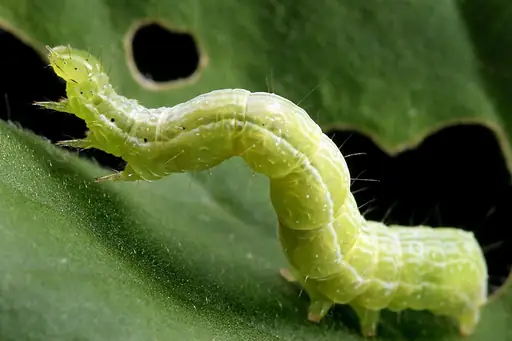
As they mature, the larvae are clearly identifiable as a green inchworm – typically one to one and half inches long – with a distinct white stripe on each side of the body.
Photo by R.J. Reynolds Tobacco Company , R.J. Reynolds Tobacco Company, Bugwood.org.They have six pairs of legs, three of these are near the head and the rest are situated towards the back of the abdomen, known as “prolegs.”
What’s the best way to be sure you’re dealing with cabbage loopers and not some other kind of caterpillar? Check how they move.
They arch their back into a distinctive loop and push the front part of the body forwards. Hence the name “looper.”
Cabbage looper demonstrating the distinctive “looping” motion. Photo by David Cappaert, Bugwood.org.But don’t spend too much time watching them move, because with every step (loop?) they’ll be taking another bite out of your crop.
In the early stages, the larvae only feed on the undersides of leaves. You’ll notice portions of the leaf that appear to be thin, referred to as a “windowpane” appearance.
Older larvae eat all the way through leaves, causing seemingly random, irregular holes. If you have a large infestation, they can completely defoliate your plant, or at the very least, stunt its growth.
You’ll typically see them on the leaves, but they can also burrow into the cabbage or broccoli heads.
These pests can consume three times their bodyweight per day, and will leave brown frass – sticky fecal matter – in their wake, contaminating your crop.
After about 20 days of making merry with your vegetables, the larvae will pupate, forming a fragile cocoon on the underside of foliage or in plant debris.
Photo by David Riley, University of Georgia, Bugwood.org.The pupa is generally about an inch long, and will start out green, gradually turning brown and then black.
Adult moths will emerge after four to 14 days, depending on the temperature, and the process will start all over again.
Distribution
Cabbage loopers are found throughout the US, although they only overwinter in warmer climates.
According to experts from the Entomology Department at the University of Florida, these pests can complete between two and seven life cycles each year.
Warmer temperatures lead to the completion of more life cycles, which means you’ll be dealing with them for most of the growing season.
In the south, this pest overwinters as an adult and some of these adults migrate north in the spring.
John L. Capinera from the University of Florida Department of Entomology and Nematology notes that it has been estimated that adult cabbage looper moths have a flight range of up to 125 miles.
How to Manage Cabbage Loopers
These pests mainly feed on brassicas but will also attack other crops including radishes, tomatoes, potatoes, spinach, lettuce, and beans.
Photo by Alton N. Sparks, Jr., University of Georgia, Bugwood.org.If you’re tired of seeing ragged leaves and loopy inchworms on your crops, there are a number of methods you can use to eradicate them.
An integrated pest management strategy (IPM) can help you manage pests sustainably. This can include the use of pheromone traps to monitor – and identify – adult populations and disrupt mating activity.
Cultural Controls
Cultural controls include the use of floating row covers early in the season to prevent the moths from laying eggs on your crops, encouraging birds and beneficial insects into your garden, and clearing out plant debris at the end of the season to prevent a repeat performance next year.
Photo by John Capinera, University of Florida, Bugwood.org.Check your crops regularly, and remove the eggs. If you have bought transplants from the nursery, inspect them carefully before planting or you may inadvertently introduce this pest.
Thoroughly inspect your plants’ leaves, top and bottom, and pick off the caterpillars by hand. You can feed them to your chickens as a special treat or drown them in a jar of soapy water and dispose of them in the trash.
Food grade diatomaceous earth can be effective in the case of a small infestation. Sprinkle it around and on the leaves of your plants – top and bottom. This will need to be reapplied after rain, and will not affect the adult population.
Natural Enemies
Beneficial predatory wasps, Trichogramma spp., will parasitize the eggs by laying their own eggs inside of them, which halts their development.
Trichogramma spp. Parasitic Wasps
You can release live parasitic wasps into your garden. The best time to do this is when you see the adult moths or eggs.
Another useful predator that attacks the eggs is the green lacewing, Chrysoperla rufilabris.
Green Lacewing Eggs
The lacewing larvae feed on the cabbage looper eggs and a variety of other insect pests, such as aphids, thrips, and whiteflies – bonus!
Biological Control
Biological control with Bacillus thuringiensis kurstaki (Btk) is effective. This is a soil bacterium that when ingested by the pest, will release a toxin that paralyzes the digestive system.
It is not harmful to humans, birds, pets, fish, or most beneficial insects.
Bonide® Thuricide
Btk affects the larval stage and is most effective when ingested shortly after hatching. It’s applied as a spray, and you’ll need to make sure you treat the entire plant, top and bottom of all leaves.
And check out our guide to learn more about B. thuringiensis and how it works.
Organic Insecticides
Organic broad-spectrum pesticides are available to control cabbage loopers, but you need to bear in mind that these can also kill beneficial insects, including honeybees and other pollinators.
Pyrethrin-based insecticides are made from plant extracts of some species in the Chrysanthemum genus. The spray will kill both the larvae and the eggs on contact.
PyGanic Insecticide
Spinosad is an insecticide that works by paralyzing the pest.
It’s a natural substance made by fermenting soil bacteria and is effective against a variety of pests including spider mites, leafminers, and ants.
Monterey Garden Insect Spray
Even though it’s listed as an organic insecticide by the Organic Materials Review Institute (OMRI), it is toxic to fish and bees.
Chemical Pesticides
As a last resort, you may decide to use chemical insecticides to manage an infestation.
Carbaryl, sold by Bayer as Sevin, is effective, but it will likely clear out any and all beneficial insects from your garden as well.
Another option is cyfluthrin, the active ingredient in Baythroid and Solfac.
If you do choose to use chemical treatments, always follow the manufacturer’s instructions. You can learn more about the safe application of chemicals in our guide.
Look Out for Loopers
If left unchecked, cabbage loopers can do significant damage to your crops, but once you’ve identified their presence they are relatively easy to control.
Photo by David Cappaert, Bugwood.org.Check your garden regularly for evidence of the adults, eggs, and the easy-to-identify inchworms. Picking them off by hand is effective but if you need some extra help, you can choose a control method that won’t harm beneficial insects and pollinators.
Have you had problems with cabbage loopers in your garden? Share your tips in the comment section below.
And for more information on pests that may damage your crops, you’ll need these guides next:
- How to Eradicate Cabbage Worms on Cole Crops and Crucifers
- Getting a Grip on Flea Beetles
- How to Keep Slugs Off Cabbage and Other Cole Crops
- Facebook28
- X
Questions et discussion