
Learn About Jackson & Perkins and Their Best Roses
Not so long ago, the idea of shipping roses across the country was almost unheard of. If you wanted a particular type, you bought it locally or you couldn’t buy it all. While I’m all for supporting local businesses, this was a rather limiting situation. Photo via Alamy. The company bred their own.
Not so long ago, the idea of shipping roses across the country was almost unheard of. If you wanted a particular type, you bought it locally or you couldn’t buy it all.
While I’m all for supporting local businesses, this was a rather limiting situation.
Photo via Alamy.The company bred their own roses and would send them to you even if you lived on the opposite coast. Suddenly, people could get their hands on hybrids that they’d never heard of before.
Imagine how exciting a time that would have been.
The company also worked hard at breeding new types of roses, and they’re responsible for the introduction of the fabulous floribunda category that fills so many catalogs.
Whether you support the ability to patent a plant or not, there’s no denying that it has resulted in some pretty incredible cultivation efforts and has no doubt brought us cultivars many of us never could have dreamed of.
If you’re a Rosa lover, your knowledge of the genus simply isn’t complete without knowing a bit about this popular and storied company.
We’re going to make you a J&P expert by chatting about the following:
What You’ll Learn
- Cultivars to Select
So let’s talk all things J&P…
Jackson.
They sold plants like strawberries, raspberries, and grapes wholesale and directly to retail customers.
By 1882, Charles was ready to expand, and roses topped the list of plants he wanted to explore. In 1884, Charles hired E. Alvin Miller to breed a new variety for the company to sell.
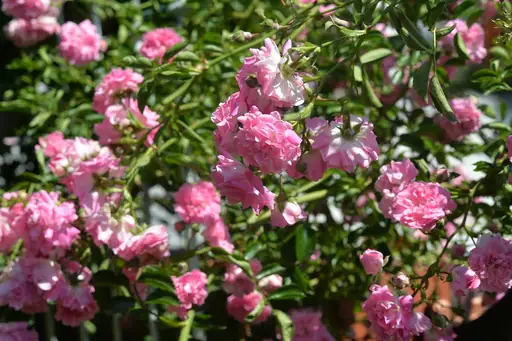
In 1901, ‘Dorothy Perkins’ was introduced to the world, and it has been a best-selling beloved variety ever since. This pretty pink rambler can be found in gardens across the globe.
The gamble paid off. From its founding until 1924, the company went from making an average of $10,000 a year to nearly $1,000,000.
When Charles’ nephew, C.H. Perkins, took over the business, he made roses an even larger focus for the company.
As part of that renewed effort, he brought in botanist Jean Henri Nicholas. When Dr. Nicholas died, his understudy, Eugene Boerner, continued this work.
Boerner collected thousands of cuttings from European growers and used them to develop what we now call floribundas.
He hybridized 60 different floribundas during his 45-year tenure, and his work led to establishment of the category now known as floribundas with the American Rose Society.
Boerner was succeeded by William Warriner, who developed another 100 hybrids.
The company also worked to establish a law that allowed them to patent their creations.
Over 40,000 plants were sent out to customers that year, and the first mail-order rose business hit the world.
In 1966, the company was bought out by the world’s largest mail-order fruit business, Harry and David, LLC.
The company continued to grow, and in 1973, their headquarters was moved to Tustin, California.
They ship over two million roses and other plants like forsythia and dogwoods annually. Today, J&P is owned by Western Capital Resources.
That makes sense, since they’re focused on mail order business.
If you’ve never purchased and planted a bare-root rose before, read our guide to familiarize yourself with the process.
Otherwise, their selections are similar to almost anyone else’s, with options ranging from dwarf plants to towering climbers, and delicate, elegant beauties to tough-as-nails hybrids.
Editorial credit: Slow Walker /While they initially specialized in floribundas, the company sells shrubs, climbers, hybrid teas, and more.
We walk you through the process of planting and growing roses in our guide if you’re looking for a place to get started.
Cultivars to Select
They carry some fantastic options, like ‘Mister Lincoln,’ Meilland’s perennial favorite ‘Peace,’ and my own favorite climber ‘Zephirine Drouhin.’
But let’s focus on some of their most popular, own-bred, beautiful hybrids:
Brigadoon
‘Brigadoon’ is a hybrid tea that stands out, with idyllic coral and cream blossoms that darken as they age.
The full flowers appear throughout the growing season on single stems, perfect for cutting.
At a tidy three feet tall, this cultivar does well both as a garden shrub and in containers.
Dorothy Perkins
The classics stick around for a reason.
‘Dorothy Perkins’ has been a beloved for decades because she’s so beautiful, blooming reliably starting in late spring with tons of dark pink double blossoms.
Hardy to Zone 4 and reaching up to 10 feet tall, this rambler needs support to look its best.
High Society
With large, double blossoms in small clusters and a heady damask fragrance, ‘High Society’ has a lot to offer.
This bright fuchsia pink climber can reach up to 14 feet tall in Zones 7 to 9. It’s a vigorous grower and will continue to rebloom with regular deadheading.
Never Been Redder
Things have never been better with ‘Never Been Redder.’
New to the market, it has nearly black buds that open to reveal fully double true red blossoms that appear in flushes throughout the season. It grows up to four feet tall and is resistant to pests and diseases.
Grow this floribunda in Zones 5 to 9.
Walking on Sunshine
A good yellow rose can be hard to find. So many of them fade too quickly, so you only get to enjoy the sunny color for a brief moment. But ‘Walking on Sunshine’ keeps the joy going.
It holds color well, eventually turning a medium yellow hue before falling from the plant.
This cultivar blooms in flushes with medium-sized, full flowers in large, anise-scented clusters. It grows to four feet tall and is good for Zones 5 to 10.
This type is so nice, it was the All-American Rose Selection in 2011.
Whether you choose an old classic or one of their newer creations, you’re planting a part of rose history in your garden.
Do you have a favorite J&P plant that we didn’t mention? Share with us in the comments below.
Then, continue on your rose-growing adventure by checking out the following articles next:
- What Are the Different Types of Shrub Roses?
- Miniature and Miniflora Roses: What’s the Difference?
- Get to Know Meilland International and Some of Their Best Roses
- Facebook60
- X




Questions & discussion