
Learn About Parasitic Beechdrops Plants
Epifagus virginiana A member of the widely distributed family of parasitic and hemiparasitic plants, Orobanchaceae, the beechdrops genus, Epifagus, contains a single species. Epifagus virginiana (syn. E. americana) parasitizes the roots of beech trees, relying on the roots for sustenance. Photo by.
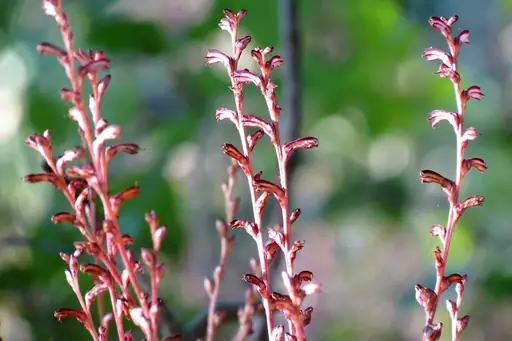
Epifagus virginiana
A member of the widely distributed family of parasitic and hemiparasitic plants, Orobanchaceae, the beechdrops genus, Epifagus, contains a single species.
Epifagus virginiana (syn. E. americana) parasitizes the roots of beech trees, relying on the roots for sustenance.
Photo by Katja Schulz, Wikimedia Commons, via CC BY-SA.Lacking chlorophyll, the pigment responsible for photosynthesis, beechdrops are entirely dependent on their host tree for nutrients.
They are an important part of the forest ecosystem and are only visible for a short period of time while flowering.
In this guide, we’ll take a look at how and where E. virginiana grow, and learn more about these fascinating plants.
Here’s what I’ll cover:
What You’ll Learn
What Are Beechdrops?
Where and When to Find Beechdrops
How to Care for Beechdrops
What Are Beechdrops?
The latin name of this unusual plant literally translates to “upon beech,” and that is exactly what it does: E. virginiana attaches itself to, and grows upon, the American beech tree, Fagus grandifolia.
While many parasitic species in the Orobanchaceae family target common agricultural crops such as beans and tomatoes, E. virginiana grows only on the roots of beech trees.
Photo by Douglas Goldman, Wikimedia Commons, via CC BY-SA.The life cycle of E. virginiana begins with a seed.
Germination is triggered when the seeds are exposed to unique chemicals exuded by beech tree roots. Initially the tiny, subterranean beechdrops plant relies on nutrients contained within the seed.
It then develops a tiny root-like structure known as a haustorium that attaches to the roots of the beech tree, piercing the tissue to allow the parasite to feed, drawing nutrients from the host.
After several years, the adequately nourished beechdrops develops a small underground tuber and the haustorium breaks down, severing the connection with the host.
Photo credit: Rob Routledge, Sault College, Bugwood.orgIn late summer to early fall, the plant produces a flower stalk – the only time E. virginiana is visible aboveground – with pale pinkish-brown to purple tubular flowers up to an inch long.
The flower stalks may grow up to 16 inches tall. These flowers are known as chasmogamous, which means they open up and are able to be cross-pollinated by insects or wind.
These flowers are pollinated primarily by different species of woodland ants and the seeds produced are dispersed by rainwater.
In addition to the chasmogamous flowers, at the base of the floral stem, beechdrops produce cleistogamous – or self-fertile – blooms that remain closed.
When and Where to Find Beechdrops
This little-known plant can be quite tricky to spot. It takes the right amount of moisture and warmth to coax it up and out of the dark layers of soil where it spends most of its life.
The only time to see this botanical oddity is during late summer and early fall when it emerges and begins to flower.
To have the best chance of finding beechdrops, you’ll need to locate a stand of beech trees.
These gorgeous, smooth-barked, broadleaf trees like rich, moist, slightly acidic soils. The species ranges across the eastern portion of North America.
Large, old beech trees are more likely to play host to a greater aggregation of E. virginiana than smaller, younger specimens.
Additionally, you’re more likely to find old, dense stands of beech in large, well-managed parks or preserves.
Community data gathering apps like iNaturalist can help you to locate unusual, harder to spot species like beechdrops.
Just remember, these bizarre little plants should be left undisturbed, just as they’ve been for thousands of years.
Don’t try to remove them from their habitat, and tread lightly when you find them. Be mindful of the potential ramifications of telling other people where these special plants live.
How to Care for Beechdrops
Learning how to care for beechdrops requires preserving the conditions that allow this species to thrive.
Because E virginiana is dependent upon the American beech tree for food, it’s impossible to successfully transplant these parasitic plants into your own garden.
Although beechdrops parasitizes beech trees and effectively steals nutrients from the tree, their presence is actually an indicator of a healthy forest.
You can do your bit to help maintain the integrity of your local forests by staying on marked trails and keeping children and dogs from running around under the trees.
Trails help prevent erosion and compaction of forest soils which in turn will help the forest to replenish itself.
Photo credit: Sturgis McKeever, Georgia Southern University, Bugwood.orgBrush out the soles of your boots before going from one trail to another.
This simple practice will remove any invasive species propagules that may have gotten lodged in your treads, and lower the risk of transporting pests and pathogens into a forested area.
Advocate for the preservation of forests in your local region and ensure that larger, intact stands of woodland are protected.
A Critical Curiosity
Beechdrops are a reminder there’s always more to the world of plants than meets the eye.
This bizarre, subterranean parasite busts our assumptions about what it means to belong to that vast, usually green, taxonomic kingdom, Plantae.
Photo credit: Sturgis McKeever, Georgia Southern University, Bugwood.orgIt’s a vital reminder that the world outside is connected in a myriad of ways invisible to our own eyes, too. Even these little known species have a critical, ecological role to play.
Try your hand at finding some beechdrops this summer or fall. While the species’ ephemeral flowers are up, see if you can observe ant pollination at work!
Let us know in the comments if you’ve ever seen beechdrops in the wild! When and where did you find them? We love to hear from you!
And to learn more about other interesting, unique flora, check out these guides next:
- How to Grow and Care for Butterworts
- How to Grow and Care for Pitcher Plants
- How to Grow and Care for Lithops Living Stone Plants
- X




질문 및 토론