
How to Prune Basil Plants
Basil, Ocimum basilicum, is an aromatic culinary and medicinal herb that’s perennial in USDA Hardiness Zones 10 to 11 and a summer annual in other regions. Our guide to growing basil has all you need to know to grow this herb at home. This article discusses two ways to prune the plant to keep it.
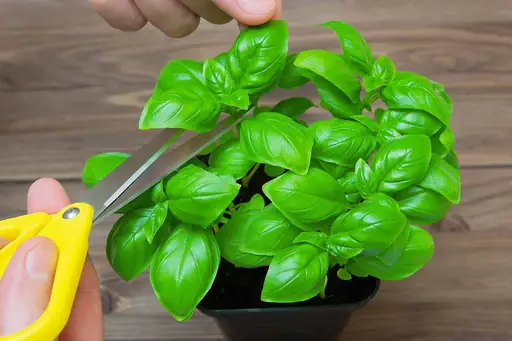
Basil, Ocimum basilicum, is an aromatic culinary and medicinal herb that’s perennial in USDA Hardiness Zones 10 to 11 and a summer annual in other regions.
Our guide to growing basil has all you need to know to grow this herb at home.
This article discusses two ways to prune the plant to keep it compact, lush and leafy, and long-lived.
Here’s what we’ll cover:
What You’ll Learn
- Basil Growing Basics
- Pruning to Address Legginess
- Preventing Seed Set
Let’s begin with a brief review of cultivation.
Basil Growing Basics
A basil seed produces an upright stem with pairs of opposite leaves, beginning with cotyledons or “seed” leaves and followed by true leaves.
When the plant is six inches tall, it’s past the seedling stage and can withstand the shock of being trimmed, provided you don’t remove more than a third of any given stem, or a third of the overall volume, at one time.
When we don’t cut it back, the stems can get “leggy,” putting energy into growing taller instead of making lots of foliage.
The space between the leaves elongates, resulting in a sparse, fragile appearance and susceptibility to breakage.
The cultural requirements for cultivation include full sun, organically-rich, well-drained soil, and nitrogen-rich fertilizer.
Regular watering is essential to maintain moist but not soggy soil. Moisture is crucial during peak summer heat that can stress plants and cause them to flower prematurely or “bolt.”
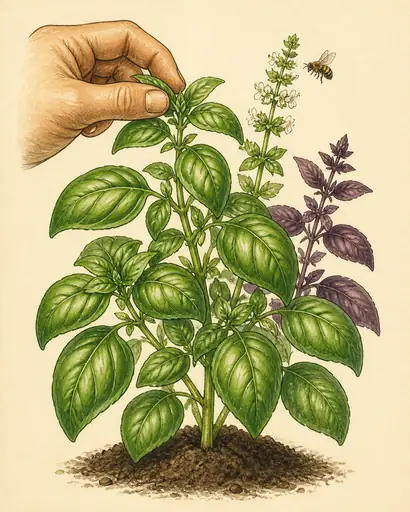
Bolting is a sudden shift from vegetative to reproductive growth, during which leaf production stops and spikes of purple or white flowers grow, signaling the end of the life cycle.
Plants with leggy stems, and those about to set seed, benefit from pruning to promote a stable form, optimal leaf production, and longevity.
Let’s find out how to trim leggy stems and those about to set seed.
Pruning to Address Legginess
To prune a leggy stem, pinch or snip it with clean scissors at a 45° downward angle about a quarter of an inch above a pair of true leaves.
As mentioned above, do not remove more than a third of the total length to avoid shock.
The angled cut facilitates water runoff to inhibit rotting that may be caused by rainwater falling on outdoor plants.
When watering, the nozzle should always be pointed at the soil, not the foliage.
The reason for locating a pair of leaves is that this is a natural growing point. By cutting here, you stimulate two new stems to grow for a denser, better-balanced plant with more leaves.
Prune as needed.
Use the clippings the same day or see our guide to drying basil for instructions on preserving them for future use.
Preventing Seed Set
If you see buds or flowers, it’s not too late to turn things around.
Pinch or snip off the budding or blooming tips.
Remove the entire leafy cluster at the tip by cutting a quarter of an inch above the first pair of leaves beneath the top cluster. From this growing point, two new shoots will sprout.
Pruning shifts energy back to leaf production. It is essential as the plant not only begins to die back post-bloom, the remaining leaves will also become bitter.
The buds and flowers are edible, so after trimming, garnish a savory dish and enjoy.
You don’t have to wait for buds to pinch the tip foliage back. Doing so at any time is beneficial because it stimulates fresh, dense growth.
Better Basil with Pruning
Cut back leggy stems and pinch the growing tips to prevent seed setting for compact, productive, and long-lived plants.
And why not take it a step further?
Incorporate these pruning techniques into your harvesting practice as well.
For example, if you spot a leggy stalk with large, floppy, older leaves, use it first. And remember to make your cut a quarter of an inch above a pair of leaves.
If you need a few sprigs for dinner and your plant is relatively uniform, pinch several tips at random rather than trimming a length of stem to preserve the overall balance you are striving to maintain.
Make a note in your garden planner to prune the basil plant regularly, and enjoy abundant and flavorful harvests.
Do you grow basil at home? Tell us about it in the comments section below.
If you found this guide helpful, we recommend reading the following guides to growing basil next:
- 5 Common Causes of Holes in Basil Leaves
- How to Grow and Care for Red Rubin Basil
- Tips for Growing ‘Sweet Dani’ Lemon Basil in Your Herb Garden
- 13 Favorite Basil Varieties for the Garden
- Facebook198
- X

질문 및 토론