

The Seedsun selection
Amsonia ludoviciana
SKU: AMSO-LUDO-01G
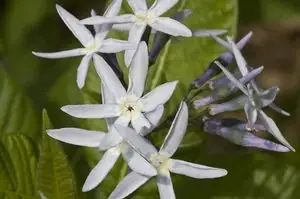
Most bluestars are smooth, cool customers; Amsonia ludoviciana is the outlier of the group. The Louisiana bluestar belongs to the dogbane family, Apocynaceae, and shares the clan's five-petaled, star-shaped flowers and milky sap, but the leaves set the species apart: narrow and willowy, and.
Ask for a tailored quote
Pricing, pack sizes and availability are confirmed in your personal quotation. Sending an enquiry does not place a paid order.
Ask about suitability, sowing and growing requirements.
Confirm delivery options and required documents in your quote.
About this variety
Most bluestars are smooth, cool customers; Amsonia ludoviciana is the outlier of the group. The Louisiana bluestar belongs to the dogbane family, Apocynaceae, and shares the clan's five-petaled, star-shaped flowers and milky sap, but the leaves set the species apart: narrow and willowy, and unusually clothed beneath with a grey-white felt, a woolly tomentum that catches the light and lends the whole plant a soft, silvered cast rare in the genus. In spring, clustered flowers of a clean sky-blue open at the tips of the upright stems, quiet and steely and worked over by the first butterflies of the season.
There is a real story behind these plants. obtained the Louisiana bluestar years ago from Brookgreen Gardens on the South Carolina coast, where the perennial had grown in cultivation since the celebrated botanist Dr. J. K. Small introduced the plant there in perhaps the 1920s. For a long stretch the species was feared lost, thought extinct in the wild, before being rediscovered in Louisiana; today botanists record scattered, uncommon populations from South Carolina west through Louisiana and Mississippi. Growing a nursery-raised plant of this rank keeps a rare Southeastern native in gardens and in circulation, a quiet piece of conservation.
The names carry their own small histories. The genus Amsonia honors Dr. John Amson, an eighteenth-century physician and one-time mayor of Williamsburg, Virginia, while the epithet ludoviciana means simply of Louisiana, the state that sheltered the rediscovered plants. Like the milkweeds to which the bluestars are related, the stems run with a milky latex that browsing deer and rabbits leave strictly alone, so the plant reads as both delicate and durable: pollinators come for the spring nectar, and almost nothing comes to graze.
In the garden the Louisiana bluestar earns a place three seasons running. Site the plant in full sun to light shade and give lean, well-drained ground; despite wet-flatwoods origins the deep-rooted perennial shrugs off drought once settled, and only floppy, over-lush growth comes of rich soil. The spring flowers read against the silvered foliage, the fine-textured mound holds all summer, and in autumn the leaves turn a warm butter-gold that lights the border before the stems die back for winter. Set a plant among little bluestem, coneflower, and baptisia for a sunny native planting, or let a drift carry the cool blue through the edge of a meadow.
More to discover



Questions & discussion