

The Seedsun selection
Hamelia patens
SKU: HAME-PATE-01G
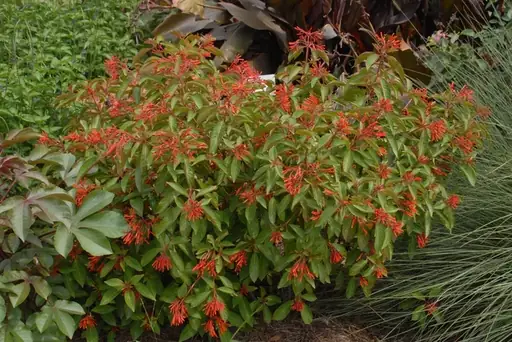
Firebush earns the name honestly. From late spring until the first frost, the arching branch tips carry tight clusters of slender tubular flowers in hot orange-red, each one a narrow torch held out for the hummingbirds and butterflies that work the plant from morning to dusk. The foliage plays.
Ask for a tailored quote
Pricing, pack sizes and availability are confirmed in your personal quotation. Sending an enquiry does not place a paid order.
Ask about suitability, sowing and growing requirements.
Confirm delivery options and required documents in your quote.
About this variety
Firebush earns the name honestly. From late spring until the first frost, the arching branch tips carry tight clusters of slender tubular flowers in hot orange-red, each one a narrow torch held out for the hummingbirds and butterflies that work the plant from morning to dusk. The foliage plays along: new leaves and stems flush bronze to burgundy, the veins stained red, so that even between flushes of bloom the whole shrub reads warm. Few plants pull in as much winged traffic through the heat of a southern summer.
Botanically, firebush sits in the Rubiaceae, the coffee and gardenia family, and the genus honors Henri-Louis Duhamel du Monceau, the eighteenth-century French botanist and agriculturist; the species name patens means spreading, for the open, arching habit. The native range is enormous, running from Florida and the Gulf south through Mexico, Central America, and the Caribbean all the way to Argentina. Across that range the plant collects names: hummingbird bush, scarlet bush, redhead, and, among the Maya of Belize, Ix Canaan, the Guardian of the Forest.
That guardian name is no accident. Indigenous peoples across tropical America have long turned to the leaves and stems, toasted and ground or steeped, as a topical remedy for cuts, burns, sores, rashes, insect bites, and skin infections, with other traditions using preparations for cramps, fever, and rheumatism. Modern screening has found antibacterial and antifungal compounds in the extracts, lending some laboratory weight to the old uses. The small berries ripen red to black and are edible, taken eagerly by birds in the wild and made into a fermented drink in parts of Mexico and Central America.
In the garden, give firebush a hot, sunny, well-drained spot and let the plant do what the name promises: a bold summer-to-frost anchor for a pollinator border, a hummingbird garden, a cottage planting, or a large container. Behavior shifts with climate, so place accordingly. In the frost-free lower South and the tropics the plant builds a woody evergreen shrub to eight feet or more; from about zone 8 the tops die to the ground each winter and return as a fast four-to-six-foot perennial. Where hard freezes are expected, cut the killed tops back, mound coarse sand over the stubs, and cover with pine straw, then pull the mulch away as spring warms and the new shoots push. offers both the typical variety patens and the smoother-leaved glabra, the latter very likely the cultivar known as 'Firefly'.
More to discover



Questions & discussion