

The Seedsun selection
Hibiscus hamabo
SKU: HIBI-HAMA-01G
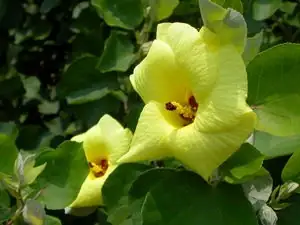
Hibiscus hamabo is a tall branching shrub reaching fifteen feet or more, wide and rounded, clothed in broad soft leaves that feel almost felted in the hand. Flowers come through summer in a clear light yellow, single and open-faced, five or six inches across, each one carrying a deep crimson blotch.
Ask for a tailored quote
Pricing, pack sizes and availability are confirmed in your personal quotation. Sending an enquiry does not place a paid order.
Ask about suitability, sowing and growing requirements.
Confirm delivery options and required documents in your quote.
About this variety
Hibiscus hamabo is a tall branching shrub reaching fifteen feet or more, wide and rounded, clothed in broad soft leaves that feel almost felted in the hand. Flowers come through summer in a clear light yellow, single and open-faced, five or six inches across, each one carrying a deep crimson blotch at the throat that pulls the eye straight into the center. Individual flowers last a day, as hibiscus flowers do, and are replaced steadily for weeks. Autumn brings a second act that catches most people by surprise: the leaves turn red before dropping, which is not something the genus is generally known for.
The plants come from the coastlines of southern Japan, Korea, and China, growing in salt marshes, tidal estuaries, and river mouths across Honshu, Shikoku, Kyushu, and the Ryukyus. Hamabo is the Japanese name carried straight into botany. This is a semi-mangrove species and a true halophyte, tolerant of salt spray, brackish water, wind, and periodic flooding, and valued in Japan and China for holding shorelines together. That toughness has drawn scientific attention: the genome was sequenced in 2022 specifically to understand how the species survives saline and waterlogged ground, and researchers have trialed the plants for reclaiming salt-damaged land. The wild populations, meanwhile, are considered endangered across much of the natural range, which makes cultivated stock more than an ornamental convenience.
has grown this hibiscus for a long time, and to the best of our knowledge these were the first plants offered in the United States. They have proven hardy and free flowering here in Aiken, and in gardens in Florida and Texas, which was not a foregone conclusion for a coastal Japanese shrub. Nothing else in the hardy hibiscus world looks quite like this: the woody frame, the rounded felted foliage, and the soft yellow are a combination the familiar rose mallows simply do not offer.
Give full sun and soil that stays moist. The salt and flood tolerance means Hibiscus hamabo will grow happily where most shrubs sulk: a coastal garden taking spray off the water, the wet end of a border, a low spot that floods after storms, a pond margin. Ordinary garden ground with regular water suits perfectly well too. Prune in late winter to shape or to hold the height down, since flowering comes on new growth. Pair with Baccharis halimifolia, Myrica cerifera, Iva frutescens, and the taller native hibiscus for a coastal planting, or use as a single specimen where the summer yellow and the red autumn leaves can both be seen from the house.
More to discover



Questions & discussion