

The Seedsun selection
Holmskioldia sanguinea
SKU: HOLM-SANG-01G
From the warm lower slopes of the Himalayas, where they scramble through scrub from India and Nepal on into Bhutan, comes one of the more theatrical shrubs you can grow. The genus carries the name of Johan Theodor Holmskiold, an eighteenth-century Danish botanist, while sanguinea nods at the.
Ask for a tailored quote
Pricing, pack sizes and availability are confirmed in your personal quotation. Sending an enquiry does not place a paid order.
Ask about suitability, sowing and growing requirements.
Confirm delivery options and required documents in your quote.
About this variety
From the warm lower slopes of the Himalayas, where they scramble through scrub from India and Nepal on into Bhutan, comes one of the more theatrical shrubs you can grow. The genus carries the name of Johan Theodor Holmskiold, an eighteenth-century Danish botanist, while sanguinea nods at the blood-red flush the flowers take on with age. For years they sat in Verbenaceae. Botanists have since moved them into Lamiaceae, the mint family, which makes them distant kin to salvia, rosemary, and teak. You would never guess as much to look at them.
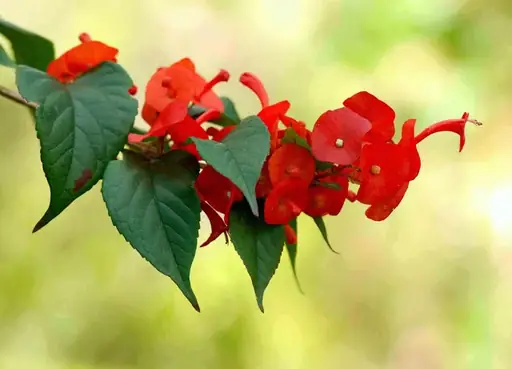
The flower is the whole performance, and it helps to understand what you are actually seeing. Each bloom opens as a broad circular calyx, flat and faintly cupped like a little Mandarin hat, and from the center of that saucer a slender tube of true flower leans forward. The tube does its brief work and drops. The hat stays. That colored calyx holds on for weeks afterward, so plants in good form read as flowering far longer than they technically are, which is a fine quality in something that waits until fall to perform. Most run orange to scarlet, though yellow and bronze forms turn up as well.
The leaves are slim and mid-green, several inches long, drawn to a long tip with a lightly toothed edge, set opposite or in whorls along willowy stems. Left to their own devices they sprawl. Given a fence, a trellis, or a warm wall they climb and arch, and can be trained almost flat, espalier-fashion, into something deliberate.
They want zones 9 and 10, full sun, and soil that drains. In a sheltered pocket of zone 8 they will freeze to the ground over winter and rise again to flower the following fall, which asks a little patience and tends to repay it. When the blooms arrive, hummingbirds and butterflies find the wall before you do.
In a long, mild autumn, against a wall they have been allowed to climb, they hang the fading season with small orange hats long after the rest of the garden has called it a year.
Additional photos courtesy of KT Wursten.
More to discover



Questions & discussion