

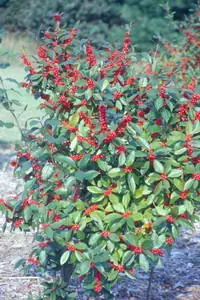
The Seedsun selection
Ilex verticillata 'Maryland Beauty'
SKU: ILE-VERT-MARY-BEAU-01G
Ilex verticillata 'Maryland Beauty' is winterberry doing what winterberry does best, and a little more of it. This native deciduous holly loses the leaves in fall to reveal bare gray stems packed with fruit, and 'Maryland Beauty' was singled out from the northern strain for an especially heavy crop.
Ask for a tailored quote
Pricing, pack sizes and availability are confirmed in your personal quotation. Sending an enquiry does not place a paid order.
Ask about suitability, sowing and growing requirements.
Confirm delivery options and required documents in your quote.
About this variety
Ilex verticillata 'Maryland Beauty' is winterberry doing what winterberry does best, and a little more of it. This native deciduous holly loses the leaves in fall to reveal bare gray stems packed with fruit, and 'Maryland Beauty' was singled out from the northern strain for an especially heavy crop of bright red berries, a dense, glowing display that holds through the winter.
Where many winterberries grow tall and upright, 'Maryland Beauty' stays low and spreading, a rounded three to five feet, easy to place at the front of a border or in a mass. The finely toothed, spineless leaves are quiet and green through summer, so the plant asks little attention until fall, when the fruit arrives and the show begins. Birds eventually strip the berries, but not before they have carried the garden through the hardest months.
Winterberry belongs to the wet ground of eastern North America, swamp edges and pond margins from Canada to the Gulf, and the name verticillata, whorled, describes how the small flowers cluster along the twigs. Only females fruit, and only with a male of matching bloom time nearby. 'Maryland Beauty' is an early-blooming northern type, so the dwarf early male 'Jim Dandy' is the right partner, set within about fifty feet.
Give 'Maryland Beauty' the moist to wet, acidic soil winterberry loves, in full sun to part shade, and let the low, heavy-fruited shrub light a rain garden, a pond edge, a wet swale, or the front of a mixed border through the coldest months. A few cut branches of red berries are a classic holiday green, and the winter fruit feeds songbirds when little else remains.
More to discover



Questions & discussion