

The Seedsun selection
Ilex verticillata 'Southern Gentleman'
SKU: ILEX-VERT-SOUT-GENT-01G
Every winterberry covered in red is hiding a secret, and his name is ‘Southern Gentleman’. Winterberry hollies are dioecious, male and female on separate plants, and only the pollinated females set the blazing red fruit the species is grown for. No male nearby, no berries. ‘Southern Gentleman’ is.
Ask for a tailored quote
Pricing, pack sizes and availability are confirmed in your personal quotation. Sending an enquiry does not place a paid order.
Ask about suitability, sowing and growing requirements.
Confirm delivery options and required documents in your quote.
About this variety
Every winterberry covered in red is hiding a secret, and his name is ‘Southern Gentleman’. Winterberry hollies are dioecious, male and female on separate plants, and only the pollinated females set the blazing red fruit the species is grown for. No male nearby, no berries. ‘Southern Gentleman’ is the male who makes the show possible, and asks for none of the credit.
His particular gift is timing. Winterberries only fruit when a male blooms in step with the female he is meant to pollinate, and the late-blooming clones, ‘Winter Red’ chief among them, need a male who flowers late to match. ‘Southern Gentleman’ is exactly that. He carries the pollen for ‘Winter Red’, ‘Winter Gold’, ‘Sparkleberry’, ‘Cacapon’, ‘Shaver’, ‘Sunset’, and the rest of the late crowd, and he is generous about the work: a single plant will service six to ten females within bee range, roughly forty to fifty feet, so one gentleman keeps a whole hedge in fruit. He came out of the nursery of Bob Simpson in Vincennes, Indiana, who first listed him under the unglamorous working name ‘Late Male’ before the better one stuck. Simpson bred him for a purpose: he introduced ‘Winter Red’ in the same era and selected this male expressly to pollinate her.
The distance guidance is a rule of thumb rather than a law. Hollies are pollinated by bees, wasps and ants, not by wind, so what really matters is that an insect can make the trip while both plants are in flower. Isolated female hollies have been recorded fruiting well anyway. Forty to fifty feet is a planning figure, not a fence, and the pairing that matters more is the one between bloom seasons. Match late to late, early to early, and the crop follows.
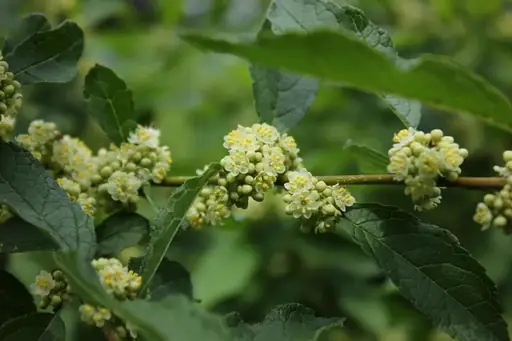
Do not write him off as merely useful. He makes a vigorous, upright, rounded shrub of glossy dark green that turns soft yellow-green and bronze-purple in fall, six to eight feet each way, and his small spring flowers hum with native bees doing the work he is there for. He will grow in the same wet feet the species loves, full sun to part shade, untroubled by clay or standing water as long as the soil stays acid. Native to the eastern wetlands, Ilex verticillata is one of our finest winter plants, and this is the one you plant so all the others can shine. Buy him for what he does, not for what he shows, and the red will follow.
More to discover



Questions & discussion