

The Seedsun selection
Iris japonica
SKU: IRIS-JAPO-01Q
A small crested iris with the carriage of an orchid and a quietly extraordinary biography. Iris japonica was named by Carl Peter Thunberg in 1794. Thunberg was a protege of Linnaeus and one of the only Western botanists allowed into Japan during the country's closed period, from 1775 to 1778, so.
Ask for a tailored quote
Pricing, pack sizes and availability are confirmed in your personal quotation. Sending an enquiry does not place a paid order.
Ask about suitability, sowing and growing requirements.
Confirm delivery options and required documents in your quote.
About this variety
A small crested iris with the carriage of an orchid and a quietly extraordinary biography. Iris japonica was named by Carl Peter Thunberg in 1794. Thunberg was a protege of Linnaeus and one of the only Western botanists allowed into Japan during the country's closed period, from 1775 to 1778, so much of what he brought back is, in a real sense, the first documented record of Japanese flora in Western science. The species had already reached Europe two years earlier, carried out of China by Thomas Evans of the East India Company in 1792. By the 1820s Pierre-Joseph Redoute, the same artist whose rose paintings turn up on every aunt's tea tray, was painting the plant under the older name Iris fimbriata in his Choix des plus belles Fleurs. A treasure of cultivated gardens for more than two centuries.
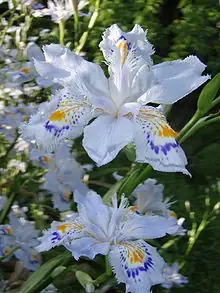
The flower is the surprise. Held flat against a slender branched stem, the bloom opens in pale lavender-blue with a yellow-orange crest down the center of each fall and a fringed, almost lacy margin along every petal, the source of both the Latin epithet fimbriata, fringed, and one of the English common names. In bloom the plant reads less like a typical iris and more like a small pale orchid hovering above the foliage. The Chinese call the flower Hudie Hua, butterfly flower, which is the right word.
What also sets the species apart is the way of spreading. Rather than clumping, Iris japonica sends out long thin stolons that root at intervals, building a slow, loose carpet of evergreen sword-shaped fans. Most of the populations in cultivation in Japan and beyond are triploid and seed-sterile, meaning every garden plant of the species today is a clone of clones, propagated vegetatively for centuries and passed along human routes, no exaggeration to say the plant has traveled with people from monastery gardens to imperial courts to East India Company holds to Aiken, South Carolina.
Excellent in dappled shade under a high deciduous canopy, along woodland edges, or as a refined groundcover in a shaded courtyard. Pair the shaga iris with hostas, ferns, Ophiopogon, and the smaller hellebores for a layered late-winter and early-spring scene. Drought tolerant once established, and deer and rabbits leave the fans alone. For the gardener who finds the standard purple bearded iris a touch too midcentury-suburb, here is something with the nuance of a botanical illustration.
More to discover



Questions & discussion