

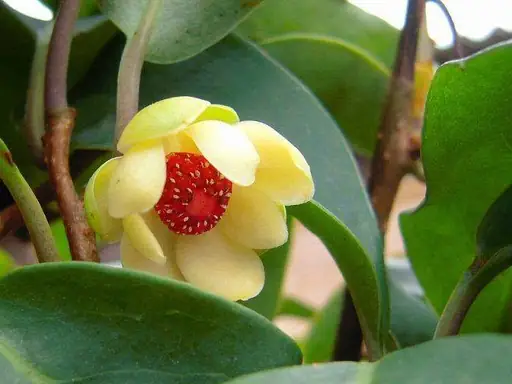
The Seedsun selection
Kadsura longipedunculata
SKU: KADS-LONG-01G
Kadsura longipedunculata is an evergreen twining vine of the star-anise family, Schisandraceae, native to the moist forests and shaded stream banks of southern and southwestern China. The leaves are narrow, glossy, dark green, and lightly toothed, carried on stems that climb without menace. The.
Ask for a tailored quote
Pricing, pack sizes and availability are confirmed in your personal quotation. Sending an enquiry does not place a paid order.
Ask about suitability, sowing and growing requirements.
Confirm delivery options and required documents in your quote.
About this variety
Kadsura longipedunculata is an evergreen twining vine of the star-anise family, Schisandraceae, native to the moist forests and shaded stream banks of southern and southwestern China. The leaves are narrow, glossy, dark green, and lightly toothed, carried on stems that climb without menace. The genus name comes from kazura, a Japanese word for a twining vine, and the species epithet means long-peduncled, for the slender stalks that let each flower hang clear of the foliage. Chinese gardeners and herbalists know the plant as nan wu wei zi, the southern five-flavor fruit, a nod to the close cousin Schisandra, whose berries are said to carry all five tastes at once. The French botanists Achille Finet and François Gagnepain gave the vine a formal name in 1905.
We obtained this species from Nanjing Botanic Garden in China, and so far as we can tell was the first nursery to offer the plant in this country. Very little of the species has ever made the trip west. What has arrived proves neat, clean, and vigorous in cultivation, hardy through USDA zones 7 to 10, and altogether easier to grow than the rarity would suggest. Your neighbor will likely not have this one.
The flower story here is one of the odder ones in botany. Unlike most of the genus, which keeps male and female plants separate, Kadsura longipedunculata is monoecious, carrying both kinds of flower on the same vine, so a single plant can set fruit alone. The blooms open at night from midsummer into early autumn, cream to pale yellow with some forms flushed red, warming themselves several degrees above the surrounding air and releasing a fruity scent dominated by methyl butyrate across a four or five hour window. The whole performance is aimed at one insect: a female gall midge of the genus Megommata, who arrives to eat pollen. The female flowers offer the same warmth and the same perfume and no reward whatsoever, a small deceit that gets them pollinated all the same. Fruit follows in fall as a rounded scarlet cluster of fleshy carpels, closer to a raspberry than to anything in the grape family, edible raw or cooked and fragrant enough that the oil has been pressed for perfume.
In China the roots and root bark are a long-standing article of the herbal trade, sold as hong mu xiang and zi jin pi, prepared as decoctions and wine infusions to move blood and ease the pain of rheumatism, traumatic injury, and gastric complaint, with the leaves turned to canker sores and menstrual trouble. Modern laboratories have taken an interest as well. Something over three hundred compounds have been catalogued from the plant, chiefly dibenzocyclooctadiene lignans of the kadsulignan and anwulignan sort along with schiartane triterpenoids, and early work has looked at hepatoprotective and sedative activity. All of that is best read as tradition and preliminary research, not as a prescription.
In the garden, treat this kadsura as a woodland-edge plant: rich, moist, well-drained soil, part shade, shelter from harsh afternoon sun and drying wind, and something to twine on. A fence, an arbor, a post at the corner of a shade border, or an old tree will all serve. The vine climbs to roughly eight or ten feet, sometimes twelve, twines rather than smothers, and holds glossy foliage through the winter across most of the range. Ferns, hydrangeas, aucuba, and Danae make good company below. Site the plant near a door or a path if you can, since the flowers do their work after dark and the scent is best met on a summer evening.
More to discover



Questions & discussion