

The Seedsun selection
Kalmia latifolia 'Bullseye'
SKU: KALM-LATI-BULL-01G
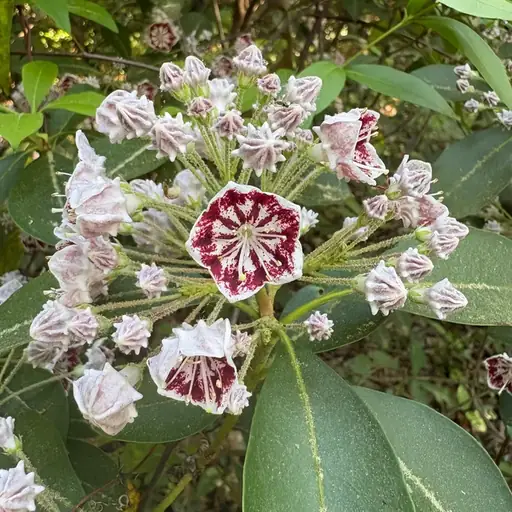
Of all the patterned mountain laurels, 'Bullseye' plays the boldest trick with color. The cinnamon-purple buds are handsome in their own right, and when they open the flowers reveal a broad band of deep purple-maroon ringing a white throat and a clean white edge, the concentric target that gives.
Ask for a tailored quote
Pricing, pack sizes and availability are confirmed in your personal quotation. Sending an enquiry does not place a paid order.
Ask about suitability, sowing and growing requirements.
Confirm delivery options and required documents in your quote.
About this variety
Of all the patterned mountain laurels, 'Bullseye' plays the boldest trick with color. The cinnamon-purple buds are handsome in their own right, and when they open the flowers reveal a broad band of deep purple-maroon ringing a white throat and a clean white edge, the concentric target that gives this selection a name. 'Bullseye' belongs to Kalmia latifolia, the broadleaf evergreen native to the acid slopes of the eastern United States, and represents the golden era of Kalmia breeding led by Dr. Richard Jaynes at the Connecticut Agricultural Experiment Station, whose decades of selection gave gardeners the banded, picoteed, and richly budded laurels grown today.
The name Kalmia was bestowed by Linnaeus for his student Pehr Kalm, and latifolia means broad-leaved, though 'Bullseye' departs a little from type: the emerging foliage flushes reddish and the leaves are smaller and more twisted than those of the wild species, giving the shrub a slightly finer texture. Habit is vigorously upright yet compact. Our own very mature specimen at the old nursery site reached only about five feet tall and spread just as wide, so this is a laurel that furnishes a border without ever bullying the plants around it. The photographs here were taken at the Margaret Reid Wildflower Garden in Raleigh, North Carolina.
Mountain laurel carries a long human history alongside all that ornamental beauty. The hard, close-grained wood earned the name spoonwood, carved by Indigenous peoples of the East into spoons and small utensils and later turned for tool handles and bowls. That heritage comes with a firm caution: every green part of the plant, together with the pollen and any honey made from the flowers, contains grayanotoxins and is poisonous to livestock, wildlife, and people. 'Bullseye' is grown purely as an ornamental and pollinator plant, never a medicinal or edible one, and the foliage should be kept away from grazing animals and curious mouths.
In the garden, 'Bullseye' wants the same treatment as any mountain laurel: part sun to part shade, cool and consistently moist roots, and an organic mulch such as pine straw, especially while establishing. Kalmia are slow to settle, but few investments repay a gardener so richly over time. Plant this laurel where the banded flowers can be studied up close, among rhododendrons, blueberries, and native ferns in acidic woodland soil, and let the toxic evergreen foliage do quiet duty as a deer-resistant backbone through the year.
More to discover



Questions & discussion