

The Seedsun selection
Agarista (Leucothoe) populifolia
SKU: LEUC-POPU-01G
Agarista populifolia, still catalogued nearly everywhere as Leucothoe populifolia, is the giant of a group otherwise built low to the ground. Where most leucothoes hug the shade at knee height, this one rises, sending up tall, erect stems that arch at the tips into a fountain of glossy evergreen.
Ask for a tailored quote
Pricing, pack sizes and availability are confirmed in your personal quotation. Sending an enquiry does not place a paid order.
Ask about suitability, sowing and growing requirements.
Confirm delivery options and required documents in your quote.
About this variety
Agarista populifolia, still catalogued nearly everywhere as Leucothoe populifolia, is the giant of a group otherwise built low to the ground. Where most leucothoes hug the shade at knee height, this one rises, sending up tall, erect stems that arch at the tips into a fountain of glossy evergreen leaves, and given years and room the shrub can pass for a small multi-stemmed tree of twelve to fifteen feet.
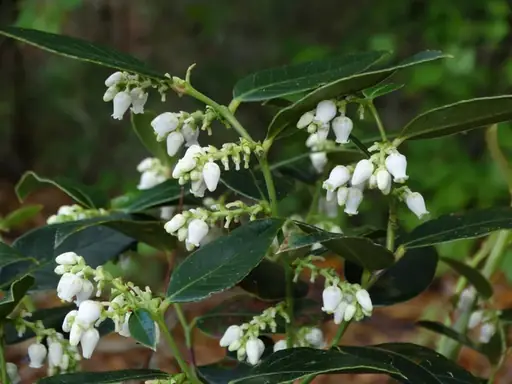
In spring the arching branches hang with small, creamy-white, bell-shaped flowers, sweetly fragrant and shaped like the blossoms of a blueberry or a lily of the valley. The family resemblance is no accident, since the plant belongs to the heath family, Ericaceae, in company with blueberries, azaleas, and mountain laurel. The flowers, in the end, are what moved the species out of one genus and into another: the botanist Walter Judd separated Agarista from Leucothoe on floral evidence, and the trade has been catching up ever since, so you will still find both names in circulation, often on the same bench. The retired name carried an old Greek myth, since Leucothoe was a princess loved by Apollo and, in the telling, turned into a fragrant shrub. The epithet populifolia came through the move intact, and means simply poplar-leaved, a nod to the broad, tapering foliage.
The species is a Southeastern native of blackwater swamps, hydric hammocks, and seepage ravines, running from the low country of eastern South Carolina south through peninsular Florida. Gardeners well north of that native ground grow the plant happily, prizing the year-round screen of dark, polished leaves and the flush of coppery bronze on the new growth. The old common name pipestem records an earlier use, when the straight young stems were cut for the stems of pipes. As with other members of the heath family, every part carries grayanotoxins and is not for eating, which is also why deer tend to leave the foliage alone.
Site Agarista populifolia where a tall evergreen is wanted but a stiff wall of conifer would feel wrong: as a soft screen along a property line, a backdrop to a shade border, or a graceful anchor at the edge of woodland. The plant asks for the conditions of the native swamp margins, meaning moist, acid, humus-rich soil that still drains, and the dappled light of high shade. Underplant with ferns, hostas, and native azaleas, or let the arching stems rise behind hydrangeas for a layered, woodland-edge planting that holds up straight through winter.
More to discover



Questions & discussion