

The Seedsun selection
Lindera benzoin
SKU: LIND-BENZ-01G
Spicebush is the shrub that tells you the ground is good. Early land surveyors in the eastern states used Lindera benzoin as an indicator of rich agricultural soil, and the rule holds in the garden: where spicebush thrives, most things will. The plant is a common understory shrub of moist, rich.
Ask for a tailored quote
Pricing, pack sizes and availability are confirmed in your personal quotation. Sending an enquiry does not place a paid order.
Ask about suitability, sowing and growing requirements.
Confirm delivery options and required documents in your quote.
About this variety
Spicebush is the shrub that tells you the ground is good. Early land surveyors in the eastern states used Lindera benzoin as an indicator of rich agricultural soil, and the rule holds in the garden: where spicebush thrives, most things will. The plant is a common understory shrub of moist, rich woods from Ontario to Florida and west to Texas, growing six to twelve feet in a loose rounded mass, often colonial from root sprouts, and every part smells of citrus and pepper when bruised.
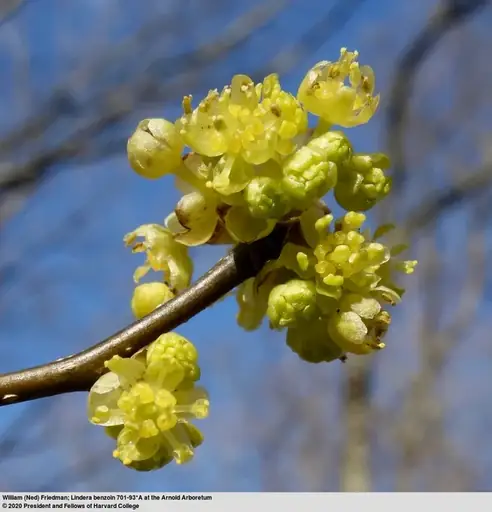
The flowers come first, in March or early April, small greenish-yellow clusters held tight against bare gray stems, a haze of color across the woods before anything leafs out. Spicebush is dioecious, so male and female flowers occur on separate plants, and only females carry the scarlet drupes that follow in late summer. Our plants are seedlings of undetermined sex, so a group planting is the surest route to fruit. Wood thrushes, veeries, and better than twenty other bird species strip the berries, which are unusually rich in lipids and time their ripening to fall migration.
The name carries two histories. Carl Peter Thunberg established the genus in 1783 for Johann Linder, a Swedish botanist and physician; the epithet benzoin comes through Middle French from the Arabic luban jawi, "frankincense of Java," borrowed for the balsamic scent of the leaves and twigs. Colonists knew the shrub as fever bush and wild allspice, drying the ripe drupes as an allspice substitute and steeping the twigs into tea. Creek, Cherokee, Rappahannock, Mohegan, Iroquois, and Chippewa people used bark, twigs, and fruit across more than thirty recorded medicinal preparations, and also to flavor game.
For the gardener, spicebush is a three-season native with an outsized ecological return. The shrub is the primary host of the spicebush swallowtail, whose caterpillars fold themselves into leaf tents and wear a pair of false eyespots convincing enough to read as a small snake, and the promethea silkmoth spins cocoons among the twigs that hang on all winter looking like dead leaves. Fall color is a clean unmixed yellow, luminous in shade. Plant spicebush at a woodland edge, along a stream, or in any semi-shaded place with steady moisture, in groups rather than as a lone specimen, and allow room to sucker gently outward.
Photos courtesy of William Friedman and John Anderson.
More to discover



Questions & discussion