

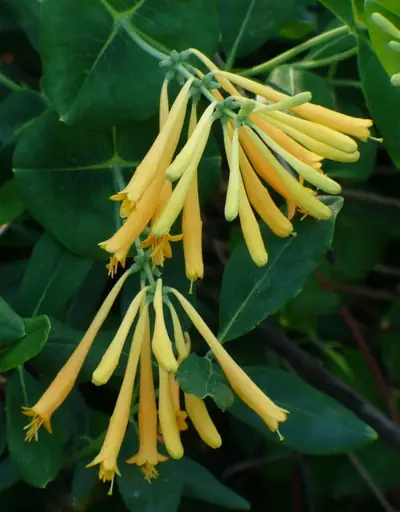
The Seedsun selection
Lonicera ‘Sulphurea’
SKU: LONI-SEMP-SULP-01G
Lonicera sempervirens 'Sulphurea' is coral honeysuckle gone golden, a yellow-flowered form of the native trumpet honeysuckle that trades the usual scarlet for clear, soft sulphur-yellow. The tubular flowers cluster in tiered whorls at the branch tips from late spring through summer, glowing against.
Ask for a tailored quote
Pricing, pack sizes and availability are confirmed in your personal quotation. Sending an enquiry does not place a paid order.
Ask about suitability, sowing and growing requirements.
Confirm delivery options and required documents in your quote.
About this variety
Lonicera sempervirens 'Sulphurea' is coral honeysuckle gone golden, a yellow-flowered form of the native trumpet honeysuckle that trades the usual scarlet for clear, soft sulphur-yellow. The tubular flowers cluster in tiered whorls at the branch tips from late spring through summer, glowing against fresh green leaves so the whole vine looks sunlit even under a gray sky.
This is a form of one of the finest native vines of the eastern United States. The honeysuckles belong to the family Caprifoliaceae, and the genus Lonicera honors Adam Lonitzer, the sixteenth-century German herbalist. The point bears repeating: the native coral honeysuckle, unlike the invasive Japanese honeysuckle that smothers Southern woodlands, is restrained and well-mannered, so 'Sulphurea' can be planted with a clear conscience.
Ruby-throated hummingbirds treat the trumpet flowers as built to order, and bees and butterflies work them too, though, like the rest of coral honeysuckle, the yellow form carries little or no scent; the draw here is color and nectar rather than perfume. Small red berries follow the flowers and feed songbirds into fall, and the repeat flushes of bloom keep the vine in color for months.
A twining vine of eight to twelve feet, 'Sulphurea' is made for a mailbox post, a lamppost, a trellis, a fence, or an arbor, climbing by winding rather than clinging, so the vine needs something to hold. Full sun brings the heaviest bloom, and once established the plant is drought-tolerant, long-lived, and close to carefree. Because flowers come on new growth, a light trim after the first flush keeps the vine tidy and coaxes more bloom. Set the soft yellow against blue-flowered companions or a dark fence for a quietly luminous effect.
More to discover



Questions & discussion